
A full moon sets over Haro Strait.
As a co-founder of the Beam Reach program, I have a great drive to make the second season successful. So I have to admit I was nervous and had a lot of questions in mind as I drove up from Seattle for a first visit during the third week of the fall program. How were Jason and Donna faring during their initial weeks as instructors? Had our admissions process selected a group of students who could learn and live together? Would I still feel excited about my plan to go to sea for a week this fall with a new baby and her lovely family beckoning from Seattle?
I gathered data to answer these questions during the busy week. Lecturing on marine geology and physical oceanography of the Salish Sea gave me a sense of the students’ inquisitiveness and academic endurance. Participating in a peer-review of proposal drafts gave me insights into the students’ mutual respect and Jason’s and Donna’s talents as facilitators and collaborators. More insights into each student’s curiosities and demeanor came when we asked questions after great guest lectures from Dave Bain, Jeff Nystuen, Lynne Barre, and Peter Westley, and short talks by Brad Hanson and Robin Baird. I think I may have increased anxiety unnecessarily when I reviewed what methods of provisioning, living, and researching worked (and didn’t) last year during the sea component, but the group persevered, tackled all the logistical tasks with amazing teamwork and efficiency. I was astonished that shopping for $800 worth of provisions took us only two hours!
By the end of the week, all of my concerns had dissolved. Jason and Donna have formed a resilient teaching partnership and they are well on their way to pioneering a team-teaching culture at Beam Reach. They have already derived ways to coordinate their efforts and be more efficient than Val and I were during the pilot program. Their best innovations, I think, are lunchtime meetings for lesson planning and mentoring 3 students each, rather than all students together. As a teaching team, we still have ideas to try (Skype conferencing may help coordinate between on-campus instructors and intermittent teachers, like Val, me, and the guest experts), but Jason and Donna are clearly excelling as they implement and improve the Beam Reach curriculum.
It was a real treat for me to meet Beam Reach class 061 in person. I met Peggy and Rena on the ferry as they returned from a respite in Seattle. Erin, Emily, Colleen, and Juliette introduced themselves as class started on Tuesday morning. I was immediately impressed with their amiable personalities and the progress they had made (in just 2 weeks!) on drafting their research proposals. They had already figured out how to shop, cook, and clean together, and I could sense that as a group they had the potential to survive the intensity of going to sea together for an extended period. In fact, after just a day or two, I was confident that I wanted to go to sea with them — and that’s a critical measure of the effectiveness of our admissions process! Our challenge as a school is to admit students who will be challenged enough to grow, but not so challenged that they compromise unduly the experience of their peers or instructors. There’s a lot of sea time and stress ahead, but my first impressions suggest this group will flourish together.
So, I will go to sea again, but I realize now that I’m lured for many reasons. Haro Strait surprised me during my visit by tantalizing me anew with mystery and beauty. Strange sounds surged from the hydrophones and kept me peering from the bluff, rocking Cora for hours. (I’m now in agreement with Val that the “heavy breather†is the local harbor seal.) Wild currents pulled my imagination into the realm of vortices, temperature profiles, and estuarine flow theory. The resident orcas were strangely elusive, making me wonder if they were reacting to the unusually high fraction of the Fraser fall-run Sockeye that is reportedly returning via the northern end of Vancouver Island. As the full moon set over Haro Strait and I sang my son back to sleep, I realized that my own curiosities about the ocean have been left unsated too long. I’m enthusiastic about this class and I’m clearly still lured by the sea itself.
—–
Read More
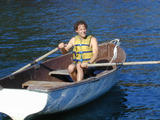
It has been marvellous and frustrating to be administering Beam Reach from Seattle on the first days of the fall 2006 program. I feel a simultaneous urge to rush up and be part of every moment in the syllabus and a great satisfaction that the Beam Reach ship is sailing along without me being involved in adjusting every line.
I hope this first blogbook entry will inspire new students and instructors alike to share their experiences on-line. It really is a rare thing these days to delve deeply into a critical issue and one’s own curiosities. That our research theme centers on orcas, an inherently awe-inspiring and communicative species, just makes the opportunity that much more intriguing.
I’d like to share two journal entries I made almost precisely a year ago, during the first couple days of the first Beam Reach program. They drive home the sense I have again today: that we are just scratching the surface of our human involvement in the decline and unprecedented alteration of the oceans.
Sunday 08/21/2005 05:30
“How much does an ecosystem have to change before we alter our values to restore it? To answer the question, one really has to do two difficult things: understand the ecosystem well enough to determine which human actions are driving the change; and discern what changes in human behavior will benefit the ecosystem at least cost.
Beam Reach is all about addressing this question in the marine environment through sustainability science. This is daunting because it is technologically difficult to analyze how marine ecosystems function and to quantify the costs/benefits of human actions within them. It is also a challenge because scientists are used to understanding a ecosystem problem, but have not traditionally studied how to solve it (through economic, technological, and/or political methods).
In the Pacific Northwest, we have an interesting range of cases in which this broad question has been tackled. Invariably they begin with the decline of a species — whether high-profile or obscure — and evolves to a broad investigation of its ecosystem. At present, we are considering a charismatic megafaunum, the southern resident orcas. We are also currently struggling with another deeply valued animal, the wild salmon. We can report the successful restoration of the iconic American bald eagle. Great sums have been invested recently in assessing the Stellar sea lion, which most people don’t value in particular. And we are still evaluating the status of the northern spotted owl, a species that many people hate as much as orcas used to be reviled.
If it turns out that noise from cargo ships is the main risk to orcas staying in residence, at what point will human individuals and society mitigate the acoustic impact? Will orcas, inherently wonderful and with ecotourism value of about $1M/animal, be compared economically with the goods being transported through the great ports of our region? How much would it cost to make those ships quiet?”
Wednesday 08/24/2005 (2:05am 8/25)
“It is strange to reside in such a beautiful marine setting while reading articles and hearing speakers declare emphatically that marine ecosystems are in collapse. With a nostalgia as invigorating as the fresh evening air, I stepped out onto the Fernald Lab deck to gaze at the half-full, waning moon. Friday Harbor rippled in the dark waters and the wet beach glistened beneath me. After strolling back to the duplex, I found emailed news about marine extinctions and prepared to introduce 2 speakers who document the decline of pelagic fish and orcas in our oceans.
Bleary eyed, I ease into bed wondering where the southern residents are tonight. Are we really helping the whales, as I tell my son Liam when he asks what I do with Beam Reach?”
Just as I came across unnerving news regarding the marine plight last year, today I came across an L.A. Times series called “Altered Oceans.” Reading through the part on ocean acidification while my newborn daughter snored beside me, I was felt downright worried about the anthropogenic perturbations of the globe we are set to experience in the 21st century. Nevertheless, I am optimistic that Beam Reach is a small step in the right direction and I’m very excited to continue contemplating how to forge a sustainable relationship between humanity and the seas.
—–
Read More
Authored by: Captain Todd Shuster and Dr. Scott Veirs
A new type of boat will study the orcas and their environment this fall. The Gato Verde is a 13-meter (42-foot) sailing catamaran that recently became the first biodiesel-electric charter vessel on the West Coast. Last winter, dual 27-horsepower diesel engines were replaced with two electric motors, extra batteries, and a 14-KW genset burning biodiesel. The re-powered Gato Verde will serve ecotourists through Gato Verde Adventure Sailing out of Bellingham, Washington, this summer and the Beam Reach marine science and sustainability school this fall when students will study orcas and acoustics.
We’re confident that ecotourists will appreciate the changes. Sea trials indicate that propulsion noise and vibration is dramatically reduced in the cockpit and hulls. Diesel fumes and exhaust are gone and the increased propeller pitch and extra blade have enhanced maneuverability in close quarters. The total mass of the propulsion and power system increased only ~100-kg, and distributing the extra batteries in the bows re-balanced the load and improved hull performance.
Teachers in boat-based programs like Beam Reach and researchers who study orca acoustics will also value the quieter system. Class discussions in the cockpit will benefit from the ability to transit quietly under electric power. Fumes and exhaust from the biodiesel genset will be less distracting than fumes from petroleum diesel and its combustion. Acoustic observations will be much easier to make while moving under power; last fall, extended, continuous recordings were only acquired when the wind and currents allowed us to sail parallel to the traveling orcas.
Noise reduction in engine compartment and underwater

Lynch motor mounted on the saildrive.
The modifications significantly decreased the in-air sound pressure levels (SPL) in the engine compartments. Using a sound meter from Radio Shack held horizontally in different parts of the port engine compartment, we measured sound pressure levels before and after the re-powering of Gato Verde. In comparing the conventional diesel propulsion system with the electric one (powered by batteries only, no generator), sound pressure levels (C-averaging setting) were reduced at all measurment locations:
| Sound pressure level in decibels (dB) |
| |
upper compartment |
lower compartment |
| |
base |
top |
loudest point |
| Yanmar diesels |
94 |
105 |
124 |
| Electric only |
83 |
89 |
97 |
| Difference |
-11 |
-16 |
-27 |
For reference, a -6 dB shift is SPL is generally perceived as a halving of loudness. All measurements were made on the horizontal centerline of the compartments, except the loudest point measurements which were at (~1 cm from) the the air intake on the diesel engines and at the outboard base of the sail drive in the hybrid system.Preliminary, qualitative observations indicate that underwater propulsion noise is reduced, as well. Quantification of this improvement will have to await re-occupation this fall of the site where the diesel engine noise was measured. If the noise reduction is substantial and the economic benefits are made clear, then Gato Verde may provide other commercial and private vessels with an inspiring example of technology that can reduce underwater noise in orca habitat.
Engineering and performance

Captain Todd holding a Lynch motor.
Gato Verde is a 1995 Fountaine Pajot Venezia 42 Catamara (LOA 42’, LWL 40’+, beam 23’, dry weight 19000lbs, full capacity weight 23500lbs). The previous propulsion system consisted of dual Yanmar 27hp (3gm30) engines with saildrives. Each Yanmar was replaced with an “off-the-shelf†Thoosa 9000 system. The muscle of each electric system is a Lynch motor and the brains are a 4 quadrant (regen) Navitas controller. There is a Link 10 Battery monitor on each system. Each of the two battery packs consist of four 12V Group 31 AGM batteries providing 105AH @ 48V to each motor. The motors are mounted to the old Yanmar SD20 sail drives and are turning new 3 blade 17â€X15†props. The saildrive reduction is 2.6:1 and was used without modification by mounting the motor to the existing power input shaft with a custom fitting.
The new biodiesel-electric-sail power system allows Gato Verde to match (or better) previous motoring performance while decreasing fuel & lubricating oil consumption by up to 50%. Additionally, the battery pack enables Gato Verde to motor silently for up to 3 hours. When extended motoring is required, the on-board biodiesel generator will provide enough electricity to power the electric motors continously. Based on the volume of the fuel tank, we estimate an endurance of 125 hours/tank or about 625 miles. Finally, the propulsion motors will be able to re-charge the battery bank when under sail by letting the props spin turning the motors into generators.
The Thoosa 9000W system was chosen for several reasons. The system is simple and uses an efficient 4-quadrant regeneration controller. Given the risks of early adoption, it was comforting that the Thoosa system can be upgraded with increased voltage if extra power is ever needed. It was convenient that the Thoosa importer (NGC Marine in Racine, WI) could provide the two systems within the desired installation window. Finally, Hank at NGC Marine provided compelling performance projections (16×16 propeller; 8 batteries [Group 31 AGM] totaling 210AH) with and without the gen-set running:
| Without gen-set |
With 12KW DC gen-set |
| speed (knots) |
Endurance (min) |
speed (knots) |
% battery assist |
| 4.5 |
130 |
7.1 |
0% |
| 5.0 |
095 |
|
|
| 6.0 |
050 |
8.1 |
100% |
For comparison, the Yanmar engines propelled Gato Verde at 7.4 knots in calm conditions @ 3400 RPM.The bio/diesel gen-set consists of an eCycle DC generator built on a 3-cylinder 23 HP Kubota D902. The water-cooled motor/generator puts out over 12KW @ 58V DC. The buck-boost regulated system is more expensive than diode charge regulation, but it will put out the full charging voltage for the 48V battery pack no matter the RPM of the engine. Changing RPM changes current, not voltage. Thus, the generator speed can be reduced or increased to provide the exact amount of energy needed for any given conditions. For battery charging or boosting, the generator can be run at low speeds using less fuel and creating less noise. In a situation where maximum power is needed the generator speed can be increased to meet the demand.
Sea trials were conducted on April 6, 2006. The following performance data was taken in calm conditions the running times are estimates with around 20% reserve:
 (Note: the last 2 data points are unevenly plotted in the range.)
 Gato Verde’s first charter with the electric drive system was a great success. Since the DC generator parts had still not arrived and a small gasoline AC generator was used for battery charging. The regeneration under sail worked whenever we were sailing over 6.4 knots. We don’t have detailed data on speed vs. current output yet but measured as much as 11 amps at one point when our boat speed was approximately 7.8 knots. We’re looking forward to getting out in a good blow to do some serious data collection.
Read More





 Twitter
 LinkedIn
 Facebook