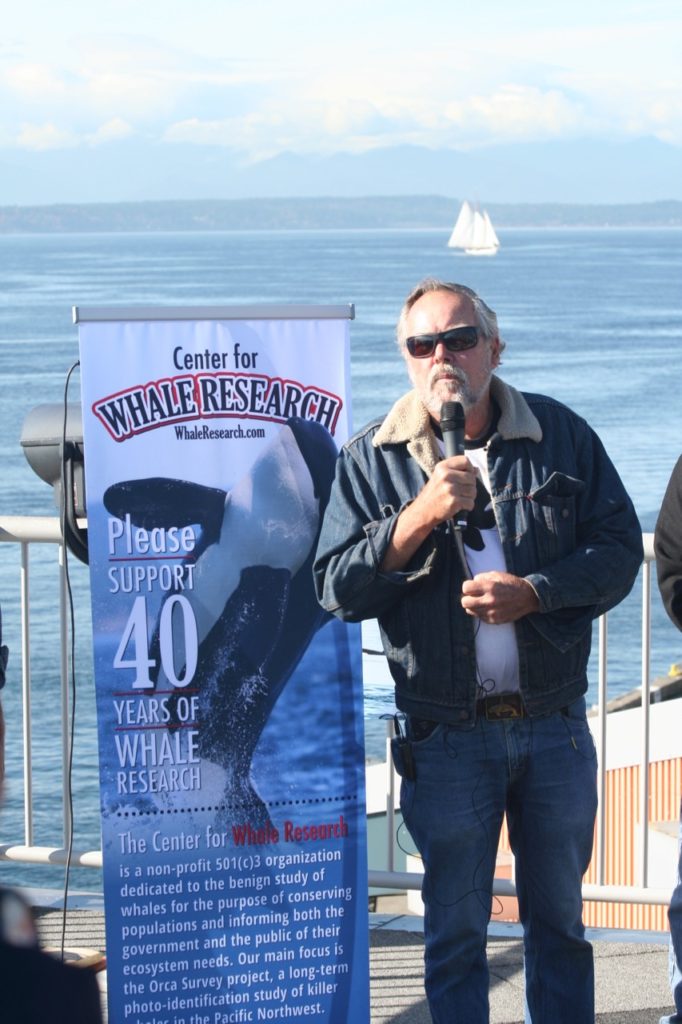
Ken Balcomb the biologist is sick of watching the iconic orcas of the Northwest die, especially mothers and their calves.  On Friday (10/28/2016) he became Ken Balcomb the activist, asking us all (the public!) to participate in saving the salmon-eating killer whales he has studied for almost 50 years.
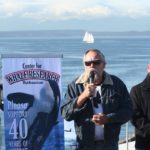
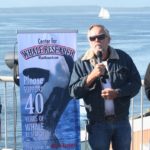
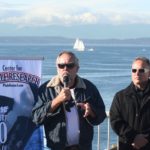
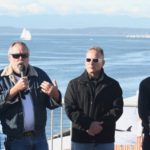
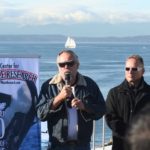
Ken Balcomb of the Center for Whale Research leads a press conference.
Call to action:
SUPPORT EXECUTIVE ACTION TO BREACHÂ THE FOUR LOWER SNAKE RIVER DAMS
In an unprecedented move, his organization the Center for Whale Research held a press conference today in Seattle.  Sadly, the purpose was to announce their conclusion that J-28 (aka Polaris) has gone missing and is now declared dead — a tragic loss of a breeding female (in a population that has declined to 80 individuals this summer) which probably also dooms her youngest calf, J-54 (aka Clipper), who was born in late 2015.  J-54 was part of the “baby boom†of 9 orcas that was heralded as good news in 2015 for the population which is failing to grow at the rate NOAA has specified in the recovery plan for the species.
Declaring that he doesn’t like reading the “obituaries” of killer whale mothers and their children, and citing a pre- and post-natal mortality rate of more than 75%, Ken and the other speakers today reiterated the clear need for bolstering the supply of southern resident killer whales’ their favorite food, Chinook salmon.  He explained that the failure of fetal and newborn orcas to survive is derived from examination of ovary morphology (which can indicate ovulations, as well as failed and successful pregnancies) in deceased whales and attributed to insufficient food supplies for the mother before and during pregnancy, as well as during lactation.
Their call to action was specific — the removal of the lower 4 dams on the Snake river. Â Ken contextualized this with a request that we recover wild salmon populations throughout the range of the southern residents — from California to SE Alaska. Â He was joined by Jim Waddel, retired Army Corp of Engineers, who posited that the Corp could begin breaching the earthen portion of the dams as soon as this December (!) — in part because a long history of studies and judge opinions have made it clear that dam removal is the only remaining option that is viable — both economically and ecologically.
Rooftop scene.
Setting up cameras
Getting ready.
The crowd gathers…
The rooftop deck where the press conference was held.
Ken before the start
Preparing for the start.
Ken Balcomb
Ken Balcomb of the Center for Whale Research backed by Elliott Bay.
Ken Balcomb
Ken Balcomb and ?
Ken Balcomb
David and Howie
David Niewert.
Debbie Giles, Research Director of the CWR.
Howard Garrett of Orca Network
Debbie Giles
Jim Waddell
?
Ken Balcomb speaking
Background information and more ways to help save the salmon and the orcas:
12:09 Starts with introduction of the science panel members
12:12 We were charged with evaluating the BiOp’s “chain of logic linking Chinook salmon fisheries to population dynamics of SRKW”
Population decline in both NRKW and SRKW was coordinated in late 1990s.
We were blown away by the quality of SRKW demographic data. This is probably one of the best-studied wildlife populations in the world.
Eric Ward estimated growth rate (lambda) as 0.99-1.04 (mean ~1.017, or ~1.7% exponential growth) for J/K pods and 0.985-1.035 (mean ~1.01, or ~1% exponential growth). The overall SRKW rate of 0.71% per year might increase to ~1%), but fisheries management changes are unlikely to raise the growth rate to the recovery goal.
There are 1000s of papers about Chinook salmon, but less is know about Chinook topics relevant to SRKWs. Listed 3 shortcomings.
Kope and Parken summarized Chinook trends for specific stocks important to SRKW. Coastwide there has been a modest decrease in recent pre-harvest Chinook abundance. There isn’t much room to lower commercial fishing in a meaningful way (e.g. decrease harvest of 20%).
Correlations between SRKW vital rates and Chinook abundance depends on abundance measure chosen. Mortality of SRKW should scale non-linearly with salmon abundance, but the existing correlations are linear.
12:38 Questions
Bain: Why weren’t acoustics impacts of fishing vessels considered? A: I don’t know. Perhaps because available data did not include fishing boats.
Felleman: Were analyses done using only Columbia Chinook? A: No, but you should email Eric Ward about that. You should also be careful about interpreting correlations as causal relationships. If you look for correlations from 50 different salmon populations, you’ll find strong ones just through random chance.
12:50
Elizabeth Babcock, NOAA
The intersection of salmon and orca recovery
Focus is on Puget Sound stocks. Locally-developed recovery plans for Puget Sound Evolutionary Significant Unit (14 watersheds from Neah Bay to Point Roberts; 22 populations) reviewed in 2005, then adopted plan in 2007, and are now implementing with partners.
70% of our estuary habitat area in Puget Sound have been lost…
Ward looked at all available Chinook time series and found many correlations, including between runs, but the strongest correlations were not with the Fraser nor the Columbia.
Interesting population projection figure from Ward (2013)
Post-workshops we have been looking at trends in other marine mammals: AK and NR KWs increasing, CA sea lions now ~6x 1975 levels, harbor seals 6-8x…
Overview of salmon status
Historic Chinook salmon abundance figure (compiled Jim Myers, NWFSC): Biggest reductions were in Columbia (~-3-5x) and Central Valley (~-3-4x)
Bonneville time series (1938-2014) shows abundance declines happened a long time ago (pre-dams!). 2014 levels approaching 1888 average levels!
A lot of the historical losses are due to extirpations (Gustafson et al., 2007): biggest extinct populations were in Columbia above Grand Coulee and Snake
Run timing changes: Columbia example — ~10x reduction in interior run (above Bonneville) from ~2.5 million to ~200k.
Hatchery production rose from 1950 to peak in mid-80s and in 2000 was near 1970s levels (Naish et al. 2007)
Puget Sound historical abundance is ~700k (based on cannery pack in 1908); current wild escapement is ~50k; hatcheries add ~300k.
Recovery activities
Habitat: 31,000 projects completed at 51,000 locations throughout Pac NW. Over $1 billion spent on restoration to date.
Hatcheries: overall reductions in hatchery releases in last few decades, and limiting genetic impacts on wild fish. One example of reductions to near zero is on OR coast…
Harvest: easiest to change and responsive; examples of successful catch reductions are Hood Canal summer chum. Coastwide harvest % has decreased by ~factor of 2 over last 30 years
Hydro: improved fish passage, predator control, spill, barging; dam removal on Elwha, Condit, Rogue, Sandy, Hood River
Heat: potential effects of climate change mostly not great for salmon; summarized by Stoute et al. 2010 and Wainwright and Weitkamp in prep
Budget comparison
Orca recovery spending: FY12 1.2M on science/research; ~300k on management/conservation
Orca salmon spending: FY12 600M!! Columbia only is 450M!
1:40 break
David Troutt, Director of Nisqually Natural Resources (for 35 years) and Chair of SRC (=Salmon Recovery Counci)
WA State salmon recovery — How we work together
2:02
State broken into regions, each with their own recovery plans (developed through the “WA way” involving many stakeholders, endorsed by Feds). Go to RCO web site for more information.
Study completed in March 2011 estimated costs of all planned regional plans is ~$5.5 billion. Funds dispersed through Salmon Recovery Funding Boards established in 1999. Funds come from PCSRF and others… Note: it is a LOT cheaper to protect than to restore…
10% of Federal grants must be used for monitoring. Example: About 80% of Nisqually outgoing smolts remain in estuary; 20% seek pocket estuaries elsewhere, but we see almost no returns of fish using the latter strategy.
There is a problem with marine survival in Puget Sound. We see 95% mortality of tagged out-going smolts between the Nisqually and Port Angeles. We’re confident that the estuary is in much better shape and 77% of the mainstem is in permanent stewardship, but we’re not seeing any result in the numbers of returning adults!
2:15 Tribal perspectives
Story: a generation of Nisqually fishers have never caught a steelhead. Annual catches of ~2k by tribes and ~2k by recreational fisheries collapsed (in 1990s?) to total run of ~500, a condition which persists. The treaties have not been withheld (and the tribes have not “shot at y’all in a long time”).
We need to work together towards ecosystem restoration. The tribes are interested in actions related to all H’s. The tribes have been working with the State to adapt how we run hatcheries to support harvest, but also be consistent with recovery goals. The North of Falcon process is part art, part science, but it is transparent and it works.
Rich Osborne, North Pacific Coast Lead Entity Coordinator (WRIA 20)
WA Sustainable Salmon Partnership — Salmon recovery on the WA coast
2:25
What’s unique about the outer coast in terms of salmon restoration?
All 5 salmon species and steel head; none are listed except Ozette sockeye.
Large areas are encompassed within tribal lands, which allows alternative restoration strategies.
Almost no people! Only 7000 people on coast with no residential areas
Large portions of watersheds in National Park, other large areas in National Forests.
Formed a non-profit to raise money beyond the SRFB: the WA Coast Sustainable Salmon Foundation. WRIA 21 = Quinalt; WRIA 22&23 Grays Harbor; WRIA 24 Pacific County.
Example projects:
Goodman Creek road decommissioning (4 miles of road and fill removed)
Quinalt: old logging road and fish passage blockage removal — facilitated by ability for tribe to control local decisions.
Grays Harbor: huge estuary Chehalis has spectrum of impacts (industrial, logging, headwaters in National Park), but again not many people
Pacific County (Willapa Bay): huge estuary w/few people; mostly Weyerhauser timber operations between pristine upper watersheds and the ocean.
28 Chinook stocks returning only 30-40,000, but could be 100s of 1000s…
An additional 12 million hatchery fish released from coastal watersheds per year
Salmon stronghold study areas (circa 2006)
 Jeannette Dormer, Puget Sound Partnership
Salmon Recovery in Puget Sound
2:45
In contrast, there are 4.1 million people in the Puget Sound region: 12 counties, 20 large cities, 100 cities total, 17 treaty tribes, many NGOs; 15 lead entities; Puget Sound Salmon Recovery Council (not the Partnership) is policy body to oversee implementation of the PS salmon recovery plan.
6 salmonid species, 3 listed under ESA (PS Chinook threatened in 1999, Hood Canal summer chum threatened in 1999, 2007 Puget Sound steelhead).
Salmon recovery success example: Puget Sound Acquisition & Restoration (PSAR) Fund. Regional priority list; increased from $15 million to $70 million appropriated for 2013-2015 biennium
100s of acres of estuary restoration in Snohomish and Skagit rivers
Elwha dry lake bed reforesting
3+ acres eel grass on Bainbridge
Seahurst seawall removal and restoration
Intersection with orca…
3:05
Jacque White, Exec. Director of Long Live the Kings (used to work at P4PS and Nature Conservancy)
Salish Sea marine survival project
Many partners supporting the coordinating organizations — Long Live the Kings in U.S. and Pacific Salmon Foundation in Canada
“Puget Sound salmon are sick and we don’t know why…”
Coho marine survival declined sharply in 1980s from ~3% to <~0.5% and has persisted, while during the same period (1974-2007) WA/BC coastal survival has been fluctuating around a mean of ~0.5%. There are similar trends for steelhead and Chinook.
Rises in Harbor seals, lags, temperatures, and human population
Little effort to integrate research efforts
Now seeing economic impacts on humans (sports fishing, tribes, First Nations)
Time line:
2007 State of the Salmon in 2007 focused on interactions of wild and hatchery salmon
2012 fall workshop led to idea of a transboundary project to increase survival in the Salish Sea, improve accuracy of adult return forecasting, and assess success (or failure) of existing salmon recovery efforts.
2014 Comprehensive planning
2015+ Implementation of research
Hypotheses (trying to identify factors that control salmon and steelhead survival that can be managed)
Bottom-up processes (PDO, environment, forage fish changes to which salmonids haven’t been able to compensate)
Top-down (predation…)
Other factors (toxics, disease…)
Research activities
Focus on juvenile fish
Predation of seals on steelhead
3:45 break
Panel discussion (audio recording: .ogg [~68 Mb] | .mp3 [~34 Mb]; responses are hard to hear for some panelists who did not use microphones)
3:58 Begin
5:14 Final comments and next steps (also included in audio recordings)
The year 2013 was an exceptionally unusual one in the world of southern resident killer whales and Pacific salmon. Most noticeably, the southern residents returned to the Salish Sea later than normal, raising concerns among conservationists. Throughout the summer, researchers and whale watch operators noted that the whales were present less than normal and the duration of their visits to the Salish Sea were abbreviated.
Meanwhile, the Chinook salmon runs on the Fraser plummeted while 80-year record returns were counted on the Columbia at the Bonneville dam fish ladder. Combined with new evidence from satellite tags that the southern residents are focused on Columbia salmon during the spring months, the sighting patterns of 2013 may indicate a transition for the urban estuary known as the Salish Sea — from one with “resident” orcas to one with southern “transient” fish-eating orcas.
Killer whale trends
Based on data from the Orca Network sighting maps from the past decade (see figure below), records were set or tied in 2013 for the least number of days spent by southern residents in the historic core of their summer habitat (the west side of San Juan Island in Haro Strait). The SRKWs were seen only once in March and not at all in April. Even more shockingly, they showed up only 5 times in May (a record low) and were observed 15 times in June, a low level not seen since 2001.
The same data show downward trends in monthly sightings over the last decade. With the exception of a high in 2011, the March prevalence has been flat or decreasing. There are stronger, more continuous downward trends in April and May sightings.
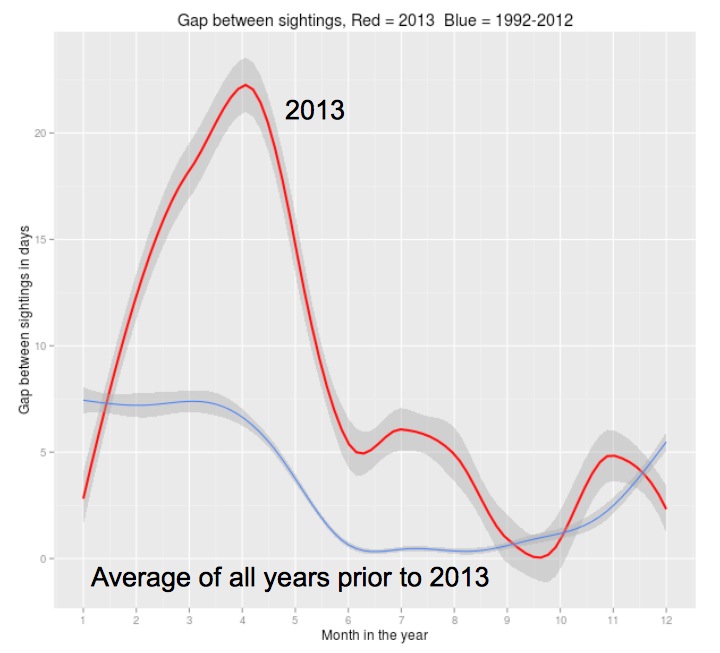
We used the OrcaMaster database maintained by The Whale Museum to look for trends in sighting “gaps” — the number of consecutive days between sightings of J pod members within the Salish Sea.  Val plotted running averages of 2013 gaps versus a historic average (1992-2012) and found that in the spring of 2013 sighting gaps were 2-5x longer than the average. Only during and after September of 2o13 did the gap return to a normal duration. (Maybe we should look at trends in Salish Sea chum run?)
Historic trends in J pod sighting gaps (Val Veirs, using R and ggplot)
Chinook trends
One way to characterize the foraging conditions the SRKWs experienced in 2013 within the Salish Sea and on the outer coast is to examine the Chinook salmon counts from the Fraser and Columbia rivers. The Albion test fishery on the Fraser provides a proxy for the abundance of Fraser Chinook, the primary prey of SRKWs in the Salish Sea from spring through the summer . The fish counts at the Bonneville dam on the Columbia are a proxy for the abundance of Chinook on the outer coast of Washington.
As marine naturalists like Jane Cogan and Monika Wieland have pointed out, 2013 was an exceptionally bad year for Fraser Chinook returns. The fish arrived late and the cumulative returns were well below this historic average and only slightly better than in the worse year on record, 2012. The highpoint of the 2013 run was the peak around the 3rd week of August that may also be related to a pulse of Chinook recorded in the first two weeks of July off southern Vancouver Island (in the Area 20 test catch fishery).
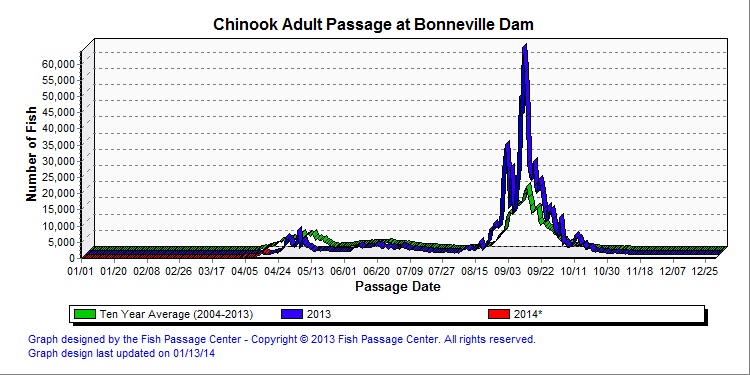
In contrast, adult and jack Chinook abundance in the Columbia River has been on the rise for the past couple decades, with 2013 standing out as a record-setting year for adult Chinook.
Daily Chinook counts at Bonneville show that while most of the record-setting abundance was due to the fall run, the spring run also had peaks well above the 10-year average.
The spring run passed Bonneville from late April to late May, 2013. This timing is consistent with the timing of the spring Columbia Chinook run in 2012. Since Bonneville dam is about 200 km upstream from the river mouth and adult Chinook swim at about 0.5 m/s, we could expect that the returning Columbia Chinook were in the ocean at least until about a week before they reached Bonneville ( 200,000 m / 0.5 m/s = 400,000 seconds = ~5 days). So where were the southern residents in March and April of 2013, since they weren’t being sighted in the Salish Sea? We don’t know about J and L pods, but the satellite tag deployed on K25 indicates the likely position of K pod (up until April 4).
The answer is: during March, 2013, K25 was spending a lot of time going back and forth along the continental shelf of Washington (and to a lesser extent Oregon) with a track that centered on the mouth of the Columbia River.
We need to know more about when the returning Columbia fish are on the continental shelf and accessible to the southern resident killer whales. But these salmon trends from the region’s biggest rivers combined with migratory patterns of the orcas strongly suggest that the southern resident killer whales may be happy to move their “residence” to wherever the eating is best! Perhaps we are watching them become southern transient fish-eating killer whales?!
Anecdotal observations of orca-salmon interactions
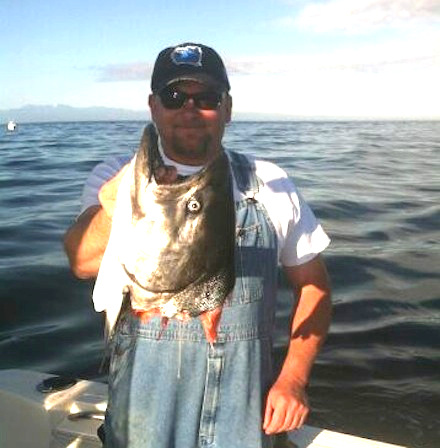
When the fish-eaters were around during the summer of 2013, they displayed some unusually aggressive foraging. A (potential) prize Chinook salmon was taken off a derby fisherman’s line and became the focus of a KPLU radio story and an impressive photo of the one that was eaten away…
The part that didn’t get (taken) away. (credit: Kevin Klein)
This local predation event was a first for Washington State (as far as we know), though it was comparable to one by Alaskan fish-eating killer whales. In the video below, the Alaskan whales were foraging amongst fishing vessels and happened (probably visually) upon a large hooked Chinook. (Mute your speakers if you don’t want to hear angry and amazed fishermen cursing.)
Later in the summer of 2013, back in Washington, a whale watch captain obtained this video of southern resident killer whales pursuing a large (likely Chinook) salmon alongside the boat —
Could these uncommon foraging observations indicate that the southern residents were having a tough time finding enough to eat in the Salish Sea? We’d be interested in hearing from local fishers about how often they’ve had fish taken off their lines by Southern Residents. Monika assures us though that it is common to observe SRKWs pursuing salmon around and underneath whale watching boats, so maybe we should attribute the second video to more typical foraging and take it as evidence that orca-salmon interactions in the fall of 2013 were more typical than earlier in the year.
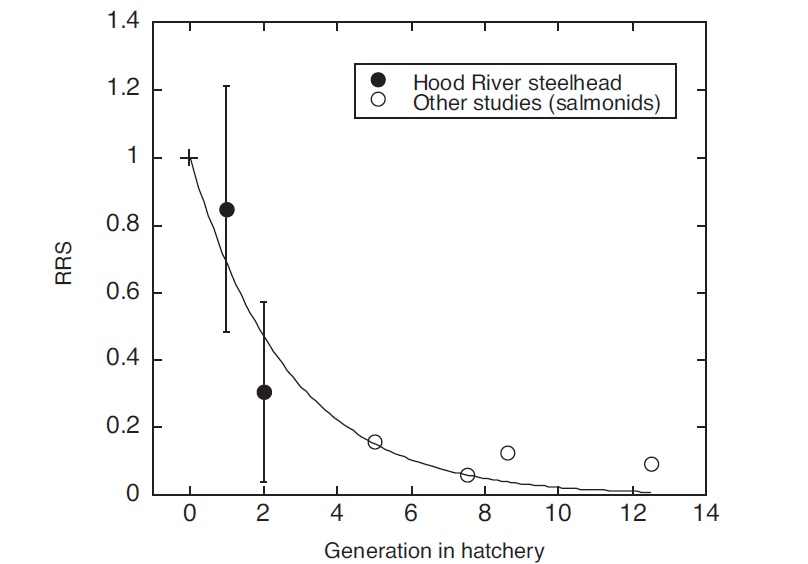
Fish hatcheries have become ever more important in recent years due to the declines in wild stocks. The aim of hatcheries is to replenish the wild stock in order to keep the fishing industry sustainable, but there is still debate as to what is the best approach to this without causing further damage to the wild population. In an attempt to make improvements to hatchery practices, Hitoshi Araki studied the reproductive success of hatchery trout compared to wild trout, and made suggestions in his paper Hatchery Stocking for Restoring Wild Populations: A Genetic Evaluation of the reproductive Success of Hatchery Fish vs. Wild Fish (2008).
The hypothesis was that fish bred using the traditional hatchery methods, in which the fish are usually non-local and are bred for many generations in captivity, have much lower reproductive success than both supplemental hatchery fish and wild fish. The idea behind supplemental hatchery methods is to use local parent fish to breed “wild stock” hatchery fish in a protected environment, and then release them into the wild population, with the overall goal being to re-create a sustainable wild population. Using DNA analysis of steelhead trout from the Hood River, Araki determined the reproductive success of traditional hatchery fish, supplemental hatchery fish, and wild fish. He found that the more generations bred in a hatchery, the less reproductively successful the fish are.
Picture 1: Araki used his own data and data from previous studies to show the decline in relative reproductive success (RRS) as the number of generations in a hatchery increased.
Araki also found that supplemental hatchery fish had significantly higher reproductive success than the traditional hatchery fish, though they still had lower reproductive success than the wild population. When a wild stock parent was crossed with a traditional hatchery parent the reproductive success dropped. This shows the effect that hatchery fish can have on the wild population. If traditional hatchery fish continue to be released into wild populations in attempt to sustain them, they will continue to lower the reproductive success of the wild population.
It seems that, though hatcheries have a positive sustainability goal in mind, the traditional methods they are using to replenish wild stocks are somewhat counter-acting what they are trying to achieve. Though it may be more work to implement supplemental hatchery methods, the benefit of higher reproductive success of the population should be worth it.
Araki used steelhead trout as his example organism, but it is assumed that similar principles could apply to other fish species. In the San Juan and Vancouver Island area, salmon hatcheries are an important part of the fishing industry (and produce important food for the Southern resident orcas!). Since Chinook salmon are endangered in the area, a large amount of juveniles are released into the wild from hatcheries. From the information I could find, it seemed hatcheries in the area are attempting to use methods closer to supplemental techniques rather than the traditional methods. For example, the San Juan Enhancement Society in Port Renfrew, BC collect their broodstock (parent fish) of Chinook from a lake connecting to the San Juan River, therefore the juvenile fish are being released into their natural habitat. Though it isn’t stated how many generations are produced in the hatchery, it still could be considered a step in the right direction compared to using a non-local broodstock. Hopefully in the future hatcheries move towards supplemental practices so that the wild stocks, the ecosystem, and everyone utilising the fish can further benefit from sustainable fish populations.
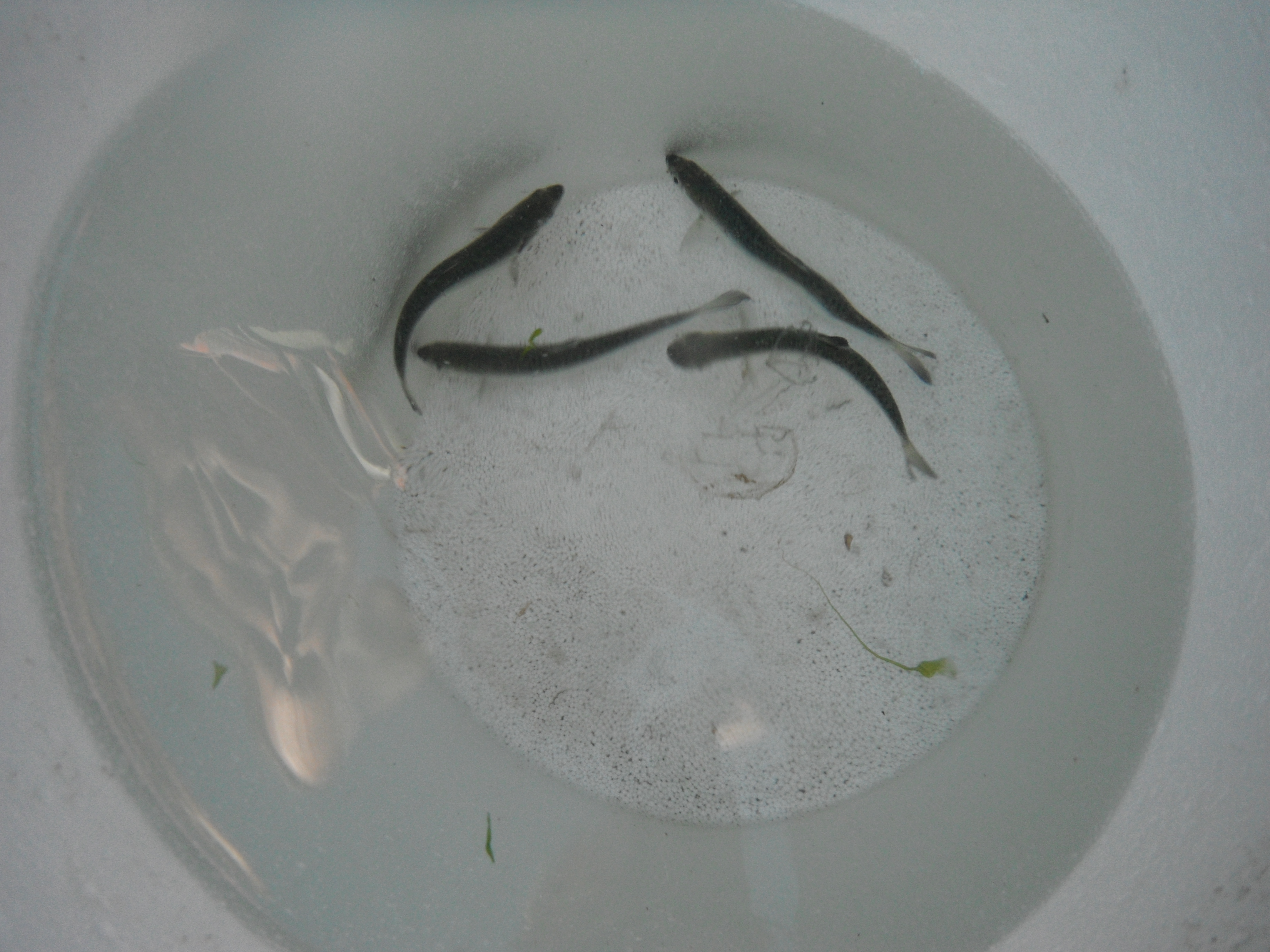
Picture 2: Both wild and hatchery juvenile Chinook can be found in the San Juan Islands, as our Beam Reach class found out while beach seining on Lopez Island. The hatchery salmon had their fins clipped for identification.
After an efficent morning chore period, we had a long discussion of our current scientific methods and how they need to be changed and improved.  Jason also began to examine the OrcaMaster data set.
In the afternoon, we sank a Vemco receiver in front of Val’s house to pick up the pings from the salmon experiments. The Vemco was deployed at 14:45 at 48, 33.7 and 123, 10.81 in around 10 meters of water. The serial number was 100913.
We did a quick drill with the hydrophone array and recorded the noise of the Gato Verde at 4 knots and varying speeds below as it slowed down. We did a quick man overboard drill with a hockey helmet that we’d found and then spent the early evening learning how to motor around in the dinghy. After a filling dinner, everybody worked through the evening. Peter and Val analysed some of the data we took on the Gato Verde’s noise levels and found some interesting results that will need further experimentation.
We’ve had a full, exciting day today, a perfect Beam Reach day. I woke a bit later than usual, rolling out of my sleeping bag at 7:50 and wandering into the kitchen to find that almost everyone had already eaten. Jason and Bubbles, his traveling sourdough starter, had made lovely sourdough pancakes.
Our morning meeting turned into an extended, incredibly helpful, strategy session. The conversation, led by Val and Jason, flowed smoothly and ranged from the last bits of research we need to complete for our proposals, to amendments to our data sheets and data collection systems to beginning to practice our analysis. I don’t know about the others but I ended up with two pages of notes and a long list of new things to address or research. About half way through, we decided to “make like plankton,†drifting from Stuart Island, south down Haro Strait, listening to various hydrophones all the while. We were so engaged that we almost, but only almost, worked past lunch.
Our morning meeting in the sunny cockpit
In the course of “making like plankton†we came across some interest flotsam. I asked for the definition of flotsam while writing this and Val promptly answered, “The things you find at garage sales.†It is actually, Todd tells me, the things you find floating in the water. Anyway, today we came across a hockey helmet, a construction hardhat and a circular piece of polystyrene (Styrofoam).
We had an equally busy afternoon, sinking a receiver in front of Val’s house to pick up the pings from transmitters put in salmon. Using an array (pun intended) of ropes, tapes, weights and boats, we managed to sink a cement block attached to the receiver and anchor it to land. As we left, we did a quick drill, pulling out the hydrophone array, as quickly and neatly as possible.
We were just beginning to relax again when Todd yelled, “Man overboard!†There was a great deal of running around without a clue where to turn, trying to decide who would keep their finger pointed at the “man†overboard. This was additionally confusing because for the first few seconds, none of us could see what was supposed to be the “man.†Hannah tossed the man overboard pole like a javelin and if it had actually been a person in the water, they probably would have been impaled. The hockey helmet, our “man†was successfully rescued and we proceeded into Mitchell Bay.
I had just gone to pull out my laptop and start work on the to-do list I generated this morning when Todd called us together and began dinghy training. Erica and I went first as the night’s cooks. It was like learning how to drive all over again only backwards, all with one hand and out in the wonderful, open blue.
The reason I wanted to blog about this day in particular was mainly an idea I had just before dinner while dicing garlic to fry with zucchini. It’s the “Man Overboard†thing. Not only did I feel like today was a bit of a continuous “Man Overboard†drill, in a good, thought-provoking, keep-you-on-your-toes kind of way, but I’ve sort of come to decide that all of Beam Reach is a bit like a “Man Overboard†drill.
It presents challenges that are usually unexpected, a bit nerve-wracking, and have an enormous payoff, if successful. All of our Beam Reach overboards seem daunting and confusing at first, but with helpful direction, good judgments, reliable instincts and hard work, we can complete the rescue successfully.
Today Val and Scott re-deployed a Vemco VR2 fish tag receiver at Lime Kiln State Park. This receiver, provided for this pilot study to Beam Reach by Fred Goetz, will help marine scientists understand how juvenile and adult salmon use the San Juans, in addition to any other passing fish that have been “tagged” (surgically-implanted) with 69 kHz acoustic tags. We at Beam Reach are most interested in the behavior and distribution of adult Chinook salmon, and secondarily any other potential prey of the endangered southern resident killer whales.
58724
58727
The photos above show the mooring prior to being snorkeled down to the pier block that remained from the previous deployment (last November).
Two other VR2s have been provided by Kurt Fresh of NOAA. (Their serial numbers are: 100910; 100913.) One will be deployed on the west side of San Juan Island; the other will be placed near Cattle Pass.  We’ve mounted them on short (~2.25m) mooring lines (1.25cm diameter 3-strand poly), supported by single yellow shrimp pot floats (see below). The base of the receivers will be ~0.75-1m above the bottom. The floats will be ~1m above the top of the receivers. The mooring weights are either ~25kg concrete slabs (35cm x 35 cm x 15 cm; see below) or paint buckets filled with cement. Both types of weights have metal hoops or chain for attaching the mooring line and for lowering during deployments from a boat.
Last Sunday (11/09/2008), Jason Wood and Scott Veirs deployed a receiver that can detect and record the signals emitted by acoustic tags implanted surgically in migratory fish, like the Chinook and chum salmon that southern resident killer whales appear to prefer. The Vemco “VR2″ receiver, provided by Fred Goetz through a collaboration with UW Fisheries, was deployed during a scheduled maintenance dive on the hydrophones at the Lime Kiln lighthouse. The plan is to retrieve the VR2 in early 2009, download any serendipitous detections that may help in the interpretation of the echosounder data (to be presented at the Puget Sound Georgia Basin conference), and then redeploy it for the remainder of the winter (and perhaps the entire year).
The dive went well and lasted from about 11-12am. We enjoyed visibility of about 20m and pleasantly calm seas (it was very rough on Saturday when we initially planned to dive). We cleaned and secured the intertidal hydrophone and echosounder cable protectors, checked the VR2 mooring for buoyancy, and then followed the hydrophone cable to the two hydrophone stands (cement-filled paint-buckets with a broad tripod of embedded rebar). The VR2 was deployed 3m NW of the southern hydrophone and its mooring anchor was tethered to that hydrophone stand’s embedded chain and one of its rebar legs.
The VR2 mooring had a total height above bottom of 2m, with the receiver hydrophone oriented upwards about 1.4m above bottom. Since the mooring was deployed in 9m of water when the tidal height was ~2m, the depth of the receiver is about 6m below the tidal datum (0m). The mooring consists of a ~2m length of 1/2″ 3-strand polypropelene line connecting a ~3kg buoyancy crab float (used in lieu of an incompressible trawl float since minimal compression is expected at this depth), the VR2 (cabled-tied through and around the strands), and a stainless steel threaded shackle (bowlines at both ends). The shackle connects to a loop of 3/16” plastic-coated wire rope that extends through a pier-block (via a 3/4 inch hole drilled through center line). The loop is secured with a clamp and is attached via sheet-bend to the ~4m-long tether (same type of line). All knots’ tails are secured with electrical tape. The float is marked with UW Fisheries research and Scott’s cell phone number.
















 Twitter
 LinkedIn
 Facebook
