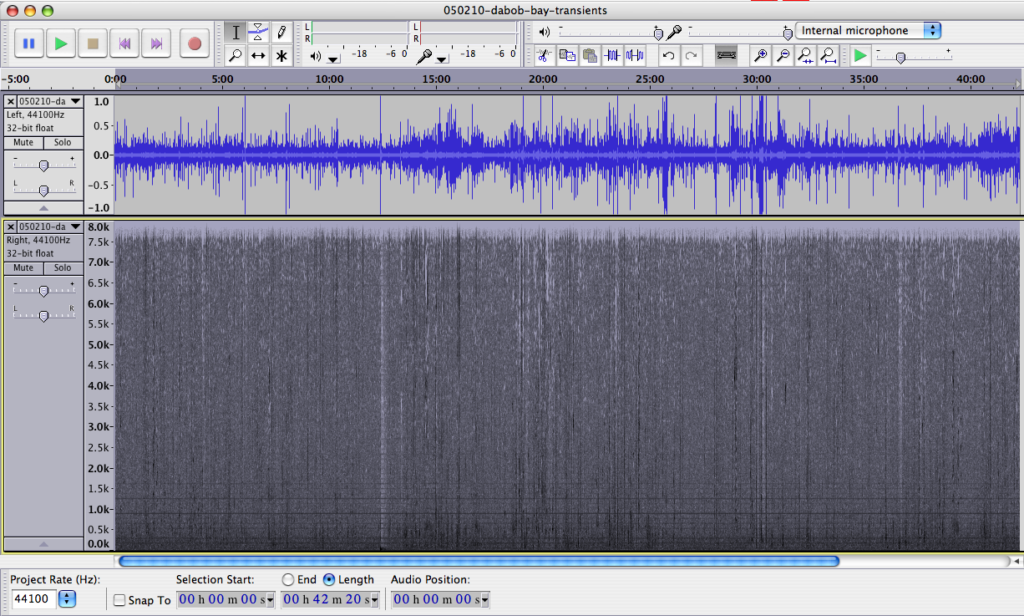
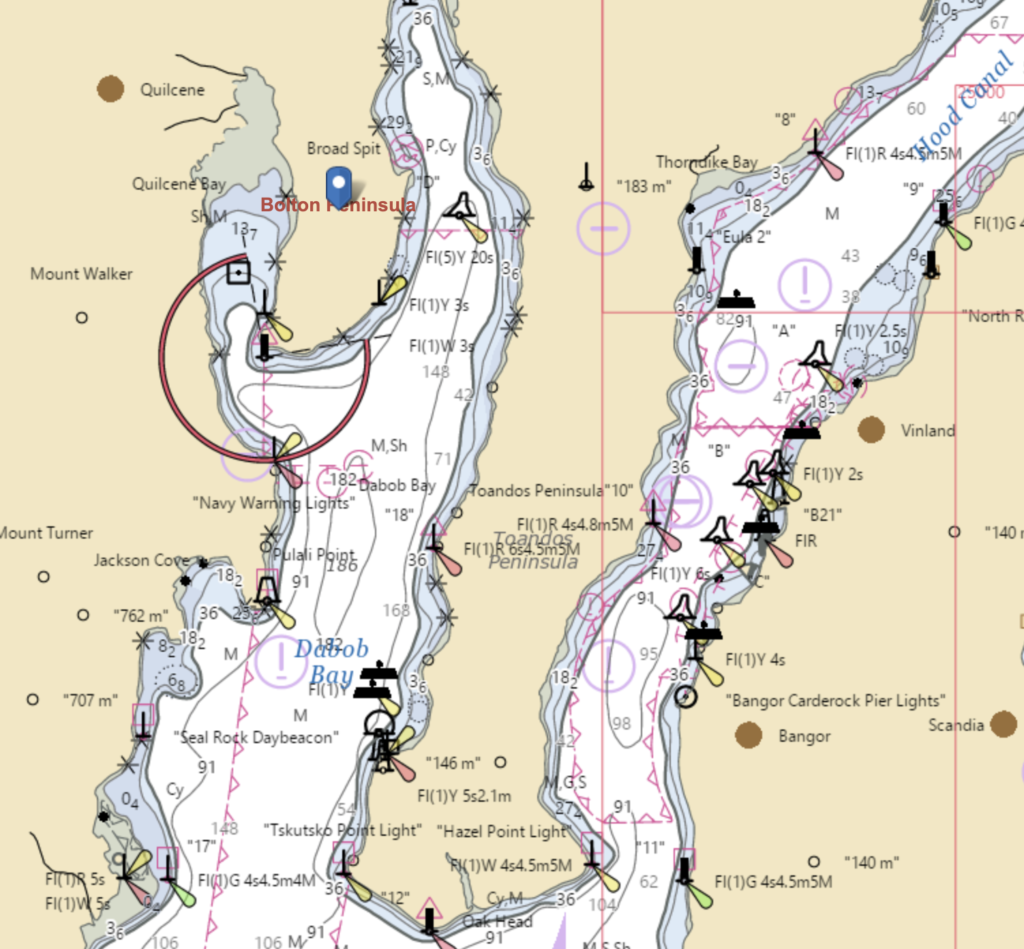
In a recent meeting led by Rear Admiral James Symonds (Commander, Navy Region Northwest), Shaari Unger of Naval Undersea Warfare Center (NUWC), Division Keyport, kindly handed out a CD with a great recording of transient orcas made in Dabob Bay (Hood Canal, WA) on February 10, 2005. She asked if any and all acoustic afficionados could listen to it and analyze it.
Here’s hoping our Northwest Navy neighbors are able to acquire and release additional recordings like this one that help us understand and enjoy the marine environment.
The CD jacket provides the following information:
The point of contact for the recording is NAVSEA, Keyport Public Affairs Officer, (360) 396-2699, kypt_pao@navy.mil
Start time: 10:45 (PST) 10 Feb 2005
End time: 11:27 (PST) 10 Feb 2005
Weather: Sunny and clear, unlimited visibility, light winds
Animals (data compiled by John Durban and Graeme Ellis): These are six killer whales, known to be part of the ‘west coast transient’ stock that ranges between the coastal waters of SE Alaska and California. These particular animals have been most frequently documented in SE AK and British Columbia. This group is comprised of two adult females [(T71 and T124A, both more than 20 years old), each with two offspring – one older offspring per femaile (T71A — 10 years, T124A1 — 9 years) and one younger offspring per female (T71B and T124A2, both around 5 years)]. These two ‘matrilines’ have not always been seen in association with each other.
Visual observation during the recording: The animals were off Bolton Peninsula when first sighted. They were staying in one location moving back and forth over one area, which is considered feeding behavior. They then moved as a group from Whitney Point south, along the west side of Dabob Bay and continued south out of Dabob Bay.
As a standard operating procedure, the NAVSEA Keyport does not conduct active acoustic operations in the presence of whales at any NAVSEA Keyport test range. The Dabob Bay Range Site is staffed during normal working hours by NAVSEA Keyport. Our range operators are trained by NOAA to identify marine mammals.
NUWC maintains and operates the range on Dabob Bay where this recording was made. Their purpose is to test and evaluate undersea systems in support of research and development, and in support of maintenance and upgrade of existing systems. There were no operations scheduled the day this was recorded, and all scheduled testing activities were postponed for several days until the range was clear of the transient Orcas.
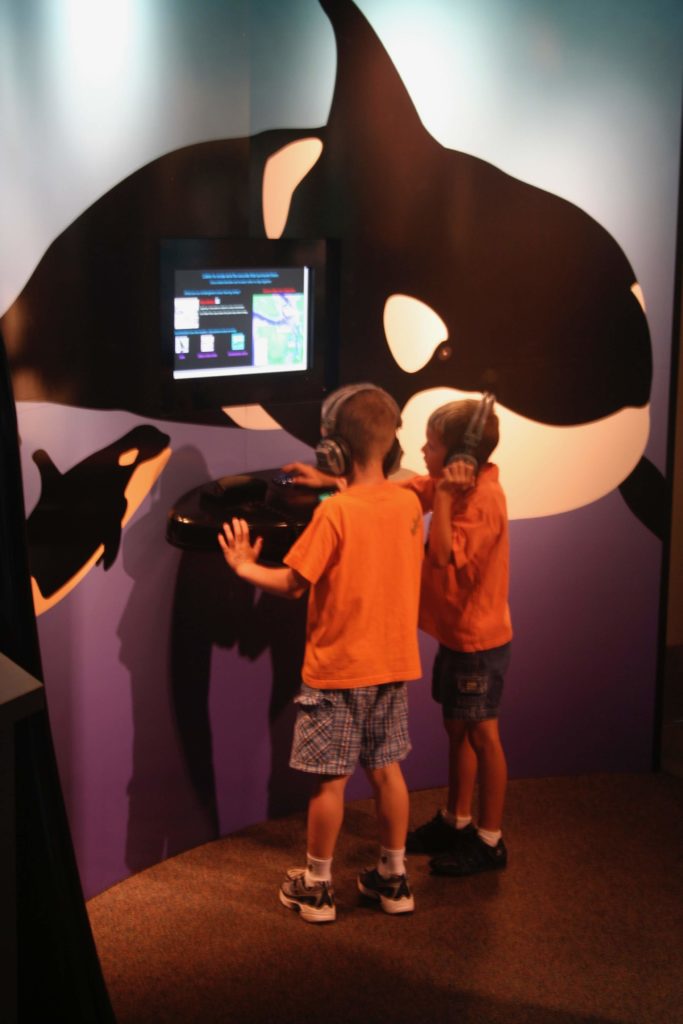
The listening station at the Seattle Aquarium lets visitors interact with orca sounds via web-based content (live and recorded audio), a monitor, and a trackball and headphones offered at kid-level on a matriarch’s fin.
At the bottom of the concrete helix at the Seattle Aquarium is the Family Activity Center (FAC)– a marine mammal hub adjacent to the big underwater dome. While fur seals and sea otters dive past visitors one side of the room, the majority of the space is dedicated to presenting the parallels between our human families and those of our regional icon, the killer whale, or orca.
Just a week ago the FAC received an acoustic enrichment. A listening station that enables visitors to listen live to the ocean or hear recordings from underwater has replaced the writing station and a panel describing orca prey (Chinook salmon). The listening station project was proposed by Brooke Nelson and me, managed by Michael Darling, and implemented by me (web design/html/php); Val Veirs (Java coding); Grant Glover, Jesse, Zach, Gary, and team at Pacific Studio (art and kiosk fabrication); Steve Harvey and Richard Ramsby (demolition, Internet, and installation).
Since the station needed Internet access for the live streams, we decided to host content on-line, primarily for ease of maintenance, trouble-shooting, and future enhancement. If you don’t have a chance to visit the Aquarium and test it out in person, you can view the pages here: http://orcasound.net/sakiosk/
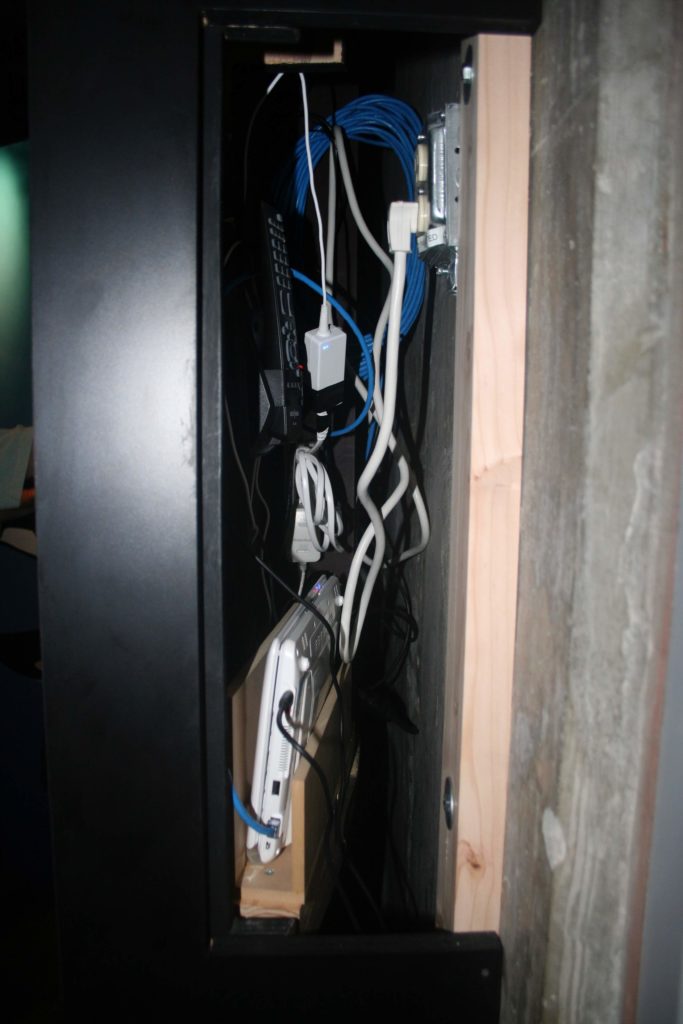
The site delivers sound through a Java-based audio player called jlGui that can handle both recorded mp3 files and Shoutcast streams while embedded and hidden within a browser window. There are also some nice photos and words to go along with the sounds. In the Aquarium, the content is presented on a 22″ monitor (using 1280×768 resolution) by an Eee PC running Firefox with the Open Kiosk plugin over Windows XP Home. A cool thing about this Eee PC is you can set it to keep running when the case is closed; that enabled us to fit it easily in the constrained space behind the mural.
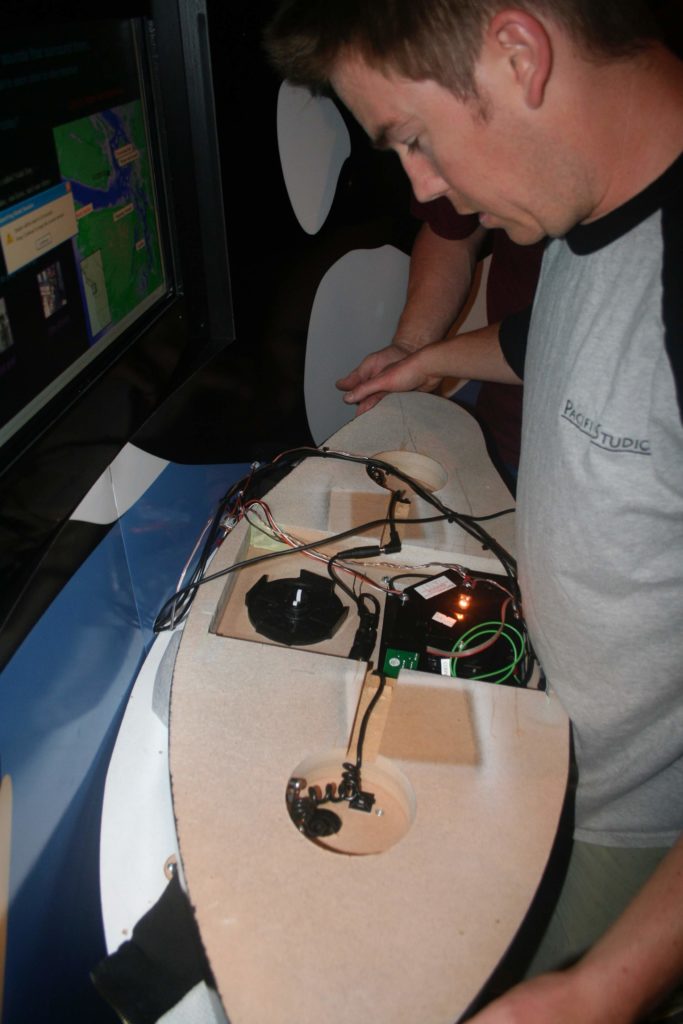
A view behind the scenes…
…and under the fin!
The highlights of watching folks try it out on the first day were hearing a 9 year-old boy walk away saying “That was really cool,” and a mother telling her child as they departed, “How would you feel if you had to listen to that all day?” Google Analytics suggests that thus far, about 20 unique visitors per day are listening to the underwater sounds for an average of about 2 minutes.
Below are links to photos of the installation, as well as notes regarding the hard-/software we considered and used in implementing the project.
Install Firefox 3.0.14 (3.5 didn’t work with Open Kiosk — though I didn’t try all version permutations)
Add the Open Kiosk add-on, version = “Firefox 3 Install Here” [July 16, 2009] (follow instructions at https://www.mozdevgroup.com/clients/bm/ — don’t download from the (outdated?) FF add-on site!)
Get updates to Java (upon autoprompt) (installed JRE and registered it…)
Disabled login screen; made user1 autologin (no password prompt)
Scheduled FF to run at system re/boot for user1
Used Kiosk admin UI to set FF-Kiosk-fullscreen to be default browser (firefox.exe -kiosk admin)
Had to restart Firefox a few times in safe-mode w/various defaults re-set… (via firefox.exe -safe-mode)
Enable jsLib 0.1.359 and BMA Kiosk 1.65
Change default start page
Under Filters tab click “Enable JavaScript on all pages” (so streams can be played through browser)
Under Sessions tab: set Kiosk to reset session after 5 minutes (max time anyone likely to listen?)
Under Customize tab: Disable tabbed browsing and Hide All UI Widgets
Click OK
Test it out (Launch under Kiosk submenu); first time I clicked on link to page that calls jlgui player, I got auto update of JRE6, then Security query re JavaZoom Team digital signature not being verifiable — clicked Always trust and Run; stream started after about 10s load/lag-time…
Had to de-select location under the View menu in FF to get location bar at bottom of window to be hidden in Kiosk mode
Back in admin, make FF-kiosk the default browser and select full-screen mode
Reboot computer and see if FF-kiosk comes up automatically with start screen
Reboot performance: blue screen at 30s, desktop at 40s; start screen in FF-kiosk mode in 65s, but XP Taskbar locked and visible at bottom of screen (though non-reactive to clicks); select auto-hide in Taskbar properties; reboot…
Reboot performance: blue screen at 30s, chime at 37, desktop at 50, start screen in FF-kiosk mode in 70s
Now has gap at bottom where taskbar is hiding, and location bar is back… (solved by resetting defaults via -safe-mode)
XP takes about 45 seconds to boot up to desktop
Eee PC Xandros 4Gb notes: — Took WAY too long to get a real desktop environment ++ Wireless connected automagically — Open Kiosk didn’t seem to want to run on the version of Firefox I initially downloaded (but I didn’t keep good notes on which permutations I tried…)
David Howitt and Jason deployed hydrophone 2 and 1 in the North array today at around 2:00 pm. We moved the last two tires into place and placed another tire at the end of the cable protector to hold it in place. During the dive we resurveyed the original placements so that we had measurements from a single dive. The data collected are as follows:
On 6/27/09 Val and Jason deployed another Vemco fish receiver at the mouth of False Bay in a depth of 26 feet at 14:22 (should have been ~ 0.16 tide at the time). The location was 48 degrees 28.748 N and 123 degrees 04.411. This location is just off the small island in the mouth of the bay. The serial number of the unit is 100910.
While we were there, a boat with a banner reading ‘Fish Research’ was also present. In talking to them, they told us they were in the process of removing old derelict fishing gear. The name of the vessel was Bet-Sea and had the numbers 785 and 53661 on it. We also spotted this same vessel off False Bay during the Spring 09 quarter.
I enjoyed this ~20minute documentary by CBC science reporter Monica Kid on noise pollution in the ocean. It provides a synthesis and synopsis of many of the inter-linked issues — from Navy LFA sonar and seismic air guns to boats and ships — with interviews with Arthur Popper, Alexandra Morton, Ken Balcomb, Michael Jasny, and Douglas Wartzoff.
I was particularly interested to hear about some of the potential impacts of noise on fish. It was also interesting to hear from Alexandra about the avoidance of seal harassment devices by resident killer whales in the Broughton Archipelago (2/3 drop in sighting rate) and from Ken about the Bahama strandings.
Thanks to Michael Darling of the Seattle Aquarium for letting me know about this nice piece (high-lighted on “and-the-winner-is” show).
For the first time, the final talks of a Beam Reach program are available for viewing on-line as videos (hosted by Vimeo). Links to the videos, as well as the final PowerPoint presentations and papers can be accessed through the spring 2009 class page.
Over the last ten weeks we have learned a tremendous amount. We learned how to: ask a question, design a research project to possibly answer this question, write a proposal, conduct research, sail, live on a boat with seven other people, analyze data, run statistics on our data, and write a final paper on our findings. Another very important lesson we learned was how to give a presentation. Knowing how to conduct research and write up a paper on it is a pretty important part of science. If you can’t explain your findings to the general public then you can’t share your knowledge with others and no one else can use your findings to ask more questions. On Wednesday, we presented our research to the other students at Friday Harbor Labs as well as other community members. I think this lesson was a great one because it is really important for others to understand what you did and what you learned from your research. Public speaking is a skill that every scientist should develop and presenting our findings on Wednesday was the perfect practice. Developing skills using powerpoint is also a good tool to have.
Somehow while we were on the Gato Verde it got out that I had never seen Star Wars. When this news hit, Jaws dropped, “OMG!”‘s were screamed, and comparisons to locking children in closets for several years were drawn. Actually that last reaction was only one comparison, made by Jason, who then showed up the next morning with all three original Star Wars movies. We ravaged through them over the next few nights, and I realized how glad I am that I didn’t see them as a kid. I’m sure the level of obsession I would’ve most likely reached as an 8-year-old would have been hard to recover from. The movies are amazing! The distinction of the dark side being a place of fear and hate instead of just sheer evil is so brilliant! Now on a regular basis I find myself thinking things like, “Calm down Hannah, it’s only a robot, don’t give into your hate and the dark side…” Then I crack up, and I am able to resist.
This is just one more example of a well-rounded educational experience, brought to you by Beam Reach.
-hmm
As Peter has explained in an earlier blog, we chose to do our sustainability project on surfactants. So after learning what surfactants actually are and how common they are we decided to go for it. We realized that this would be difficult to measure and find an effect. We started out just wanting to calculate our output of greywater into the ocean. Since we don’t shower on the boat the main greywater output is from washing dishes. So how do you collect greywater? Well since we were on a catamaran and the drain from our sink is between the two hulls above water that should be easy to collect right? I thought so when I volunteered to take the dinghy under the boat and collect the grey water from dishes one night after dinner. I quickly learned this was more difficult than I anticipated. First I tied a rope to the stern of the boat and had the other end of it in the dinghy with me. Then I tied the bow line of the dinghy to the bow of the boat so that I could pull myself back and forth under the boat and make it easier to position myself for the water collection. Once I was under the boat I realized that the space between the water and the boat is not as big as it looks. Once I was under the boat I managed to get the dinghy to a spot where the bucket was under the drain. I quickly learned that the water didn’t run out of the drain in a nice stream. It splattered and ran along the bottom of the boat for a few centimeters before falling. So I had to hold the bucket under the drain with one hand and hold the dinghy in place with the other.
My set-up
collecting the water
When the dishes were done the bucket had 4 gallons of water (~12 liters). We then collected and filtered about 4 milliliters to take into Russel Barsh’s lab to test the concentration. We found that the concentration of our grey water was 55 parts per million (ppm). So grey water is extremely concentrated. After washing dishes from one night we produced 4 gallons of greywater with a concentration of 55 ppm!
Then we started thinking, we know what we are putting into the water, but we don’t know what is already there. So we decided to take samples from some of the different Harbors we stay at overnight. After running a test sample using water from Friday Harbor we quickly realized that areas with good circulation will not have high concentrations even if they have higher inputs because it is mixed better. Our focus soon became harbors that have poor circulation but still have a lot of boats inhabiting them throughout the summer. The more people and the more boats in the harbors, the more surfactants are put into the water. The harbors we sampled were Mitchell Bay, Reid Harbor, Prevost Harbor, and Roche Harbor. Friday Harbor was also tested but there was no detectable amount of surfactants in the water. We are currently still waiting for the results. This information will be very useful as far as management goes. It is possible that some of these popular Harbors with poor circulation might need to have maximum amount of boats allowed in the Harbor at any given time to keep the concentrations from building up too much.
Our time aboard the Gato Verde has come to a close. I miss sleeping in my narrow forward berth and being surrounded by water all day everyday. I must admit though that it is nice to be able to walk and move as I please, instead of being confined to a 42 by 26 foot square. I have always wondered if I would like to spend day after day on a sailboat in the big open ocean. These last three weeks have confirmed my reliance on movement and open space, and I now know that long periods of time in small spaces is not for me. However, I did thoroughly enjoy the act of sailing and hope to continue building on what I have learned here in the future…just as long as I can swim or run in the same day.
-hmm






 Twitter
 LinkedIn
 Facebook