Observing transients orcas at sea
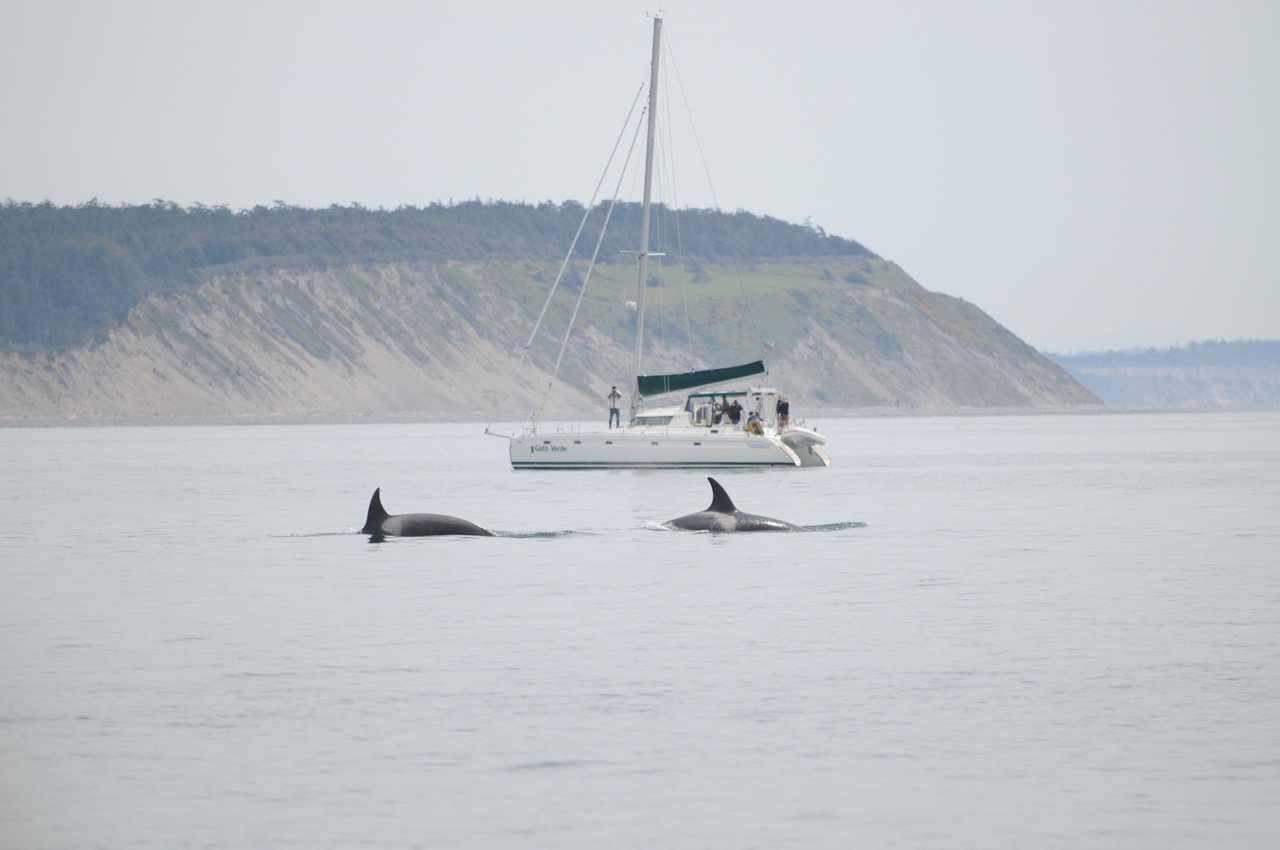
Thanks to John Boyd for snapping this great shot from the Western Prince.

Thanks to John Boyd for snapping this great shot from the Western Prince.
I have could never find a good chance to update the blog. This is most likely due to the fact that I was out at sea for two weeks and no internet connection. Also might be the fact that I have too much to do and I’m always scrounging around to finish everything. I hope everyone is getting updates on our travels and experiences through the other blogs though. We have been through quite a bit these past 2-3 weeks.
We set off on the end of April and headed out to look for the whales. Todd was a bit late picking us up that day because he had to go out to buy groceries to prepare for our two week departure. Jason also got a call from the Stranding Network about another Steller sea lion washed up on a beach on Orcas Island. We ended up departing at a very late time, but two weeks, I was looking forward to it no matter how late we left. The next day, unexpectedly, J-pod returned to San Juan Islands, after a long period of absence. Jason heard the update right when we docked on Stuart Island; my heart jolted straight away. The residents are back! I was really excited from hearing this, trying to contain myself in the middle of Todd’s sailing lecture. We did peek our heads out off of Turn Point to see if we could spot them. We actually did too! They were pretty widespread, as I could only spot two females surface a couple of times. We believed them to be foraging around that time, which was 6 pm. But the next day, they were gone. No updates left of the residents, which made us sad. The salmon runs are probably not quite here yet.
The next few days, we did not hear from Orca Network about any updates on the whales’ whereabouts. We did see quite a number of other marine mammals though, such as harbour seals, dall’s porpoises, and more. But getting lots of science goals out of the way was really great. We calibrated our hydrophones, went through a behavior exercise with Jason on the Gatito, had a couple of sailing lectures, wrapped up our final research proposals, and journal club readings. It was sort of nice that the whales did not come by during this time, because it was indeed crunch time when we had to finish up our proposals. I can recall I was one of the ones that were sleeping later than usual, with my eyes popping out of their sockets from working on the proposal for hours. We finally turned it in on Friday, after what I felt was a long process of hard work.

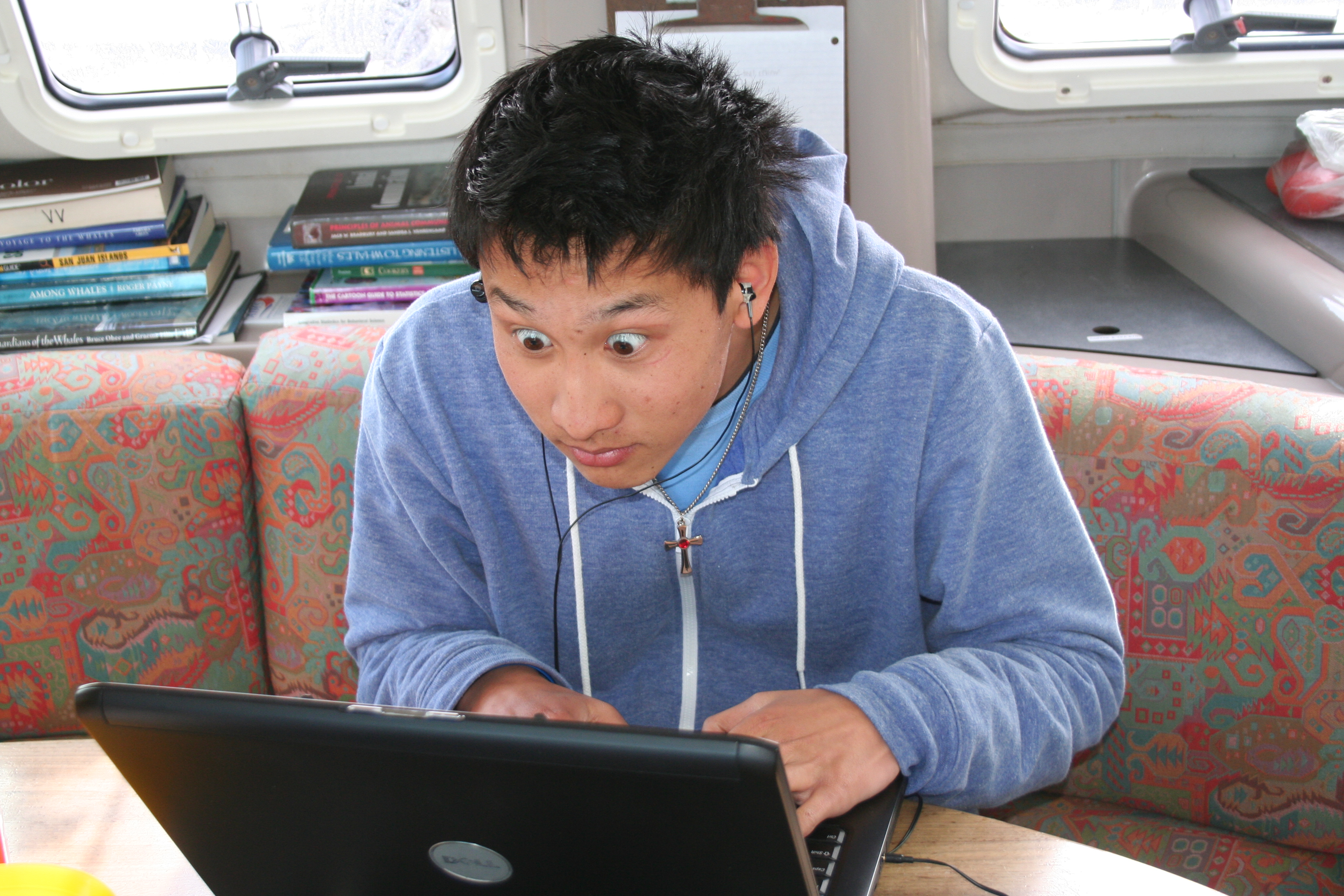
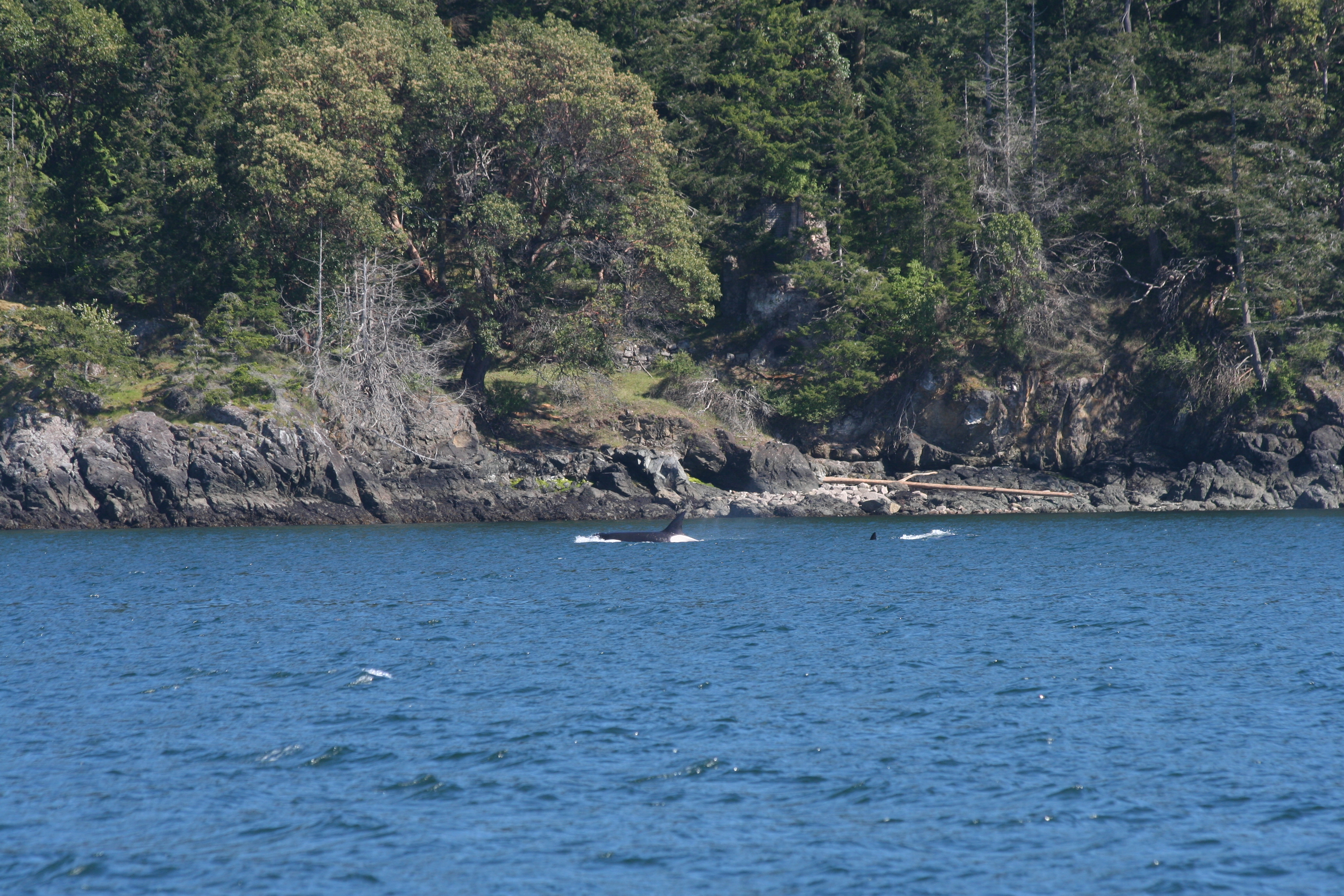
But, before turning the proposal in on Friday, transients! We were stationed out by Turn Point for almost the entire week, drifting about, waiting for the whales to show up. It was on May 7 that we finally got to see the whales. We got the text that there were two transients heading north on San Juan Channel. Perfect! We were right north of them, heading south.  In that sense, we immediately headed down towards them, in hopes to catch them on camera and film after not seeing whales for a long period of time. We motored all the way down towards Orcas and saw several boats off in the horizon. We thought that they were the whale watching fleet out there, and sure enough, they were. There must have been over eight of them surrounding the two whales. It was much more different than the time that Kathryn spotted the whales when we wanted to go to Neah Bay. We were practically the only ones following them. This made such a huge difference for us, since we had to tow the hydrophones this time to get recordings and boats kept getting in our way. It was seriously very frustrating. But we did get a great recording of what we thought of as a call around 17 minutes into the recording!
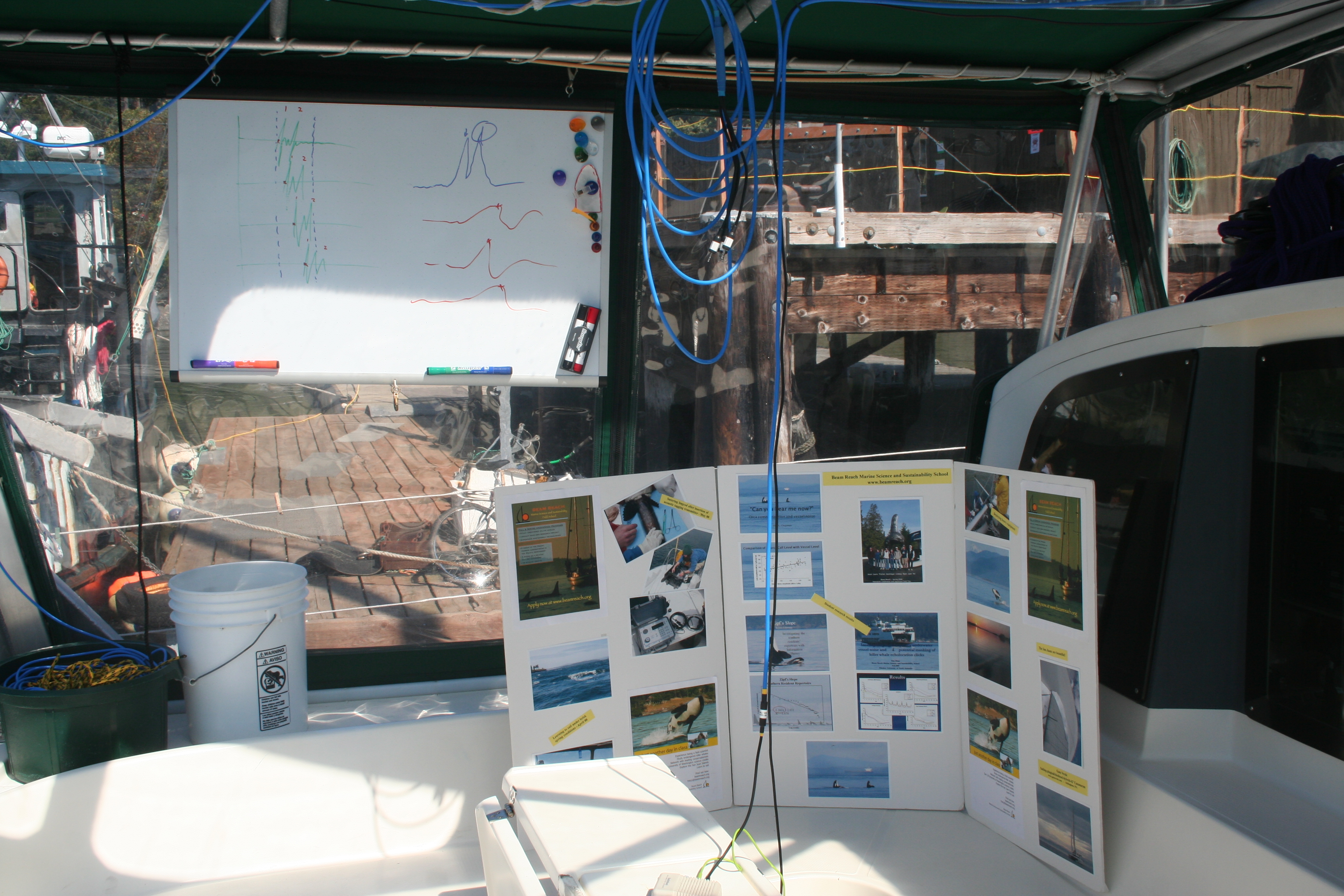
Afterwards, we sailed back to Friday Harbor Labs in preparation for the open house that was going to happen. The open house was an event in the labs where the area is open to the general public. All the students at the labs get to show off what they have been doing this whole time in the labs and demonstrate what they have learned so far. I thought that this was a great time for everyone to share their findings and interests to the public, hoping to educate them as well about the science out in the world. For their service project, Libby and Kathryn went to a walk to spread awareness about the salmon farms at Vancouver Island and Alexandra Morton was going to be there. She was one of the leaders and since it was during the exact same day as the FHL open house, Nora and I had to take over the entire chore rotations and make sure everyone was attended to during the event. The open house was a success. I loved every bit of it: the enthusiastic kids, parents that had loads of questions, and all the FHL folk that came down to take a gander at the Gato Verde. I really felt my communication skills come out during that day, since several times, Jason and Todd were occupied with another person and I would have to take over along with Nora. Even better, was the fact that it was such a nice warm day. During my break, I went over to visit the Zoobots and Kellen’s genomics class to see what they were up to. I ate some gummi worms while investigating the labs, and learned some pretty neat stuff! Vincent showed me this hermit crab that had a mutualistic relationship with a sea anemone that lived inside of the shell. Whenever the hermit crab was fed, the tentacles would pop out, and gather and food. That is just crazy! I saw scallops also flip around and swim too, rather quickly I would have to say. But all in all, it was such a great day. To top it off, we had internet and stayed another night at the labs. That meant another night of soda, showers, and comfy rest.
It was then, during the next day, that we saw two transients again. We crossed the Canadian border and found two whales being followed by about 8 vessels once more. We were at first very far out so it was difficult to see them. I had the camera for the first time and it was hard for me to get shots of them since we were facing right towards the sun. I tried my very best. This time though, it was much more exciting than the day before. We got to be able to see them act quite strangely. For one, they started heading towards a boat and not going away from it. We thought that there was perhaps a seal or something heading underneath the boat that the orcas were that interested. But for a solid 10 minutes, it would not leave the vicinity of the boat. The whales kept bobbing up and down around the Prince of Whales and stayed there for a long time. They did the exact same thing to Eagle Wing. What was most memorable was when we saw lots of great splashes and some interaction between the two whales. And…what was most intriguing was that we thought we saw a bit of pink flash on the surface of the water. Sea snake perhaps? We all shouted and exclaimed in excitement over the orcas as they were just a spectacular sight to see, yet again.
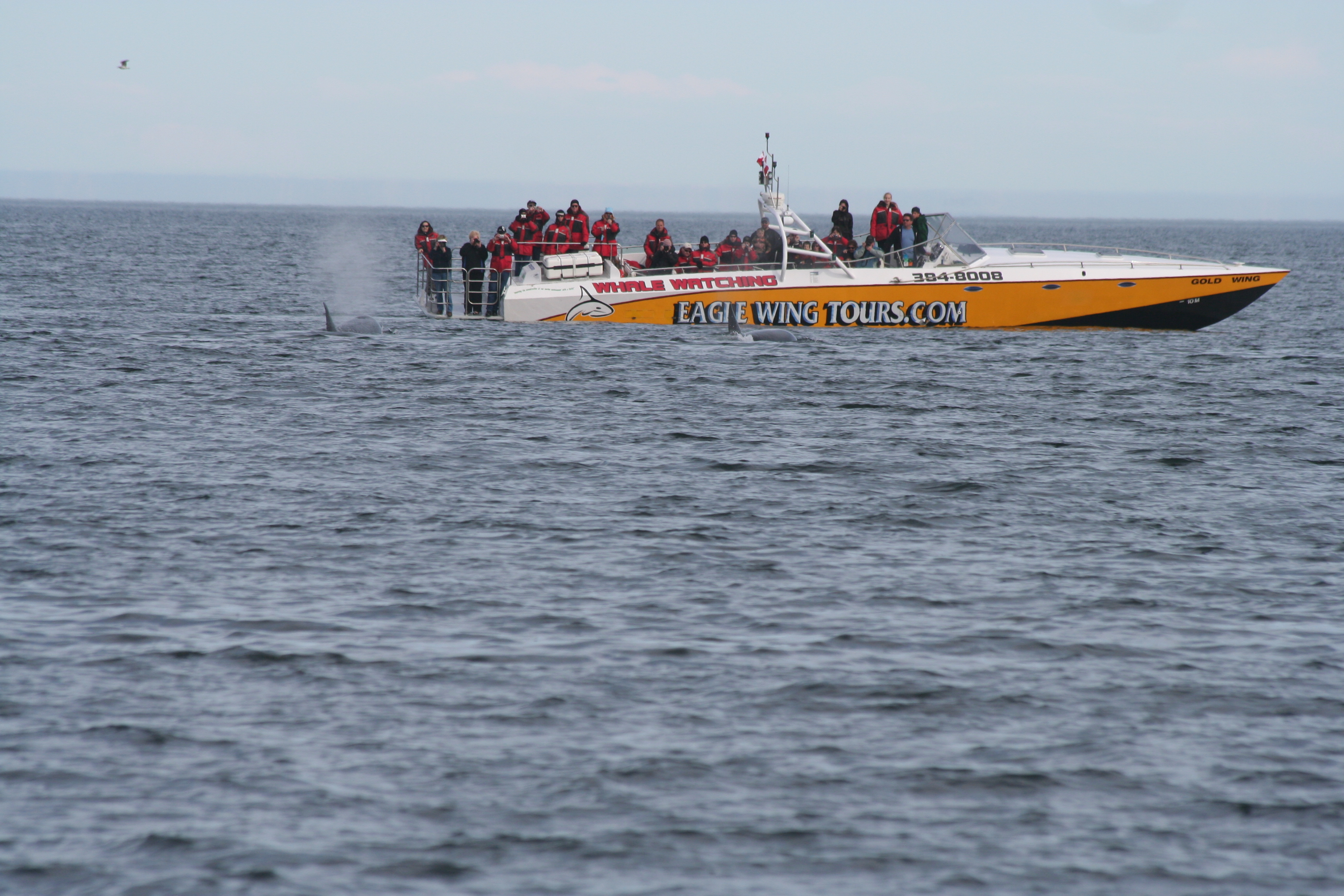
I felt as if these two weeks zoomed by so quickly, that I did not even notice. Time never waits for anyone does it? But we did accomplish so much, and I have felt that I have grown so much since the very first day of Beam Reach. I am constantly learning, being the youngest and only teen of the group. I have a long way to go but I aspire to end with lifetime lessons and exuberant experiences that I can share to my folks back at home.
Read MoreI got blisters on my fingers… and by fingers, I mean toes. My feet have never been so beat up in my entire life, but I can safely say that I sacrificed their happiness for a worthy cause. On Saturday, Libby and I walked from the marina in Sidney, British Columbia all the way to the parliament building in Victoria.
Libby walking
We walked approximately 18 miles with hundreds of other people as part of the Get Out Migration, a march to raise awareness about open-pen fish farms led by a woman named Alexandra Morton. She has lived in the Broughton Archipelago for more than twenty years, researching the Northern resident killer whale community and, more recently, the effects of open-pen fish farms on the wild salmon populations. After ten years of working to eradicate Norwegian fish farms from the area, Alexandra organized a three-week walk from the Northernmost to Southernmost tip of Vancouver Island to spread the word about their negative impact on local communities and ecosystems. During a trip to Vancouver Island a few years ago, my father bought me Alexandra’s book, Listening to Whales. I did not read it until last summer, when I was living at a remote research station off the cost of Maine. Her narrative about studying killer whales and her depiction of life as a field scientist was formative for me – since then, I have dreamed of meeting Alexandra Morton. When I heard that she was due to walk into Victoria while I was right across the water, I decided then and there that I had to walk with her. After much logistical planning, Libby and I pinned down a ride and set out for Sidney. Because we had to clear customs, we missed the start of the walk at 8 am, so the beginning of our journey was fairly rushed. Walking briskly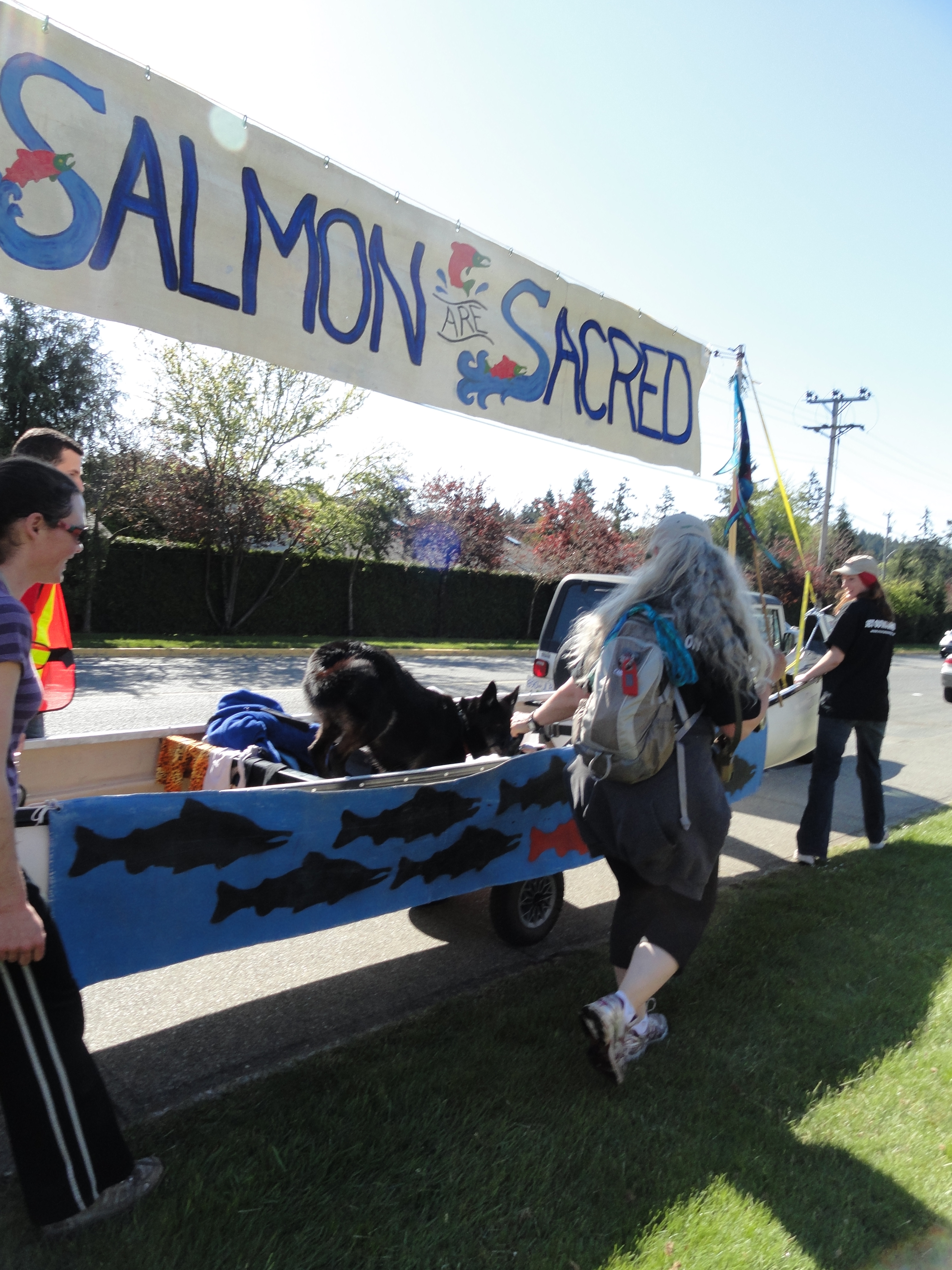 through the Sidney suburbs without any sight of Alexandra and her entourage, Libby and I started to wonder if we’d be walking all the way to Victoria alone. Just as we were beginning to contemplate hitchhiking, a car pulled up beside us. “Hey, are you guys trying to catch up to the migration?â€Â A young woman named Megan, who turned out to be none other than Alex Morton’s assistant, opened her car door and ushered us inside. “I know migrators when I see them!†she said. Five minutes later, we came upon a train of cars, signaling the back of the migration pack. A woman with long, wispy white hair came into view, and my eyes widened. I was way too sweaty and frazzled to be thrust into the presence of Alexandra Morton already! Libby and I thanked Megan for saving us many uncomfortable miles of walking and started down the road, trailing Alex’s heels and wondering what to do next. Turns out my body is not too keen on the idea of walking 18 miles, so for the majority of our migration to Victoria, I was solely focused on putting one foot in front of the other. Because of this, I did not get the heart-to-heart with Alex I had imagined, but simply being in her presence and taking part in this massive culmination of her efforts was enough for me. After a long day of trekking down Highway 17, we entered Victoria, greeted by a huge group of supporters. The final 1 km walk to the parliament building was spectacular – thousands of people flooded the streets, marching to the beat of the First Nations’ drum and shouting to spectators.
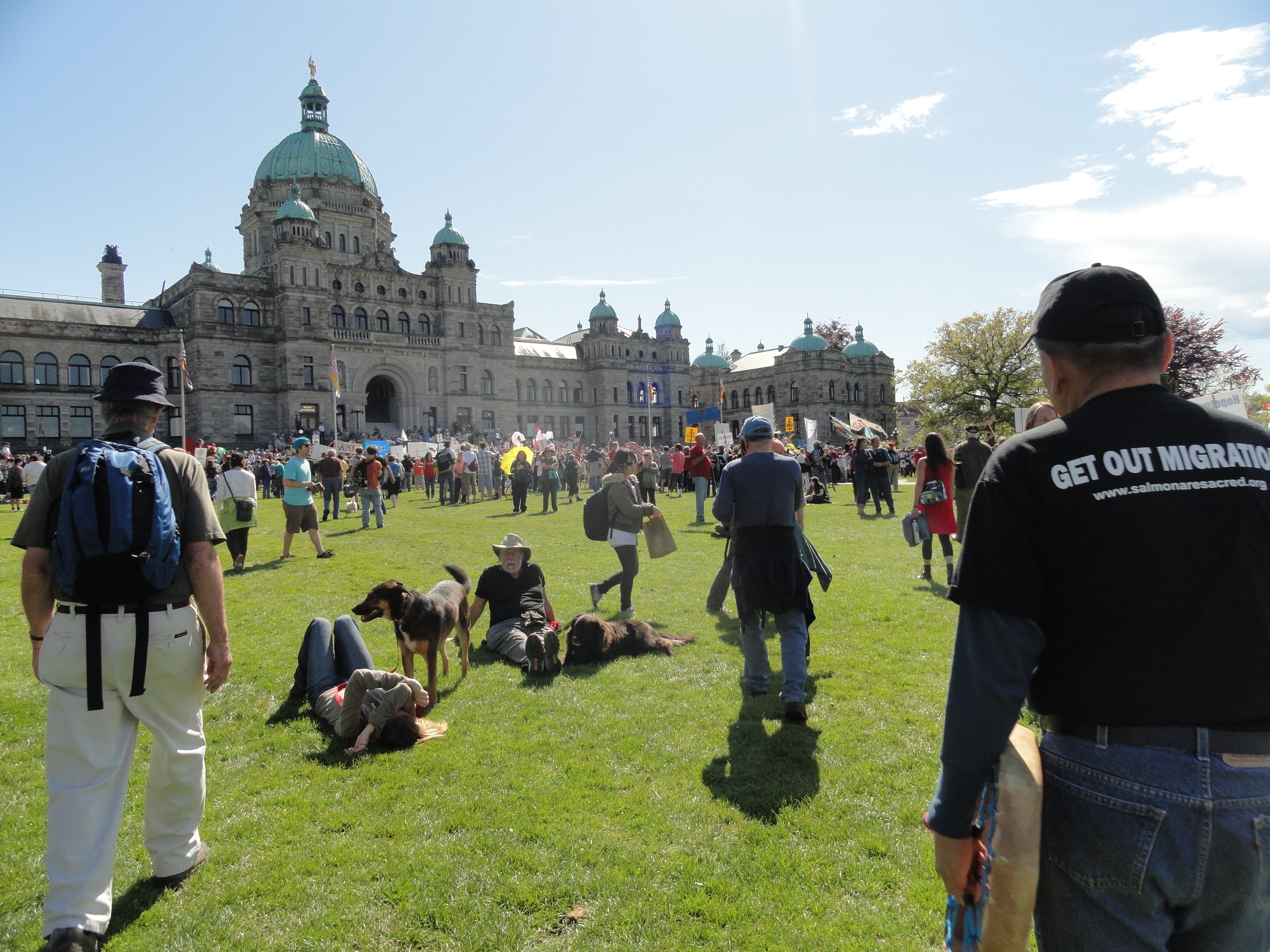
At the Parliament Building
It became evident to me that this is an issue that affects all of British Columbia’s citizens in different ways, but it is undeniable that the effects are uniformly negative. Libby and I collapsed on the parliament building lawn, ready to yank our shoes off and douse ourselves with cold water. The wide range of speakers at the final migration event, from First Nations chiefs to commercial fishermen, spoke of the cross-cultural concerns fish farms have raised. There were so many people crammed onto the lawn that we could not even see the stage, but it was enough just to be able to sit and listen. Alexandra was the last to speak; I had not lost all hope of meeting her, so I tried to keep one eye on her as she snaked back through the crowd amidst roaring applause. Libby pointed. “There she is!â€Â We knew this was the last chance we would get, so we pushed forward until we were standing right in front of her. As this was the end of Alex’s very long journey, I didn’t want to goad her into taking a photo with me or signing my book. I just wanted to say hello, so that’s what I did. Libby somehow managed to snap a candid photo of this moment (she’s amazing!), and I am so glad she did. Like I said, the blisters were well worth the pain.

To learn more about the Get Out Migration, click here
Read More4/29
Today was our departure for the first two-week boat excursion. Todd decided that, since he had access to Costco, he would do most of the re-provisioning which meant that his estimated time of arrival was 2:30 instead of 12:00 meaning a leisurely morning for us. At about 11:30 Jason called to tell us that there was another beached sea lion that he was going to retrieve if anyone wanted to go with. He arrived at about 12 and he and Libby left shortly there after to get the sea lion. We found out that the seal had died from blunt force trauma, probably caused by Transient orca practicing hunting.
Horace Kathryn and I stayed behind to bring the equipment down to the Gato Verde when it arrived. Libby called around 12:30 to tell us that the office had said that we needed to be out of S1 by 1:00. We panicked, stored our lunch in the kitchen, ran to S1 and hauled everything down to Lab 8 where the Beam Reach office is.
Afterword Horace went to the computer lab and Kathryn and I returned to the dining haul to finish our lunch. We spent the next little while looking up sea shanties that we wanted to learn. After Todd arrived and we got everything on board we decided to anchor at Jones Island again as we really like it there.
4/30
We decided to try and find the Southern Residents by sailing down the west side of San Juan Island, which we usually just call ‘the west side’. It was a beautiful day but by the time we reached Haro Strait, because the currents and wind were fighting each other, the seas were a bit uncomfortable. The sailing was amazing though and we even reached about 13 knots with sails only.
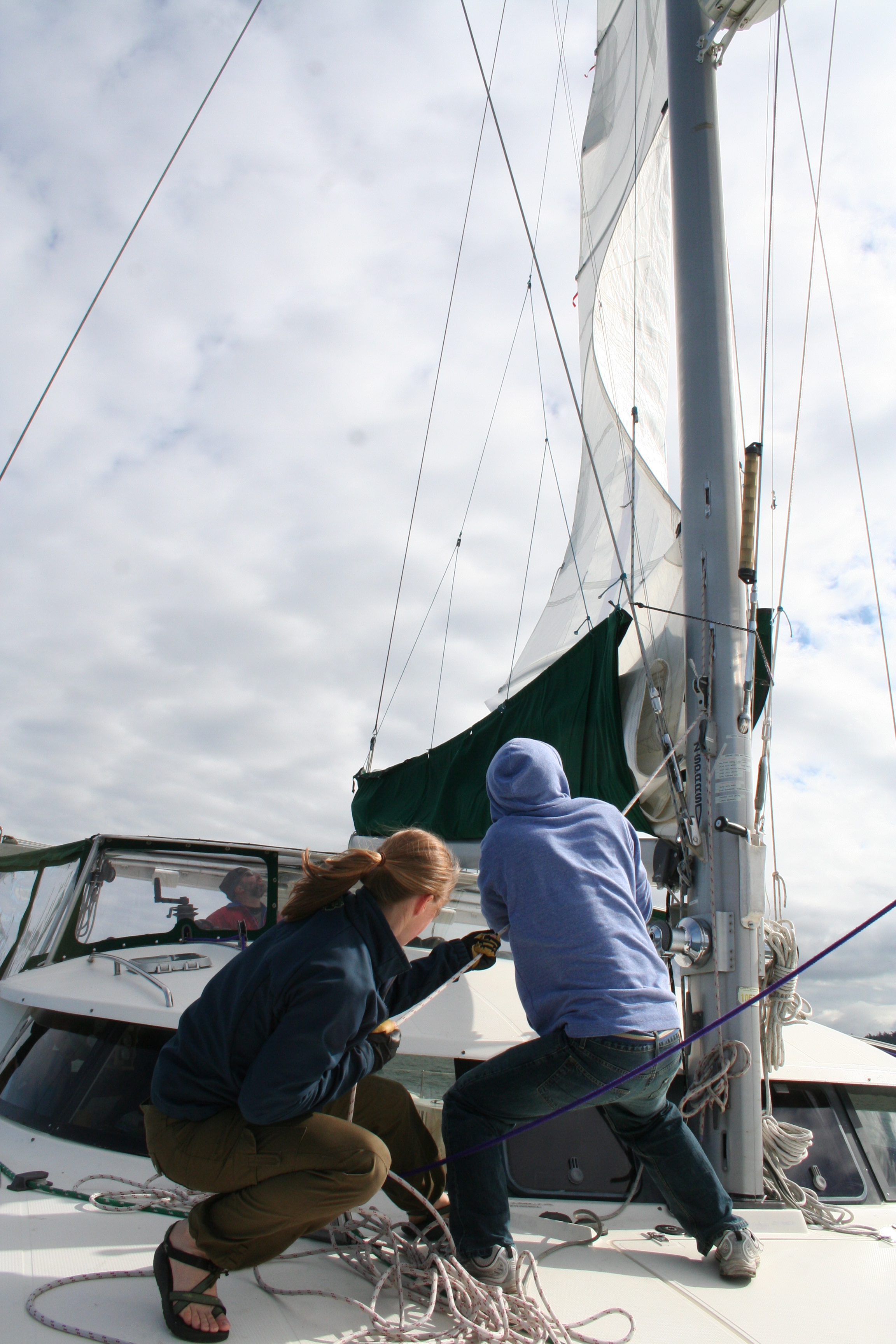
Libby and Horace raising the Mainsail
Unfortunately I was on lunch once again and due to the size of the waves, some even crashing over the bow, I got pretty seasick. Luckily I didn’t throw up but it was close a few times. We finally made it to calmer seas and I fell asleep. I woke up for our docking, which was at a place called Prevost Harbor on the North side of Stuart Island. It is very pretty and is densely forested, but to get to the land heads you have to hike up a very steep hill.
Todd taught us some theory about sailing and shortly afterward we got a call from Scott telling us that J pod had been spotted at Lime Kiln headed North an hour and half prior. We went back out to sea to see if we could spot them. At the point we saw what looked like a white line of breaking waves from the point across the middle of the ocean. It turned out to be the convergent zones of major upwelling areas caused by the strong tides moving over the rocks on the sea floor around the point. There was a massive amount of gulls there all feeding on the fish that were getting pushed up.
Shortly after crossing that area I spotted a dorsal fin! We had found the whales. We stayed out there for about 30 minuets, but it was getting late and the winds and currents were pretty bad. We didn’t get close enough for any ID photos but Jason thought that they were Residents! We are all really excited. We came back, had a very yummy soup and later that evening Jason made brownies and I made my new yummy peanut butter cookies!
5/1
This morning we departed from Prevost Harbor full of thoughts of whales. We headed out to the West side of San Juan Island hoping to catch them there. The weather was amazing but alas we couldn’t see any whales. We dropped # 4 of Blueberry (the blue 4 hydrophone array) from the stern of the boat to listen for them and though we heard a bunch of boats, still no whales.
After a few hours we heard that they had been spotted near Anacortes heading down Rosario Strait. They were too far for us to try and catch up to! We decided, after much deliberation, that we should go with the statistics and stay in Snug Harbor tonight betting that the Residents will hang around the West side tomorrow.
On our way back up to Snug we decided to calibrate the hydrophones. We tied all 6 hydrophones to a pole and deployed them off of the back of the Gato Verde while we deployed the speaker off of the front. Â Kathryn and I spent the entire time holding the 4 hydrophones and two 8lb. weights in place away from the boat.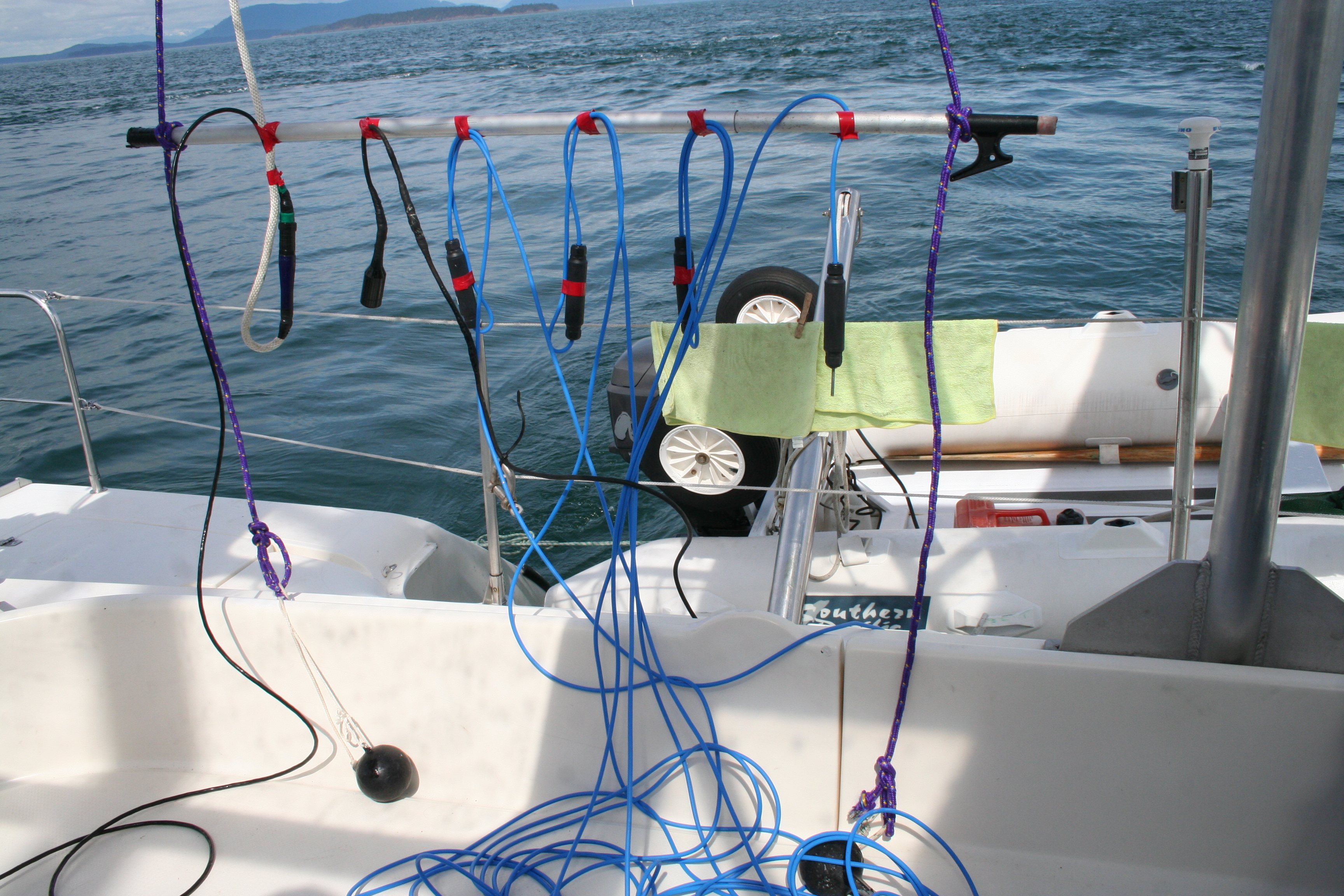
When we were finally done we also decided to try and find the lost Lime Kiln hydrophone again with the newly repaired SplashCam. This time we decided to deploy it from the bow of the Gato Verde. After getting it ready to deploy Horace and I waited on the trampoline for the go signal. We waited and waited and finally. . . it started to rain. The camera wasn’t working!
We packed everything back up and by the time we had passed Lime Kiln and put everything but the camera away Jason had fixed the camera. It was a great example of Murphy’s Law!
5/2
Today was a bit choppy. We didn’t hear anything about where the whales might be, much to our disappointment, so we decided to head down the West side. There was a lot of wind so we got to do a bit more sailing.
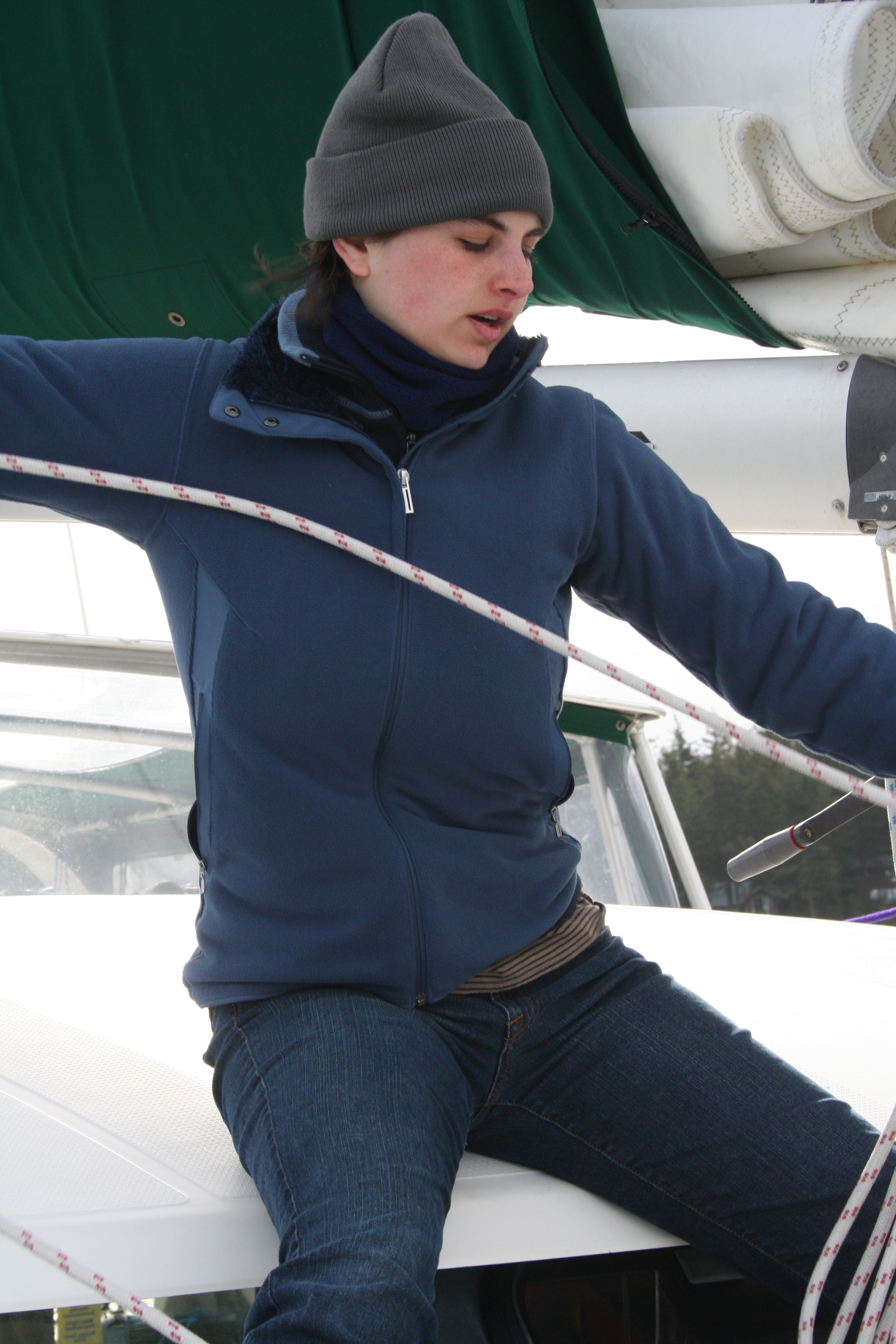
Coiling the main halyard
We didn’t see any whales and so shortly before lunch we decided to go to Mackey Harbor on Lopez Island because the tides wouldn’t shift for another 2 hours and drifting was beginning to become less and less pleasant. We pulled into the harbor and learned how to take the data from the calibration recordings and calibrate the hydrophones. It was a bit confusing but in the end I think I got it.
You can’t just look at the recordings and figure it out. You have to have a hydrophone with a built in tone creator that can create a tone that is a certain known amplitude. Then you have to look at another recording from the same hydrophone and, using the known tone, figure out what the received level of sound was in that recording. Then you use that known sound to calibrate the other hydrophones by looking at the same time on all of the recordings. Long and involved I know.
Amazingly enough hydrophones that can create an internal tone of known amplitude are pretty few and far between, outside of the Navy.
Around 4:00 we decided to motor back up to Snug Harbor because the weather on Monday is supposed to have wind up to 35 knots, which we can’t go out in, and we need to be in Snug on Tuesday to pick up Val!
5/3
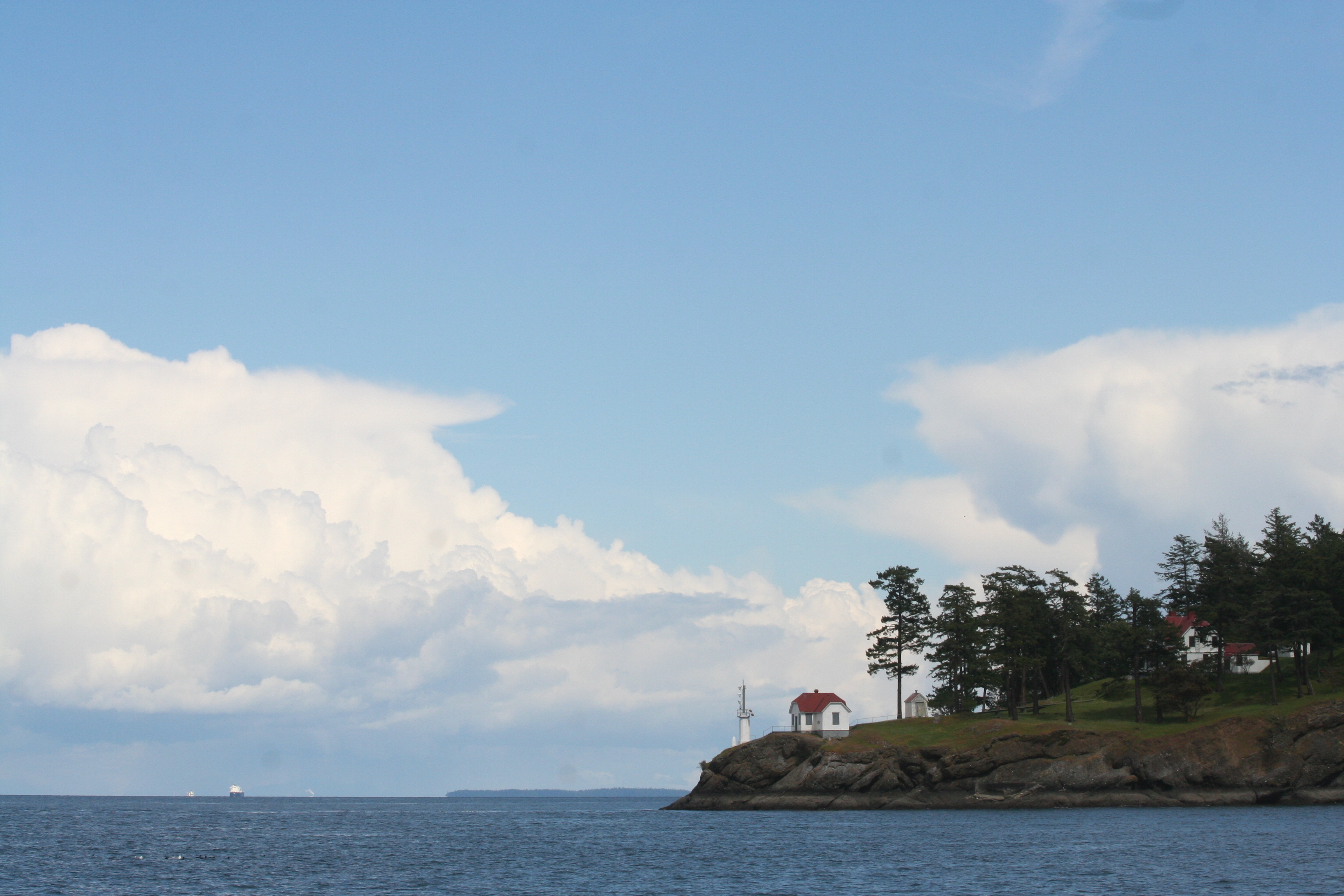 The weather was amazing today. It was completely sunny till about 6:00 but the entire day it was blowing from about 20-34 knots in Haro Strait. So needless to day we didn’t leave Snug Harbor. We spend the day working on our various projects as well as doing our behavior exercise, which basically consisted of Jason in the dingy writing behavior states on the whiteboard and having us record the information on PDAs. It was incredibly amusing, even though we thought the PDAs were broken!
After dinner we got to watch an episode of the show produced by Jacques Cousteau, a true explorer. It was a relaxing and enjoyable day.
5/4
Val came aboard this morning!
The weather today was nice. It was sunny and warm with only a light breeze. We spent the day drifting on the tides staying North of San Juan Island.
We saw a few porpoises foraging in the convergent zone at Turn Point and even saw them jump out of the water and chase after the fish at the surface. It was pretty wild especially since I usually think of porpoises as ‘the dorsal fins that appear and disappear rapidly that don’t do much else’.
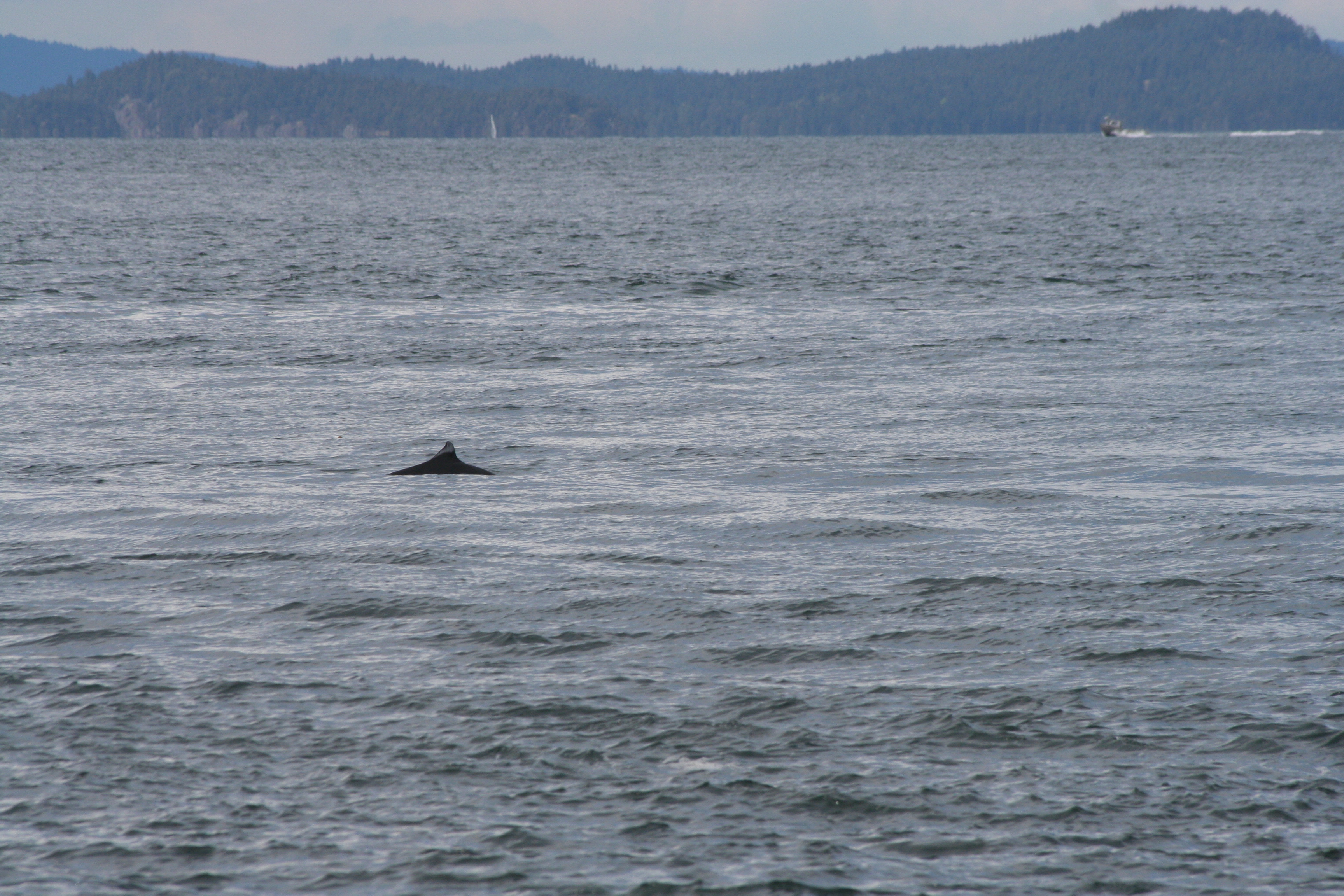
Porpoise dorsal fin
A while later, around 4:00, I saw some lightning strike land on the Vancouver side so we decided to head in to port. We stayed at Reid Harbor, which is the harbor across from Prevost Harbor on Stuart Island. This side too had a major hill leading to the bathroom. On Stuart Island you have to EARN the use of the bathrooms.
Later that evening, we looked over our calibration exercise and found out that while blueberry is calibrated within expectable boundaries Libby’s hydrophone needs be re-calibrated.
5/5
Today we decided we needed to to pump out our holding tank (sewage) and conveniently enough there was a barge to do so in Reid harbor. We went over and started the process then realized that the pump wasn’t pumping, so we had to ditch the barge and go to Roche Harbor instead.
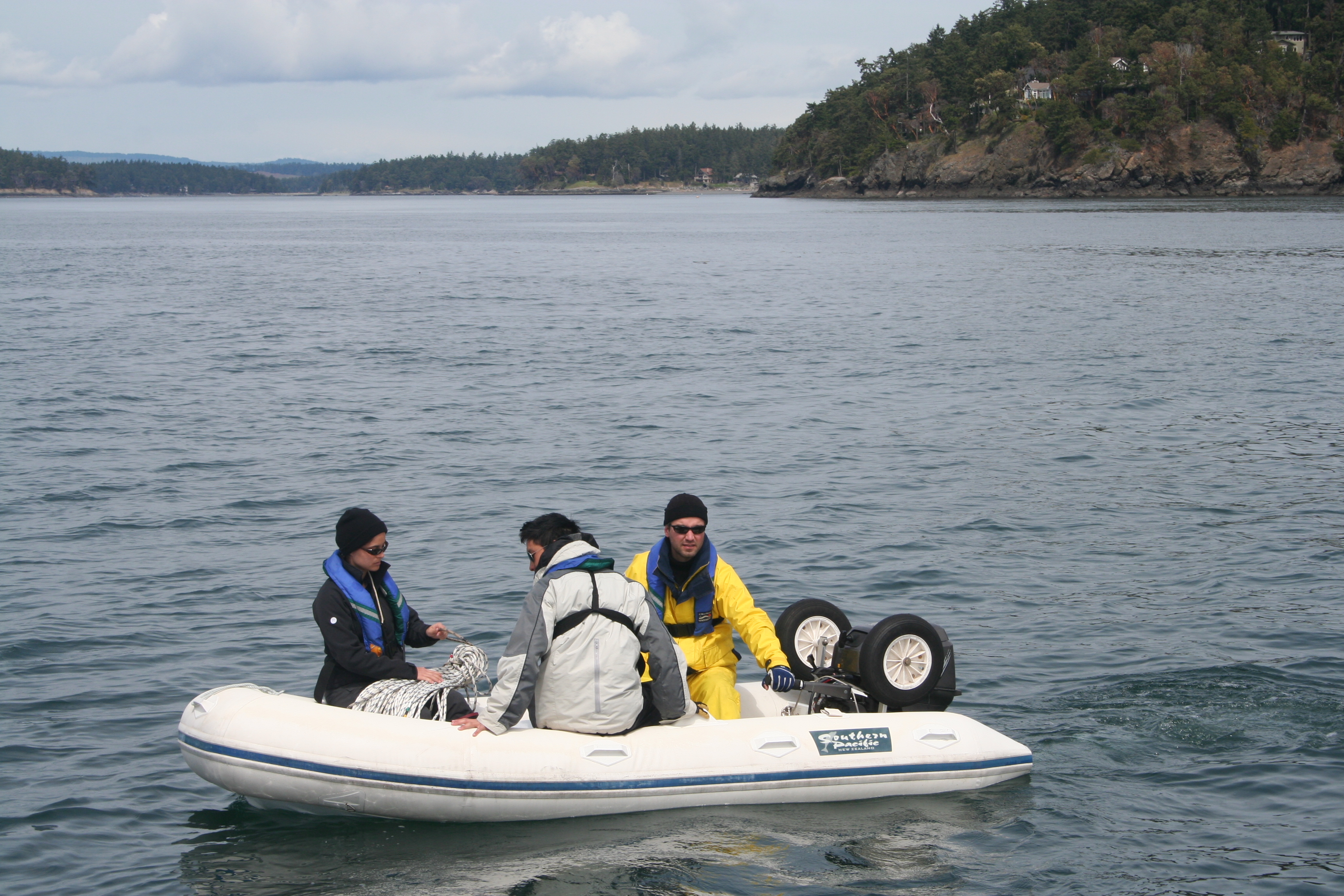
Kathryn, Jason and Horace in the Gatito
While there we pumped out, Val bought propane and Jason bought milk. Very exciting I know.
We head out to drift along the west side of San Juan Island to try and listen for the whales, now that we had an easy deployment hydrophone that Jason put below the Gato Verde that morning. We didn’t hear anything of note, but the weather was nice so we decided to revisit the light bulb popping exercise.
The first one at 100m from the boat went off spectacularly! The imploding light bulbs sound a little like gunshots. It was amazing to listen to! After that more and more problems just kept coming up.
During the exercise I was on the range finder, recording the distance between the Gato Verde and Gatito, as well as the radio. I have to say I am not the most adept at radio communication. It is kind of odd how flustered I got calling on the radio, it is a little like stage fright. I would say the most convoluted and confusing things because my mind blanked and I couldn’t think of the appropriate word. It was fun though. After that we decided to head back to Snug Harbor for the night.
5/6
We decided (again) to drift around North of San Juan Island and, once again, saw no whales! We think that the Residents have gone back out to sea for a while; apparently this happened last year as well, though not quite as late in the year.
Jason and Val gave us fake data sets today so we could see how we are going to analyze it and what data we really needed to collect. It turns out that my data sheet is completely useless and I will have to make a new one. I actually need to pay attention to fewer things, but that means that my current data sheet is unsuitable.
 My hypotheses also have undergone serious reduction and refinement. I still have three hypotheses but the three I have now were actually only one of my original three.
Though organizing and analyzing the data was exceedingly useful, I spent the day trying not to destroy my computer while doing so in Excel. I am very aggravated with Excel right now and I wish I could easily give pc people numbers documents! I finally figured it out, with a lot of help from both Jason and Val, and have completed my fake data set analysis. Now we are sitting in Westcott Bay working on our proposals which are due on Friday.
Oh, we also saw some harbor seals that we think were mating, but were not sure they could just have been splashing around a bit while playing.
5/7
 Today after breakfast, since we were in a quiet harbor, decided to recalibrate Libby’s hydrophone. It went well, but this time since we knew that there were harbor seals in the bay we decided to ramp up the tone amplitude slowly so the seals could move away from the sound if it bothered them.
After we headed out we decided to go north and drift hoping the whales would be there. Our proposal is due tonight and tomorrow is the open house so we will be docking at the labs.
While we were heading out north of San Juan Island we decided to have watches for marine mammals. I was on the bow and saw a number of porpoises as well as a sea lion.
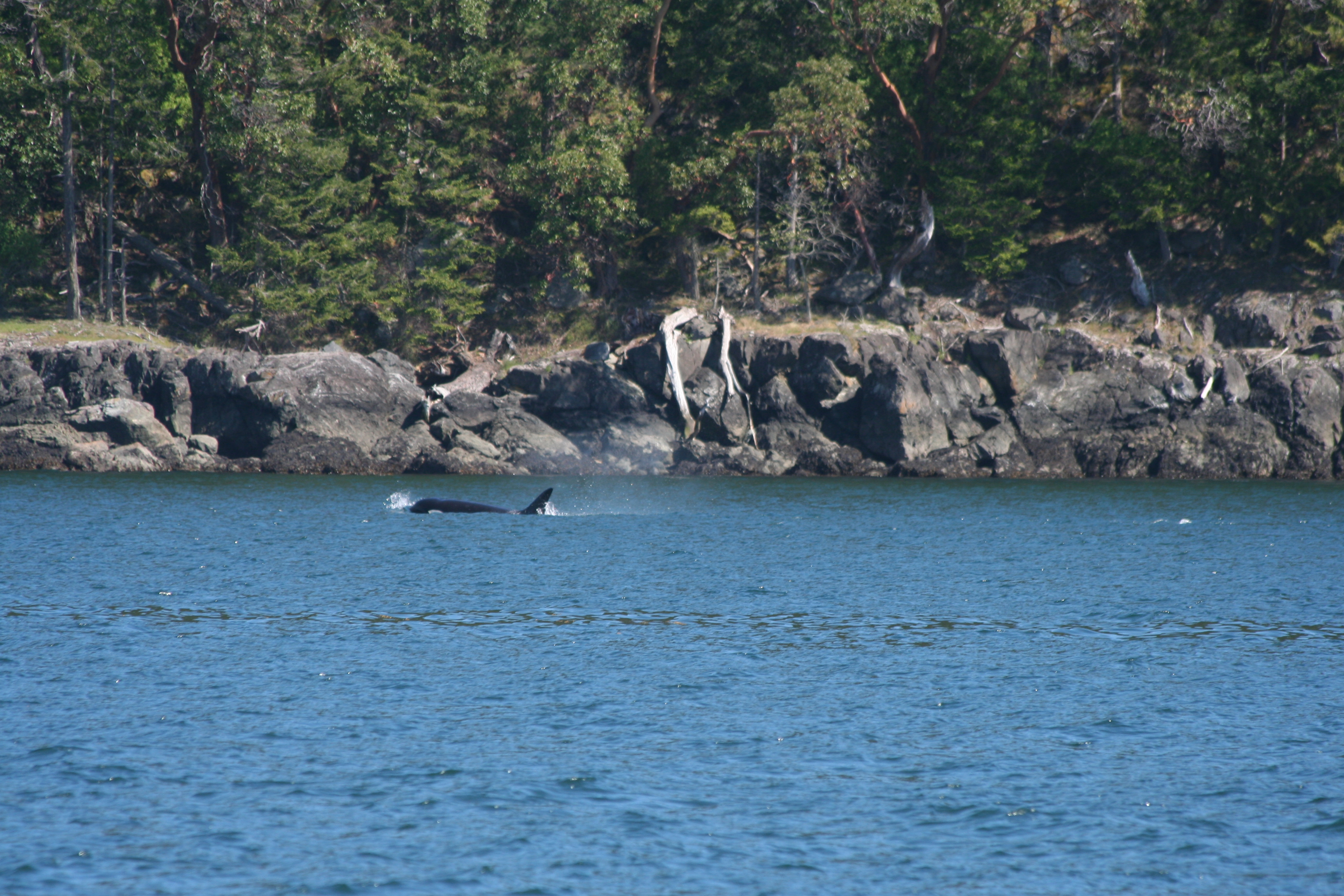 At about 2:30 we were informed that there were a few Transients only a half hour from where we were so we decided to go check it out. We motored up and found them! It was awesome. There was one female and one adolescent male. We deployed blueberry and managed to hear one call! Our first live acoustic recording! They were socializing and milling for a while before they decided to leave.
There was one very oblivious boater that motored at high speed right over where they were and only slowed down well after they passed them. This, for those who don’t know, is very much against the law as orca are an endangered species.
After that we decided to motor back to the labs to take showers and do some laundry!
 Be joyous
Mitchell Bay to Wescott Bay
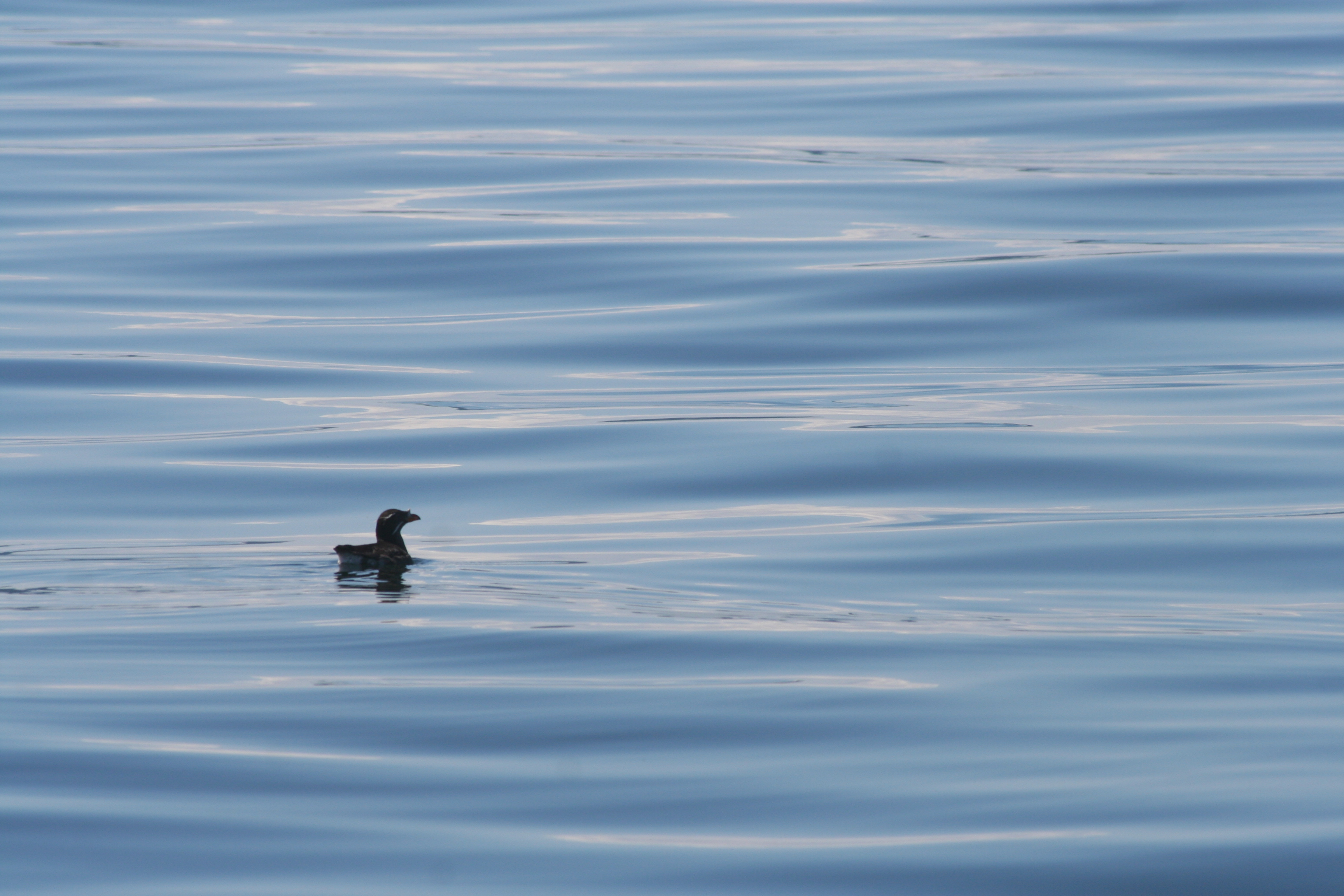
The beautiful sun was shining and the tides were cooperative today for a lovely day on the water. Unfortunately, the whales did not agree and stayed away from the Strait (and everywhere in the Northern inland waters) again today. I am crossing my fingers that they make an exciting appearance tomorrow morning directly off our bow sprit. Other animals seemed to enjoy the day, and we were able to watch a number of porpoises play in turbulent waters just off Turn point, some harbor seals napping at high tide on a reef too flooded to be relaxing, and various birds surrounding us all day. We watched cormorants eat skinny silver fish (and thought in awe of the research that gathers data on the species that a bird eats) and seagulls noisily chase each other down while the rhinocerous auklets were focused on diving to the depths. The group had great discussions about the complicated methods in behavioral science and hashed out details for when the whales arrive. With our hearts full of laughter and sunshine, we set off to Wescott Bay to watch the harbor seals play and listen to the orchestra of birds just off our bow. And of course, to fill up on fried rice.
Read MoreReid Harbor to Snug Harbor
The weather today started out cold but became very nice. We tried to pump out at the barge in Reid Harbor, but it wasn’t working so we decided to go to Roche Harbor instead. Before we left, Jason got on the dingy and fed the plug end of the single hydrophone up through the drain for the recycling area so we have an easy deployment of a hydrophone. At Roche we pumped put, filled the propane tank and bought milk, and then were on our way. We drifted down the west side of San Juan Island till about 4:00 when we turned around so we sould make it back to Snug in a reasonable time. While we were drifting we decided to re-try the lightbulb implosion experiment and had much more sucess this time. There were no waves or dodging ships. The 100m test went of beautifuly. The imploding light bulbs made a great sound, kind of like a gunshot. The first snag came on the next test at 200m. The recorders heard 6 sounds and stopped the recording but two of the sounds were taps where the smasher got stuck on the lightbulbs and shortly after stopping the recording we heard a great implosion. The next test was another at 200m and this one set the tone for the rest. It didn’t go as well but good data came from it. All three tests at 400m had problems, but between the three there was usable data. After we pulled up we headed back to Snug Harbor for the night.
Read MoreMitchell Bay to Reid Harbor
Finally the winds died down enough for us to venture forth into Haro Strait again to look for whales and conduct other research. We enjoyed some breezes in the morning and rode the flood time up to Turn Point on Stuart Island where we positioned ourselves to watch and listen for killer whales. Val came aboard this morning in Snug Harbor which allowed us to have mentor meetings with both Val and Jason and all to iron out some more of the wrinkles in research methods. Science always makes its best progress when multiple minds focus on a problem and discuss the matter at hand. During the day we were graced with sightings of a number of porpoises, including two different sightings of around 3 Dall’s porpoise in the area of Turn Point. This was a real treat as we have not seen many in these waters during the last several years. After a wonderful dinner at the dock in Reid Harbor we revisited our calibration exercise to make sure we all understood the process and decide which the most appropriate calibration factors to use were. Nothing like an invigorating discussion of logarithmic decibel scales around the lounge of the Gato Verde to end off the day.
Read MoreMitchell Bay to Mitchell Bay
We bunkered down in snug harbor today and didn’t even bother to stick our noses out into the Strait. The small craft advisory and warnings of gusts up to 60 mph kept us away and content today. The sun was shining although the wind was blowing, and we were able to avoid all sea-sickness by avoiding everything other than our lovely harbor. We discussed various methods of taking data and send Jason out in La Gatita to pretend to be whales behaving in several manners while we took recordings.It was quite entertaining to see the dingy bouncing around in the harbor and catching enough wind to almost send Jason into the brisk water. Luckily, he made it back just in time to start dinner. Being the responsible one on board, he was sure to serve broccoli, beets, and polenta-lasagna. Oh, we did spot a harbor seal taking a few breaths and resting at the surface just a few meters from the bow. So there’s the reported science from the day. Other than that, we worked on papers and read several scientific articles between the five of us. I think that if you combined all of the knowledge that our brains host, you could form a small acoustic and marine mammal behavioral library.
Read MoreMitchell Bay to Mitchell Bay
We headed out towards the south side of the island in hopes of finding J pod. Not much wildlife sightings today, other than some seagulls. No updates on the phone or email on sightings of J pod either, which was sad for us to hear. We had a general prediction that since they finally came back into the area, they are still looking for the fish to eat. It is like moving back home after college life in the dormitories: the whales have to resettle into the area. We anchored at Mackeye Harbor on Lopez Island to have a quick lunch consisting of grilled cheese sandwiches. At Mackeye, we finished our calibration exercise using the data that we got from the hydrophone calibration yesterday. Afterwards, we headed back up to Mitchell Bay, spotting about 3 seals (unidentified) poking their heads out of the waters. At Mitchell (Snug Harbor), we then enjoyed at nice dinner cooked up by Jason and Nora: chile. Then moved on towards journal club to finish off the night.
Read More


 Twitter
 LinkedIn
 Facebook