Martha Baskin of Green Acre Radio (on KBCS) put together a story about “Orcafest 2010,” an event welcoming the southern resident killer whales back to Puget Sound this winter, organized by The Whale Trail and Killer Whale Tales. The piece features music and explanations from Duwamish tribal members, and quotes about the orcas from Donna Sandstrom, Darcie Larson, Scott Veirs, and Brad Hanson.
In support of a collaborative study of how fish use the San Juan Archipelago (headed by the University of Washington and funded through the Salmon Recovery Board), the fall Beam Reach students deployed a new fish tag receiver at the mouth of False Bay. The wind and wave conditions were worsening, ultimately reaching 30 knots and 4′ waves in Haro Strait, but we managed to launch the dinghy safely in the lee of the point that bounds the southern side of the Bay.
Waves were moderate enough (1-2′) at mouth of False Bay that we were able to deploy a 2nd Vemco VR2 receiver (SN 101006) with the dinghy. Waves were too rough to get ashore to secure a tether, so we deployed two pier blocks connected with ~100′ of crab pot line about 20m WSW of the highest point on the islet.
The inshore block is in about 4-6′ of water and was deployed at 11:29 at 48 28.785, 123 04.406 (WP 265) after being tied via the galvanized ring to the 100′ connector with a rewoven figure-8 knot with a double stopper safety. Garrett thought the inshore block may have been in a depression between the main islet and a subtidal boulder. The connector line was deployed more or less linearly through the abundant kelp and then tied to the bottom loop of the offshore block. The offshore block and mooring was lowered with a slip line (attached to the uppermost loop, above crab pot float) in ~25′ of water at 11:37 at 48 28.774, 123 04.417 (WP 266), still well within the kelp forest. Water depth was measured by halving the total slip line length (30′) and adding it to the mooring height (~3m).
Mooring details can be ascertained from the photos, but the spacing between block and receiver was about 1.5m and the space between the receiver and the float was about 1m. Both blocks were fixed with crab pot line run through hole with double figure-8 knots, each secured with a double stopper knot.
Double pier-block mooring ready for deployment
We will have to return at a lower tide and in calmer conditions to again search for the shore tether used in the previous deployment. With luck, a snorkel or short SCUBA dive will lead to the recovery of the previously deployed receiver (SN 100910 at 48 28.748, 123 04.411). There isn’t much hope, however, for using a grapnel in that kelp forest!
The side of the False Bay islet where the mooring was deployed
This Sunday (10/10/10) Beam Reach will be joining thousands of other 350.org activists around the globe to do something about global warming. If you’d like to help reduce the concentration of carbon dioxide in the atmosphere from its current level, 390 parts per million (ppm), back down to what scientists say is a safe limit (350 ppm), then use this map to find a local event that interests you.
If you can’t find an inspiring action to join this weekend, we recommend that you use this cool website to make your home more efficient. Not only does the site provide a prioritized list of actions you can take to reduce your carbon footprint, but also it shows you how you can save money through conservation. It turns out green is gold!
We who live in Washington State have a special obligation to reduce our energy use. Not only do many of us contribute to global warming by burning natural gas or fuel oil to get through the cold months, but our electricity use is directly impacting the hunger level of one of our most cherished regional icons: the killer whale. You might think that because Washington Public Utility Districts get 82% of our electricity from hydropower, that we’re pioneers of sustainable energy use in America.
The problem is that we’ve recently learned that our local orcas love eating chinook salmon, particularly the big fish that return to the Columbia and Fraser Rivers. Unfortunately, the same dams that provide our power are preventing the recovery of chinook populations on the Columbia and Snake Rivers. Reducing our energy use in Washington is a direct way to allow more water to be spilled over dams in the short term (increasing smolt survival) and more dams to be removed in the long term (giving adult salmon easier access to pristine habitat). With plenty of salmon to power them through the winter, perhaps our orcas could recover from their current ~85 animals to their historic 150, bringing the combined (southern and northern) resident killer whale population to 350 itself!
On land at Beam Reach headquarters in Seattle, we’re always humbled when the students at sea report their water and energy use levels. Their typical daily water usage is only 2.5 gallons/person/day! In comparison, in our typical residential house we use 40 gallons/person/day.  All energy on the Beam Reach boat comes from biodiesel, and the students’ usage is about 0.5 gallons/person/day.
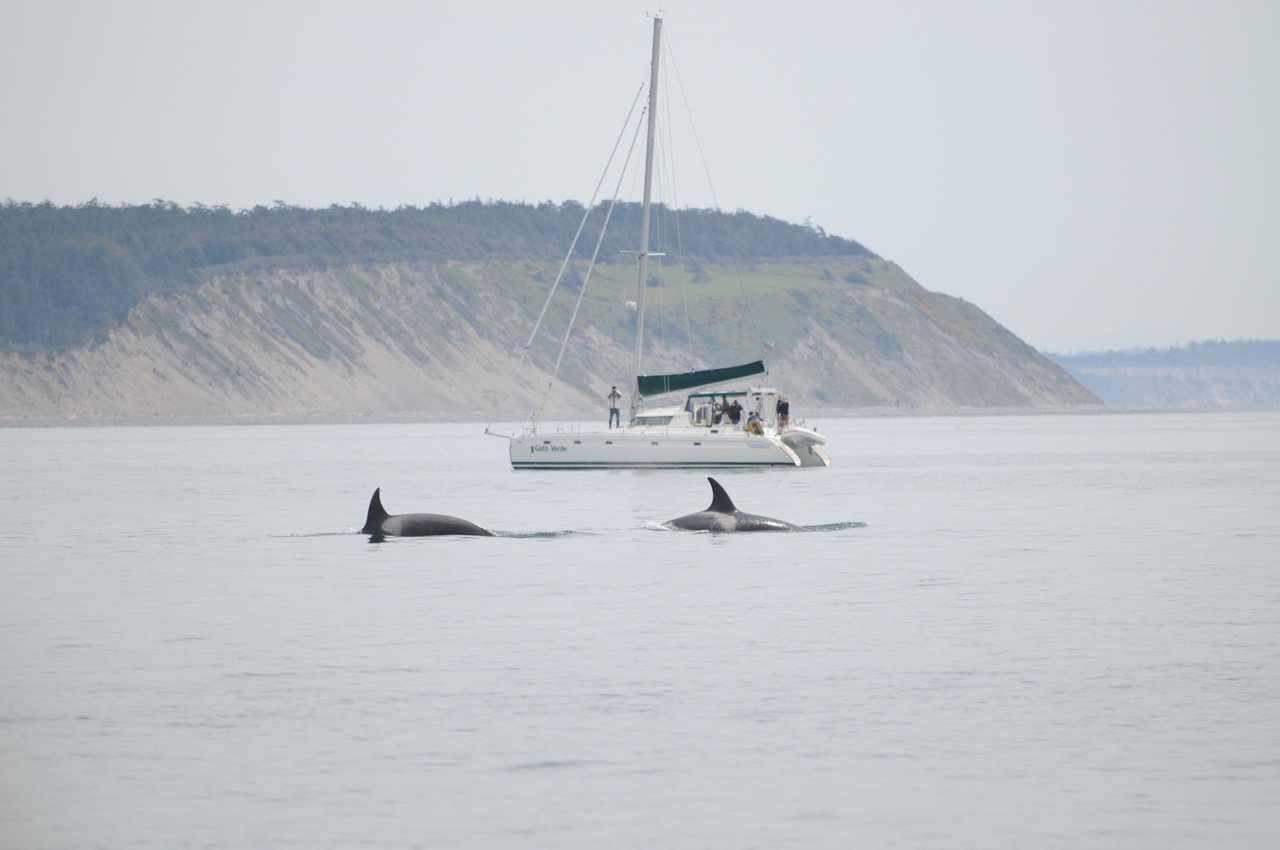
At sea, we’ll be continuing our efforts to practice sustainability science. We’ll be powering our studies of endangered killer whales with biodiesel bought from local supplier Island Petroleum Services.  Our captain, Todd Shuster, encourages us to burn biodiesel instead of fossil diesel in the 42′ sailing catamaran, Gato Verde, that has a nearly-silent Prius-like hybrid electric propulsion system that enables us to listen to the orcas as we move with them. We’ll also be discussing the science and ethics of deriving liquid fuels from oceanic plants while filtering some plankton and taking a first stab at extracting their oil for conversion to biodiesel.
If you’re not a home owner or can’t modify your living space, another action we recommend is to try cooking a meat-free meal this Sunday. Food production from farm to fork is responsible for between 20-30 percent of global green house gas emissions. Over your vegetarian meal you can discuss joining the meat-free Mondays movement, a way to make small changes in your life that can make a big difference for the planet.
There are many ways to lower CO2 levels and many questions yet to answer. We hope you’ll join us in considering them creatively while taking a few practical steps forward this weekend.
The last time I visited the fall students up in the San Juans, I was pleasantly surprised to learn that Vanessa is a particularly talented photographer (and that she uses a Canon Rebel XT, the model Beam Reach has adopted as a standard). After discussing the nuances of different camera settings, she kindly contributed some of her favorite photos of her Beam Reach experience to our on-line gallery. Here are a few examples of her ability to artfully capture diverse facets of the Beam Reach adventure. You can see (and rate) all of her shots in the Beam Reach gallery.
Although the rain made the logistics of loading the boat more difficult and Todd faced 25 knot wind as he departed Bellingham, the Gato Verde made it to the FHL dock just afternoon and we departed just a few hours later. Everyone got a chance to steer as we worked our way south into Griffin Bay where we anchored for the night and enjoyed some award-winning chili and corn — no wait — oatmeal bread for dinner.
A highlight for me was watching the skipper of a 20′ scow row his boat past us using a yuloh — a stern oar that is swept side to side like a fish tail. Made of Douglas fir and almost as long as the boat, the oar was mounted in a horse-shoe shaped oar lock on the transom and the end of the loom was held down by a lanyard. Without working hard (not even holding the end of the oar) they made 1-2 knots past us and then set an anchor and boom tent.
The yuloh is another nice way to move oneself sustainably across the planet, one that is simpler than our biodiesel-electric propulsion system, but certainly less powerful and able to make a schedule. Of course, it might be hard to keep up with the southern resident killer whales using yuloh power… and our 12 kg electric motors and 14 kW biodiesel genset are a grand improvement over the dual 27 horsepower inboard diesels that we started with in 2005!
Click on the photos below to see more images from the fall program which began two weeks ago. The program started with the students and Scott emerging from overcast Seattle into the sunny San Juans. We car-pooled up and felt lucky to be one of the last couple cars to be loaded aboard our planned ferry departure.
The first class session was spent at Lime Kiln lighthouse, listing and discussing each student’s questions about the endangered local killer whales and their environment. While the southern resident orcas didn’t pass by the Whale Watch State Park while we were there, we have heard them frequently on the live hydrophones of orcasound.net.
Since then, the focus has been on learning what past students and other researchers have accomplished and practicing with the bioacoustic instrumentation available through Beam Reach, our research vessel, and the University of Washington’s Friday Harbor Labs. This process has led to the formulation of a draft research proposal by each student which will be further refined in the third week on land, as well as during and after initial data collection over weeks 4-5.
You can monitor the students’ progress via their class home page: beamreach.org/102
Here is a great video put together by the spring 2010 students. It is a half-hour fantastic eye candy and an elegant visual tour of the 10-week program. Check out the still photos and video of springtime coming to the San Juan Islands, transient killer whale encounters, a sailboat race, life at sea, rope craft, the southern residents from Ken Balcomb’s boat, data collection, breaching professors, and more. Thanks to Libby, Nora, Horace, and Kathryn for putting it together!
This is the best way to summarize our 10 week adventure. Enjoy!
The beautiful sun was shining and the tides were cooperative today for a lovely day on the water. Unfortunately, the whales did not agree and stayed away from the Strait (and everywhere in the Northern inland waters) again today. I am crossing my fingers that they make an exciting appearance tomorrow morning directly off our bow sprit. Other animals seemed to enjoy the day, and we were able to watch a number of porpoises play in turbulent waters just off Turn point, some harbor seals napping at high tide on a reef too flooded to be relaxing, and various birds surrounding us all day. We watched cormorants eat skinny silver fish (and thought in awe of the research that gathers data on the species that a bird eats) and seagulls noisily chase each other down while the rhinocerous auklets were focused on diving to the depths. The group had great discussions about the complicated methods in behavioral science and hashed out details for when the whales arrive. With our hearts full of laughter and sunshine, we set off to Wescott Bay to watch the harbor seals play and listen to the orchestra of birds just off our bow. And of course, to fill up on fried rice.










 Twitter
 LinkedIn
 Facebook