Four new student papers and presentations are now posted on the spring 2011 class home page as PDFs and on-line videos. The titles of the student projects are listed below, along with the embedded video of their 10-15-minute talks.
Introduction by Scott Veirs and Robin Kodner
Introduction by Scott Veirs and Robin Kodner to final presentations of the spring 2011 program at the Beam Reach Marine Science and Sustainability School, including first showing of a highlight video by Carlos Javier Sanchez (streamed and recorded on 6/3/11 at the University of Washington’s Friday Harbor Laboratories)
Variation in Southern Resident Killer Whale Acoustic Signals in Relation to Environmental Factors (Mandy Bailey, University of Maine)
Final presentation by Mandy Bailey of the spring 2011 program at the Beam Reach Marine Science and Sustainability School (6/3/11 at the University of Washington’s Friday Harbor Laboratories)
Bottom-up Analysis of Lower Trophic Levels within Foraging Areas of the Southern Resident Killer Whales (Kelsey Donahue, Western Washington University)
Final presentation by Kelsey Donahue of the spring 2011 program at the Beam Reach Marine Science and Sustainability School (6/3/11 at the University of Washington’s Friday Harbor Laboratories)
Variation in the S1 Call Type of Southern Resident Killer Whales (Emalie Garcia, Texas A&M University)
Final presentation by Emalie Garcia of the spring 2011 program at the Beam Reach Marine Science and Sustainability School (6/3/11 at the University of Washington’s Friday Harbor Laboratories)
Determining the correlation between call frequency and matriline density in Southern Resident killer whales (Ally Meyer, University of Washington)
Final presentation by Ally Meyer of the spring 2011 program at the Beam Reach Marine Science and Sustainability School (6/3/11 at the University of Washington’s Friday Harbor Laboratories)
Erica Beneze talks about clicks. (Note the reflection of co-author Jason, as well as session Chair David Mellinger.)
Beam Reach staff and alumni presented no less than six talks at the Acoustical Society of America (ASA) meeting held this week in Seattle. Setting a record that will be hard to beat, in one session on killer whale acoustics a full third of the 12 presentations involved Beam Reach! The talks ranged widely in their topics and methodologies (abstracts below). Bravo to the whole crew!
Three Beam Reach alumni were involved in this ASA meeting, up from one (Kenna Lehmann, fall 2007) at the 2008 ASA meeting in Paris. Alumnus Erica Beneze (spring 2009) spoke about the relationship between the behavioral state of killer whales and their echolocation click rates and how it changes in versus out of areas proposed for marine protection. Alumnus Laura Madden (fall 2005) spoke first in a fisheries workshop session, comparing two ways to assess fish habitat restoration structures: non-invasive hydroacoustic methods versus the traditional electrofishing technique. Jason Wood and Peggy Foreman (fall 2006) asked whether the southern residents compensate vocally when ship noise increases using new recordings and ship track data from the Lime Kiln acoustic observatory maintained by The Whale Museum.
Val Veirs discussed ship noise signatures from a long-term study in killer whale habitat on Monday, and then introduced the concept of new underwater noise metric — the orca-weighted decibel — on Thursday. Scott Veirs presented a model of killer whale signal masking by commercial ship noise (Prezi embedded below).
4pAB5. Masking of southern resident killer whale signals by commercial ship noise. Scott R. Veirs and Val R. Veirs
The endangered southern resident killer whales (SRKWs) emit sound to communicate with each other and to hunt fish. Communication or fishing are possible only within a distance R at which a signal can be detected.We determine detection distance by comparing the power spectra of the ambient noise and the received signal, with attention to the auditory response curve of the receiver. In Haro Strait, the center of the SRKW critical habitat, about 21 commercial ships per day, increases the ambient noise level by about 20 dB. To assess how ship noise may affect the SRKW communication and hunting, we define the fractional reduction in the zone of audibility at any location and time as the ratio of the area where signal detection is expected to occur in the increased noise regime to the maxi- mum detection area expected under ideal conditions R^2/Rmax^2. We map the decreased zones of audibility in Haro Strait during average and extreme ship noise by combining field measurements of spreading rates with source power spectra 1–100 kHz of common SRKW signals and typical ships.
1aABa8. Shipping noise signatures. Val Veirs, Scott Veirs, and Jason Wood
Throughout 2010, underwater recordings have been made of each ship passing two separate Haro Strait nodes of the orcasound.net hydrophone network. About 20 ships pass each day. Each ship has been identified in real time [automatic identification system (AIS)]. Measurements of received underwater noise levels and AIS variables are recorded as each ship passes the listening stations. Individual ships are observed multiple times moving in either northerly or southerly directions at times separated by a day or two and also by intervals of months. A database has been developed that contains the spectrum level of each ship ô°ƒbandwidth 96 kHz at one location and 22 kHz at the other and the source level both in terms of intensity and angular distribution. Ship signatures in terms of frequency quantiles and angular distributions of emissions are quite reproducible. This database can be used to predict limitations on echolocating and vocalizing marine mammals’ active space due to specific ship noise emissions. In particular, predictions of marine mammal noise exposures in specific frequency bands can be made prior to specific vessels’ entry into an area opening the possibility of planning field observations to investigate correlations between behaviors and specific predicted noise exposures.
4pAB9. Are click rates in killer whales an indicator of group behavior and foraging hotspots? Erica L. Beneze, Jason Wood, Scott Veirs , and Val Veirs
Killer whales use sound to communicate, find food, and navigate through the ocean. Southern Resident killer whales are specialized hunters and predominantly target Chinook salmon. It is presumed that these whales use echolocation clicks to distinguish between different species of salmon and to navigate. If this is the case, then click rates should vary by group behavior as the need for locating prey and navigating change. It has also been suggested that certain areas are utilized heavily by this population for foraging (hotspots) and some of these areas have been included in NOAA’s proposed “no-go†zone. If click rates during foraging are distinct, then hotspots should be identifiable by click rates. This study tested if click rates varied by behavior state and geographic area. Group behavior was categorized into five states: foraging, traveling, milling, resting, and socializing. Click rate varied significantly by behavior state and by area. Socializing had the highest click rate followed by foraging, traveling, milling, and then resting. The Southern Residents had higher click rates in foraging hotspots.
4pAB6. Shipping noise and vocal compensation by Southern Resident killer whales: Haro Strait as a study case. Jason D. Wood (SMRU Ltd.), Peggy Foreman (Univ. of Washington), Val Veirs, and Scott Veirs
Southern resident killer whales (SRKWs) use acoustic signals to navigate, forage, and facilitate social dynamics. Researchers have published evidence that suggests SRKW compensate for increased background noise by increasing the source level and duration of their signals. Unpublished reports have also suggested that SRKW may compensate for background noise by repeating their signals and by preferentially using certain signal types. Most of this work has focused on noise from whale watching vessels or general background noise. Haro Strait is both the center of the summertime home range of the SRKW and an important shipping channel. From September 2009 to December 2010 almost 10 000 ships transited through Haro Strait with an average of 21 ships passing per day. Ship transits in Haro Strait can increase background noise by up to 20 dB and are detectable above back- ground noise for up to 30 min. This may be impacting the ability of SRKW to detect and utilize their acoustic signals. A five hydrophone array and Automatic Identification System receiver located at the Lime Kiln Lighthouse were used to record passing ships and SRKW in Haro Strait. This project investigates signal compensation strategies in SRKW in correlation with increased noise from passing ships.
4pAB7. Orca hearing weighted decibels: Underwater sound measurements appropriate to studies of Orcinus (killer whales). Val Veirs, David Bain, and Scott Veirs
In community noise studies, sound levels are usually measured under the dB-A weighting scheme, which was introduced 50 years ago in an effort to match noise measurements to the response of human listeners. Here we pro- pose an underwater noise decibel weighting scheme matched to the hearing sensitivity of killer whales (dB-O). This scheme is based on a convolution of the spectral energy of sound with the frequency-specific hearing detection thresholds of killer whales. The biological significance of noise sources may be more readily discerned if underwater sounds are quantified dB-O weighted. Further, use of this measure would emphasize the importance of broad-band measurement of noise rather than characterizing noise sources by the frequency with the peak power-spectral density and the source level of low frequency components. We compare the measures of representative noise sources, which have been recorded within the range of Southern Resi- dent Killer Whales, including small boats, ships, airguns, and mid-frequency sonar, using both flat and db-O weighted levels. While dB-O provides a more relevant characterization of noise than flat measurements e.g., for predicting noise-induced stress, more detailed measurements will be required to address masking of biological signals, whose frequency structure varies with type of phonation and direction.
4pFWa1. Evaluating freshwater habitat restoration with active acoustics. Laura E. Madden (School of Forest Resources and Appl. Res. Lab., The Penn State Univ.) and Jennifer L. Miksis-Olds (The Penn State Univ.)
The effectiveness of adding a submerged physical structure in order to increase fishery production is uncertain. Measuring fishery response to these alterations with conventional techniques is difficult. Electrofishing is a typical assessment method in freshwater fishery management and is often limited in sample size and sampling frequency. This study used active acoustic technology to evaluate the distribution and behavior of fish assemblages associated with added submerged rock structures in a reservoir currently undergoing habitat improvement. An acoustic water column profiler was deployed for three 1-week intervals at each of three replicate sites consisting of adjacent treatment areas with added rock structures and control areas without added structures. Electrofishing was conducted during each sam- pling interval. Fish abundance and behavior at each site were assessed from the volume backscatter time series and electrofishing data. Differences between areas with and without structures were compared. Combining acoustic technology with conventional assessment methods has enabled a more thorough evaluation of habitat restoration projects and helps guide the development of future conservation efforts.
Today NOAA finally issued a new rule that will govern how boats interact with endangered southern resident killer whales in 2011, starting in early May. The big news is that the legal approach distance has been doubled from 100 yards to 200 yards and the proposed “no-go” zone along the west side of San Juan Island will not be implemented.
The rule will go into affect 30 days after the date of the official Federal Register notice. The NOAA web site suggests the notice publication date is not yet known, but will presumably be today or within the next couple days:
Apr. 8, 2011: The Northwest Region announced final regulations to protect killer whales in Washington State from the effects of various vessel activities. There may be minor changes once the rule officially files.
Here’s what the Q&A document says about how and why the final rule differed from the proposed rule and suggested conservation actions:
The proposed rule included a no-go zone along the west side of San Juan Island that boats would not be allowed to enter from May through September. The no-go zone was not adopted as part of the final rule. During the public comment period, we received a large number of comments specific to the no-go zone including new speed zone alternatives, different exceptions, and questions about the economic impacts of a no-go zone. We’ve decided to gather additional information and conduct further analysis and public outreach on the concept of a no-go zone, which may be part of a future rulemaking.
The “Be Whale Wise” guidelines have not yet been updated to reflect the new rule at http://www.bewhalewise.org/ That will presumably be rectified shortly, as the management, whale watching, research, and stewardship communities rally around the vast educational outreach that will be necessary to promulgate the new rules efficiently during the 2011 boating season.
A key issue this season will be how many resources can be mobilized for both education and enforcement. NOAA is forecasting a gloomy funding environment generally for their 2011-2012 fiscal year. Does the cancellation of the normally-annual survey for southern resident killer whales along the outer Washington coast by NWFSC suggest there will be even fewer NOAA enforcement agents trained and monitoring boat-orca interactions this summer? Will Soundwatch and Straitwatch be adequately funded? Given the state of the WA State budget, it seems highly unlikely that WDFW or the San Juan County Sheriff will increase their training or monitoring presence…
Thanks to Jenny Atkinson of The Whale Museum for the notice of the announcement today.
This year a new professor has joined the Beam Reach crew. Dr. Robin Kodner is an accomplished teacher, scientist, and sailor who we enthusiastically welcome aboard.
This spring, Robin is a lead instructor during the land and sea components of Beam Reach. In addition to working as a teaching fellow at Harvard for 5 years, Robin has taught two field research courses at Friday Harbor Labs (the Beam Reach land campus), and guided boat-based Outward Bound courses for 7 summers.
Robin has a PhD in Biology from Harvard University and specializes in geobiology and biological oceanography. Her post-doctoral fellowship (University of Washington, 2008-2011) focused on using comparative genomics and metagenomics to understand phytoplankton diversity and bloom dynamics in changing environments, like the San Juan Islands. She has also studied how we may harvest energy from algae, obtaining fuels like the biodiesel that powers our research vessel, the Gato Verde.
Robin enjoys helping students explore the Salish Sea ecosystem — from plankton to whales. When she’s not teaching science on sail boats, Robin can be found kayaking in the San Juans, skiing or climbing in the North Cascades, riding her bike, practicing yoga, or dreaming about sailing around the world looking for her favorite phytoplankton.
An NPR short piece aired today on “soundscape ecology” is focused exclusively on the terrestrial environment, featuring sound clips of elephants, ants, and nighthawks. Its overall point, however, is worth considering when studying the acoustics of killer whales and their environment. As the article says, “we should pay attention to the ecological characteristics of sounds and their spatial-temporal patterns.”
What does the din of underwater anthropogenic noise mean for the Northwest’s marine species — not only endangered killer whales, but also other marine mammals, soniferous fish, crustaceans, and beyond? What do killer whale calls and fish sounds mean for other species? How do our region’s marine biological sounds and underwater noises vary geographically and through time?
As we continue to study ocean sound at Beam Reach, we might consider the research agenda the authors propose for soundscape ecology:
While you can get a good sense of the Beam Reach program through the highlight video from fall 2010 or spring 2010, Erin Corra pointed us towards another fun way to get a sense of the San Juan Islands: music videos! The following two were filmed on or above San Juan Island and include some good scenery from Friday Harbor, American Camp National Monument, inland roads and forests, favorite beaches, Kenmore Air float planes, WA State ferries, and local lighthouses — including the Lime Kiln lighthouse at the Whale Watch State Park.
This year we’ll be putting new efforts into using video to share the Beam Reach experience, so consider this inspiration and a prelude…
Dave Cade recently finished editing a great highlight video with footage he, his classmates, and Beam Reach staff acquired last fall while studying endangered southern resident killer whales and their environment. We hope you enjoy the new footage! He even mixed some underwater recordings into the musical sound track.
Soundtrack credits:
(Please support these artists by visiting their sites, going to a show, or buying their music and merch!)
This is forwarded from Ed Gerstein, egerste1@fau.edu; please contact him for more information. There are 8 potential research projects listed in the ad,
from which presumably 5 postdocs will be selected. The part of the ad covering
the potential bioacoustics project is shown here. -Dave Mellinger
———————————————————————-
Up to 5 Postdoctoral Investigator positions are available for the two-year
period, October 1, 2011 to September 30, 2013. Postdoctoral research is
primarily conducted at FAU’s Harbor Branch Oceanographic Institute (HBOI) in
Fort Pierce with a member of the resident HBOI faculty, who serves as the
supervisor and mentor, with one or more co-mentors from other FAU colleges,
departments, and centers. Topics include marine ecosystem health, marine
natural products chemistry, marine mammal biology, and marine ecology.
Qualifications for Application: Applicants who have received their Ph.D. or
equivalent within three years of the date on which the postdoctoral
investigator position would commence, are eligible to apply. Recipients must
have completed their degree before the award can begin. Applicants should
submit a cover letter and a statement of interest (no more than 2 pages in
length) that addresses one or more of the proposed research projects, a CV, and
three letters of recommendation. Applicants will be selected on the basis of
the strength of academic course work, research and development experience,
publication record, letters of support, and statement of interest. Applicants
are encouraged to contact any of the mentors listed for topics of interest. An
online application must be completed to be considered for each position:
https://jobs.fau.edu/, reference position number 980126. The application
deadline is March 15, 2011.
[The bioacoustics project:]
Acoustic Behavior and Ecology of Marine Mammals
Faculty mentors:
Juli Goldstein, D.V.M., HBOI
http://www.fau.edu/hboi/ProjectManagers/JuliGoldstein/jghome.php
Edmund Gerstein, Ph.D., Charles E. Schmidt College of Science
egerste1@fau.edu or gerstein2@aol.com
George Frisk, Ph.D., College of Engineering & Computer Science
http://www.ome.fau.edu/directory/georgefrisk
The effects of anthropogenic noise on the health, behavior, energetics, and
ecology of marine mammals are shared concerns of the U.S. Navy, NOAA, USFWS,
and other regulatory agencies. This postdoc will be a part of a team that
systematically studies marine mammal bioacoustics and the acoustical
propagation characteristics of marine mammal habitats in Florida. The project
will identify, measure, and model zones of masking and other direct and
cumulative impacts from anthropogenic sources on marine mammal hearing,
biology, and behavior.
This research will capitalize on the strengths of Dr. Edmund Gerstein in marine
mammal acoustics, behavior, sensory biology, and ecology; Dr. Frisk in ocean
noise propagation, computational acoustics, and modeling; and Dr. Goldstein in
veterinary medicine and marine mammal health. This postdoc will participate in
passive acoustic data collection and subsequent analysis and in the detection,
classification, and localization of marine mammal vocalizations and associated
measurements of ambient noise and signal propagation within the Indian River
Lagoon system, and other estuarine and coastal habitats along east Florida. The
postdoc should have a skill set that includes acoustic signal processing,
computer programming, and proficiency with MATLAB tools.
Brandon Southall gave a great synopsis today of an impressive study (SOCAL-10) of how cetaceans respond to simulated sounds, including mid-frequency sonar. (Edit 1/20/11: recorded lecture is at http://www.ustream.tv/recorded/11956611 ) Responses were assessed using data from a suite of instruments, including passive acoustic monitoring and tags attached to the animal that reported position at the surfaces, as well as underwater depth, heading, and received sound level.
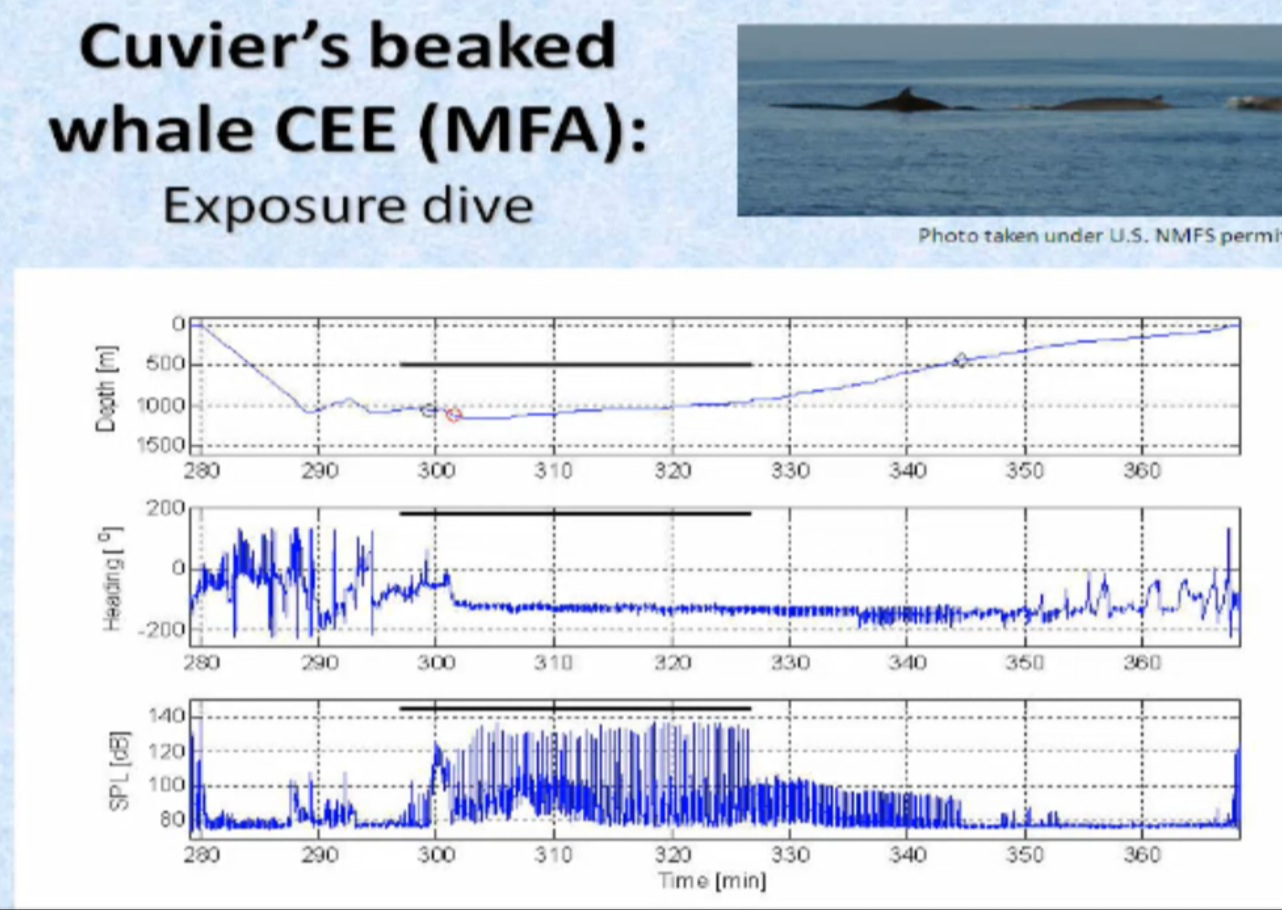
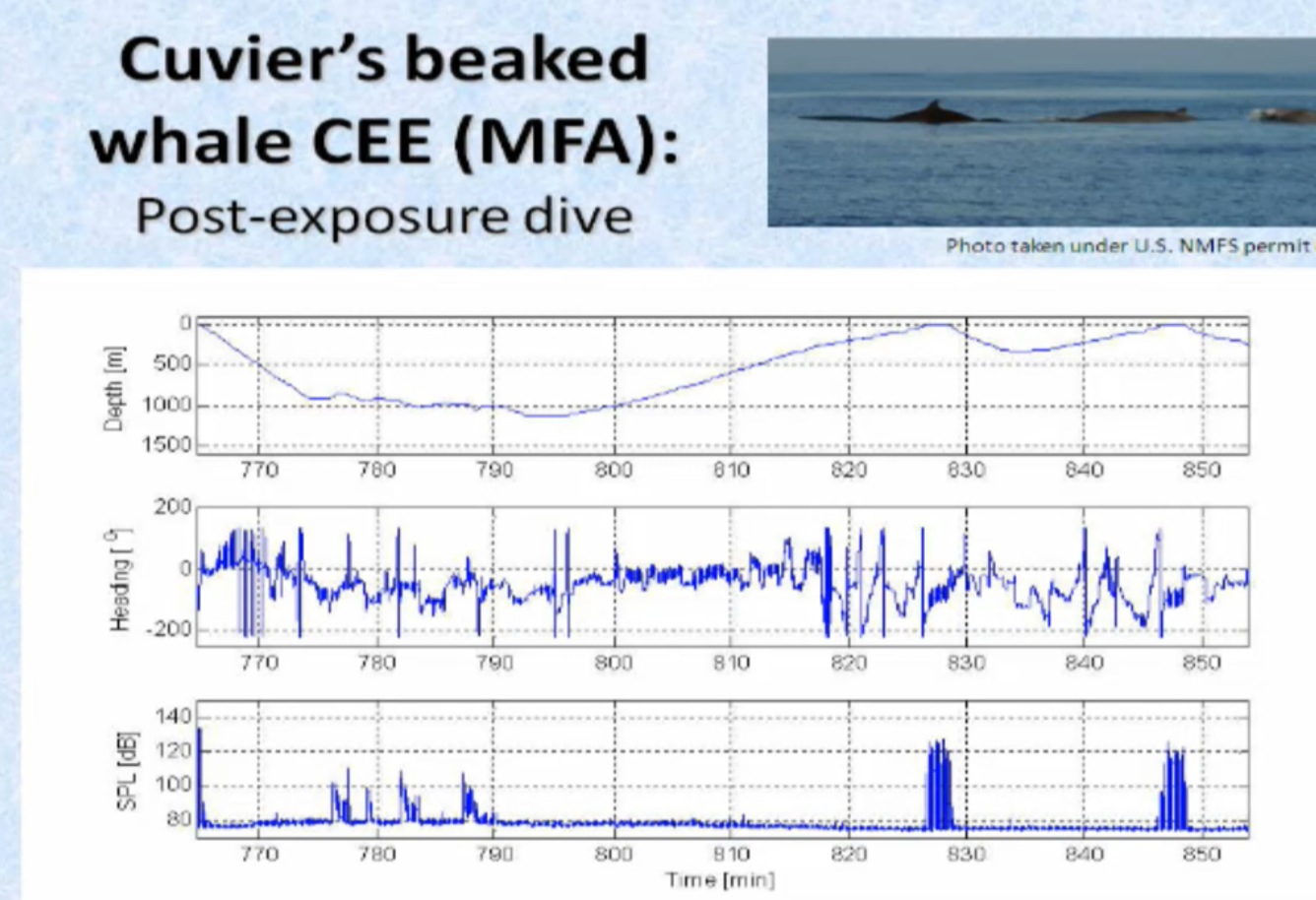
The highlight from my perspective was that different cetaceans off the coast of southern California seem to respond differently to the simulated sounds.   While a sperm whale showed no mid-dive response to simulated mid-frequency sonar (210 dB 15-element vertical source rather than the military’s 235 dB 30-element source), a beaked whale showed a strong response mid-dive — it suddenly switched from swimming around in different directions to swimming faster (more flow noise) on a steady heading (see screen-grabs below).
Southall commented during his talk that “Beaked whales, like harbor porpoises, seem to be particularly sensitive.” In the interesting back story provided by the Smithsonian, Southall similarly noted that in the Bahamas “beaked whales seemed much more responsive than other species, like pilot whales.”
An outstanding question posed by Brandon today as he presented the slides shown below is whether or not the beaked whale was swimming away from the SOCAL sonar source or not. In these Matlab plots, the exposure is denoted by the black bar. I think the red circle represents the time when the sonar sounds were first emitted (at full source level?).
A dive during which whale was exposed to simulated sonar and responded with increased flow noise and steady heading
Post-exposure dive has little directed swimming except during ascent (as did the pre-exposure dive)
It seems an answer could be derived by estimating the beaked whale’s speed from the flow noise time series and then combining it with the heading data to estimate the whale’s track underwater. If the location of the whale when it dove is known (even roughly) relative to the sound source, then it may become clear whether the whale headed away from the source or not. From about the onset of the exposure for about an hour the animal was headed between -90 and -180 degrees.
Assuming a heading of 0 degrees represents magnetic or true north, the bulk of the response movement was to the southwest. The descent included some slow turns throughout the compass points, but was also predominantly to the southwest or northwest with the highest speed sections (based on the flow noise increasing with speed) occurring when the animal was headed generally southwest. So, if the source was east (or maybe north) of the dive location, then the response was probably away from the source. If the source was west or south of the dive location, then the response may have been toward the source…
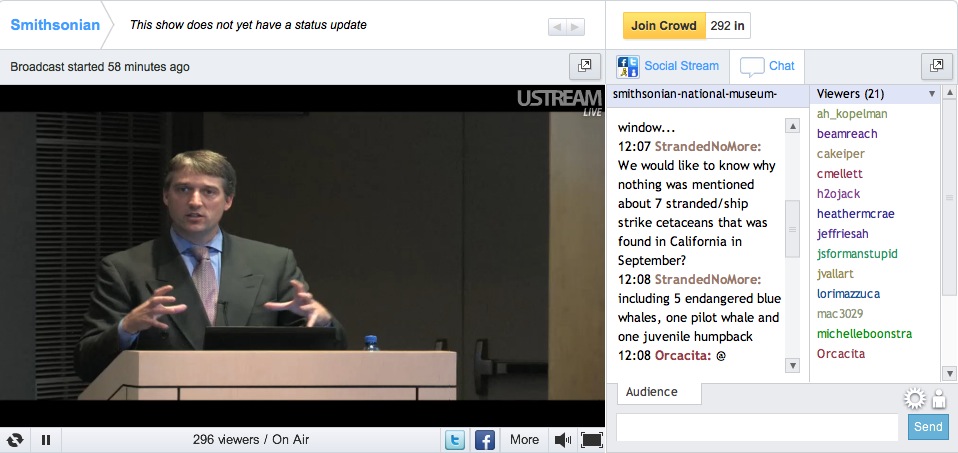
Also, in the question session within the uStream chat window, a user named strandednomore posed a provocative question which went un-answered:
We would like to know why nothing was mentioned about 7 stranded/ship strike cetaceans that was found in California in September? Strandings included 5 endangered blue whales, one pilot whale and one juvenile humpback. Prior to SOCAL-10 and Navy tests in San Diego nearly no cetaceans stranded in California from January up to August, then suddently we had 7!
Overall, this was a great use of streaming video. Thanks to Orca Network for the Facebook reminder to tune in and a suggested improvements for the Smithsonian folks: clarify how virtual audience members should submit questions; respond to audience comments in the ustream chat window; provide a link to the archived recording immediately after the broadcast ends.
It turns out the sounds are made by the black drum to attract mates during spawning events. By “drumming” their sonic muscle — the fastest muscle known in vertebrates — against its swim bladder about 200 times per second, it generates a sound akin to a heartbeat. According to the abstract of Jim Locascio’s doctoral thesis (advised by David Mann at the University of South Florida), the black drum sounds are surprisingly loud:
Source level estimates averaged 165 dB RMS re: 1 microPa (SD=1.0) (n = 1,025). Call energy was concentrated in the fundamental frequency (94 Hz) and first two harmonics (188 Hz and 282 Hz).
At Beam Reach, one of our 2011 resolutions is to identify the source of a variety of grunts and groans that we often hear in the Salish Sea. We suspect many of them come from fish like rockfish and midshipmen, but we’re still narrowing down the list of soniferous (sound-producing) fish of the Pacific Northwest.
If you know about local fish (or other marine animals besides mammals) that make sound, or if you have recorded mysterious sounds that you suspect may be fish, please let us know in the comments. For the curious, here are some “mystery” sounds recorded in the Salish Sea — some of which may be coming from marine fish — while listening to the live hydrophone network we help run. One to listen for is a “chorus” of fish calls that often occurs in temperate waters within a couple hours of dusk or dawn.






 Twitter
 LinkedIn
 Facebook