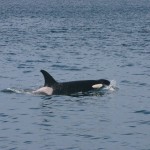
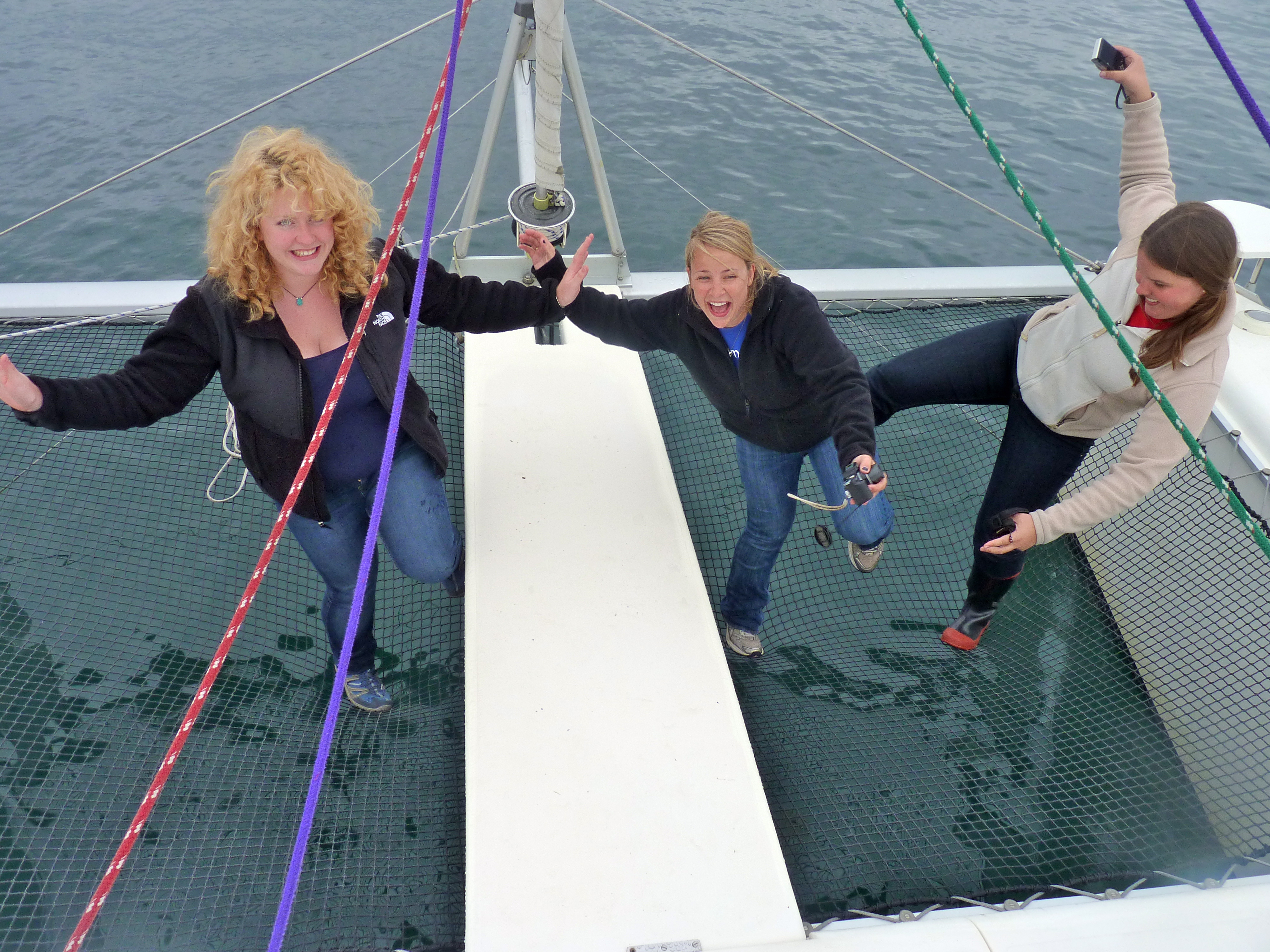
I thought things at Beam Reach were awesome last week, but man, they just keep getting better and better! These past few days have been absolutely STUNNING! It’s been clear, sunny, and even a little wild on the water! Monday we had some wild waves, and had our first true chance to test our sea legs. Luckily we all passed the test, and had a blast sitting out on the bow of the Gato Verde, enjoying the sunshine and salty wind on our faces as the boat plowed through the most significant waves we’ve experienced yet! And the best part was that we got to see orcas after riding what felt like a mini roller coaster!
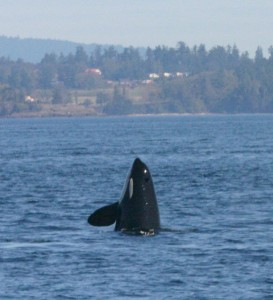
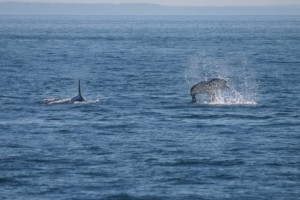
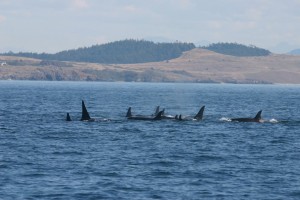
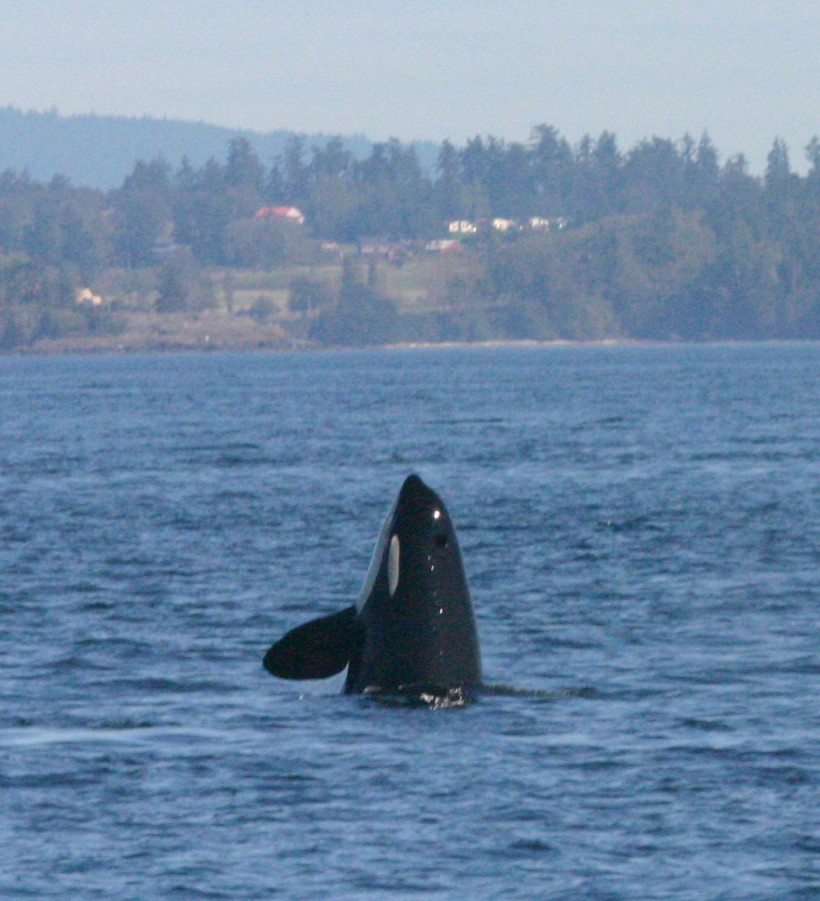
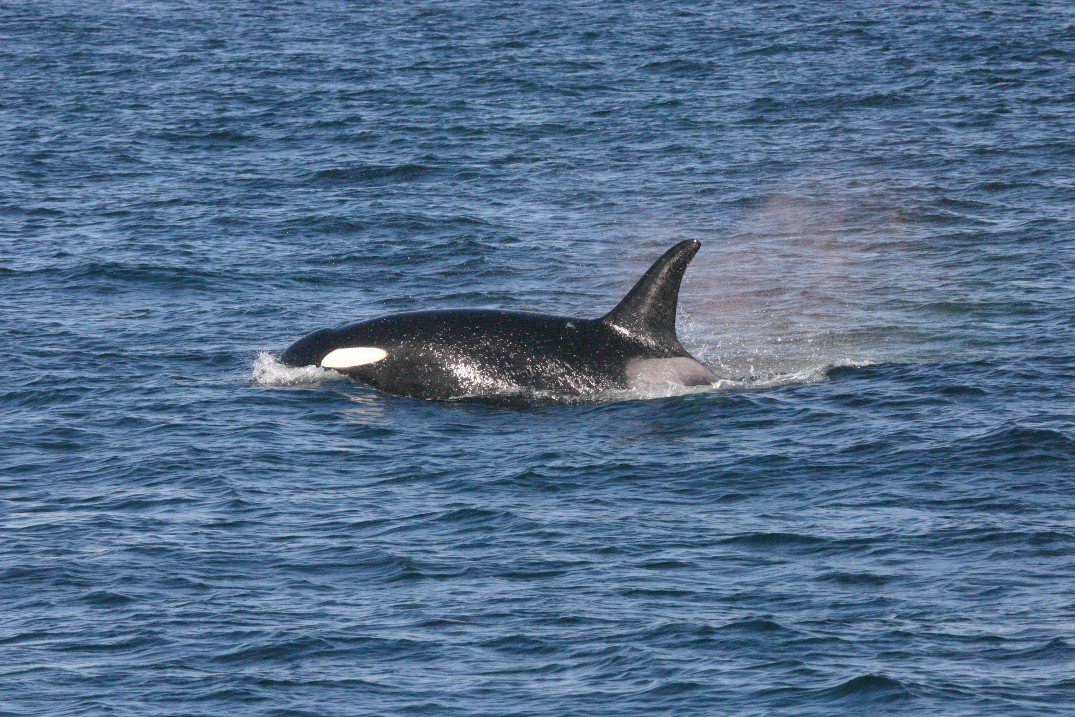
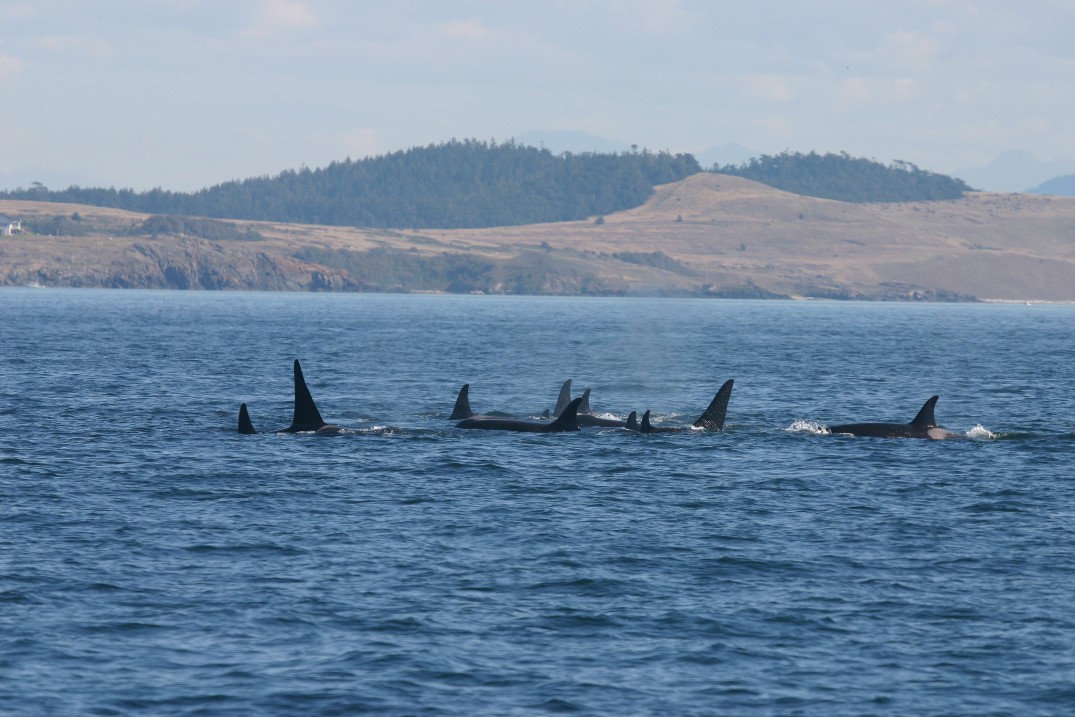
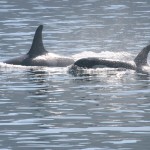
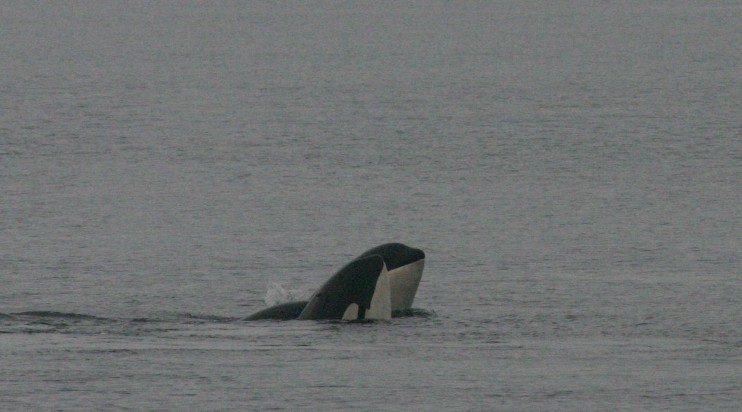
Yesterday and today have been some of the most beautiful days we’ve had out on the water. It’s been bright and sunny and clear, and there have been huge, and I mean huge, amounts of whales gathered together! Today there were at least 40 clustered into 2-3 groups and we saw almost the same yesterday–someone (sorry, not sure which whale watching operator it was) called yesterday one of the best days of the season, and I believe it! The orcas were resting for a good portion of the day, and it was crazy to see them all gathered together, rising and falling in uniform synchronization in such huge numbers. Suddenly, around Turn Point, the whales woke from their resting state, and almost flew down the coast! They would absolutely blast through the water–it was porpoising like I’ve never seen before.
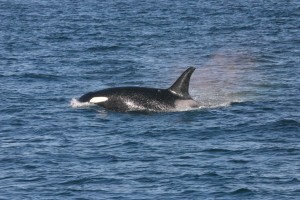 You truly get an idea of their speed and power when they’re in travel mode! We even got to observe foraging behavior, as many of the whales stuck around to feed, making quick lunges, deeper dives, and moving in random, sporadic movements! All the behavior changes were great for me, since part of my research question will be comparing echolocation click rates and behavior states; I got a lot of excellent data to analyze!
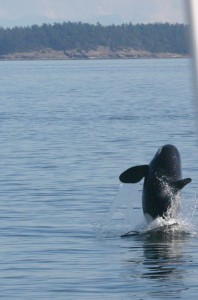
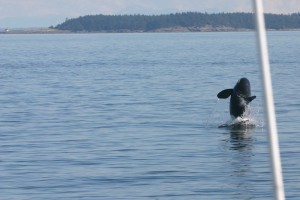
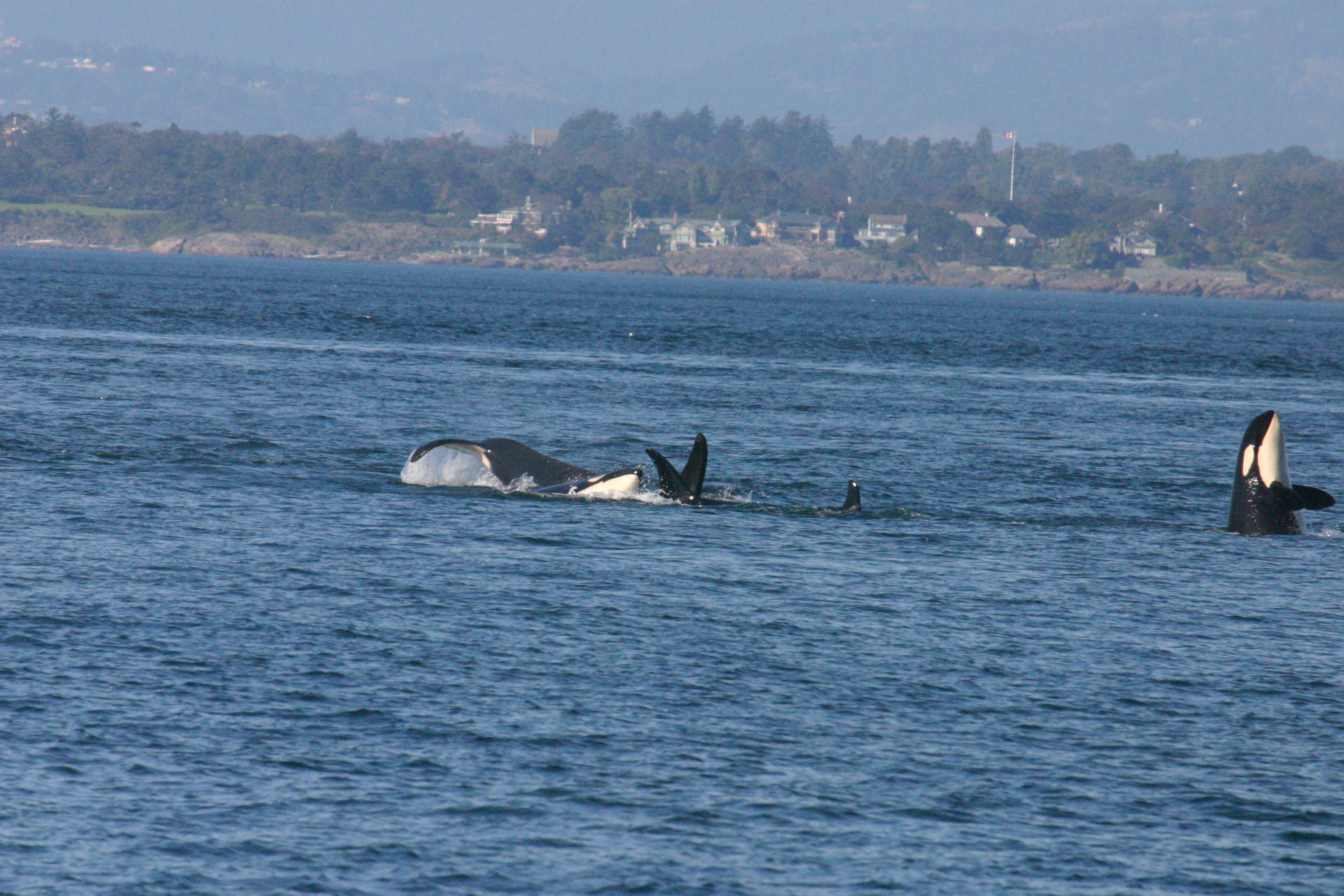
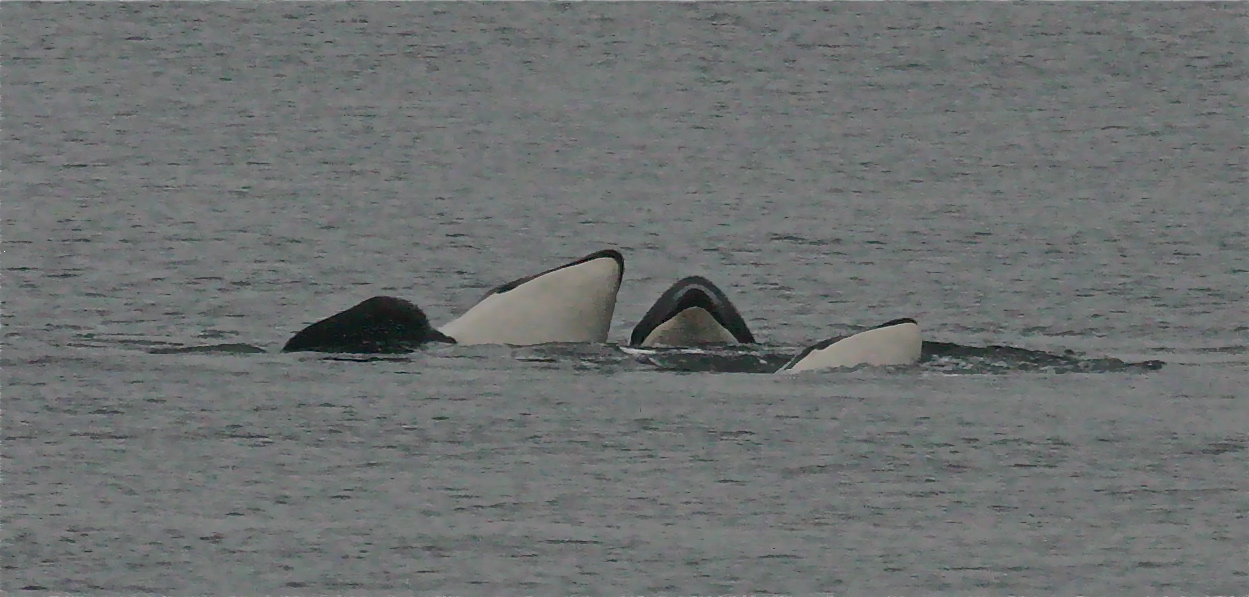
Today was just a continuation of yesterday’s amazing weather and behavior. I have never (granted, I’m still a newbie at this whale research thing) seen as many whales grouped together as I did today. We heard that members from J, K and L pods were clustered in the super-pod we followed! In addition to huge numbers of whales, they were so active: so many breaches (I saw at least 30!), spyhops, tail slaps, peck slaps, nuzzling…you name the behavior, the whales were doing it! I think they were enjoying the beautiful weather just as much as we were! I was honestly star-struck by the number of whales and gorgeous behaviors we saw today. I was honored to be able to observe their world, and so thankful that Beam Reach has given me this wonderful opportunity to pursue my love of orcas! I’ve said it before, and I’ll say it again (likely every post I make!), these whales are more than gorgeous, they’re more than amazing. They inspire me to do everything in my power to help them, and I’m so glad that this is my life right now. I love every second of this!
Read More
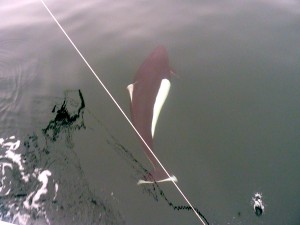
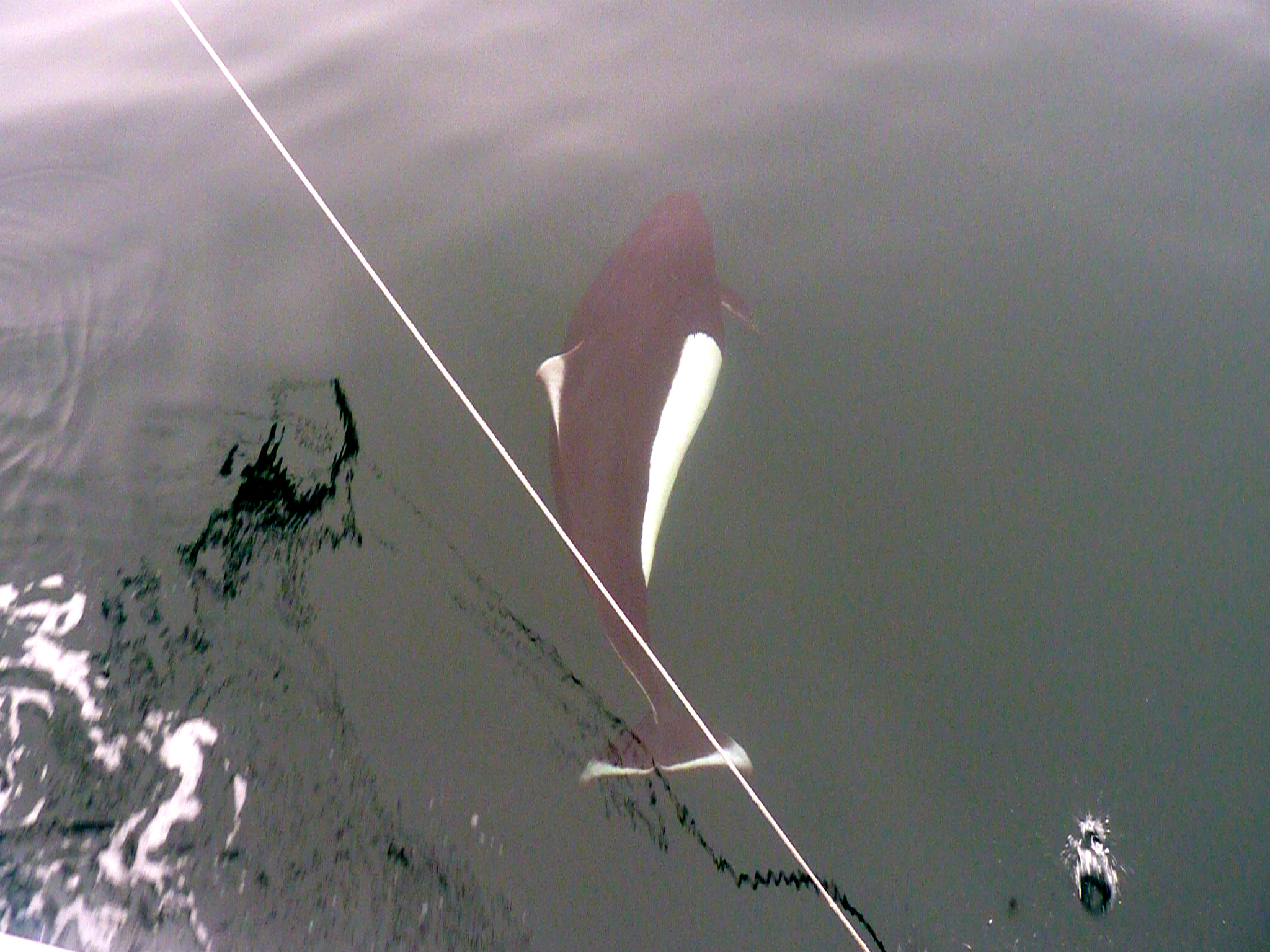
After cleaning and getting everything in order while at Friday Harbor we had the rare chance to sleep in the next morning before taking off again. Once we were back on the water we were lucky enough to finish our day with learning a new form of sailing which involved the screecher sail. aptain Todd is great teacher for sailing, and on Monday we were out on the west coast of San Juan Island clinging to the side of the boat in 20 knot winds learning how to deploy the mainsail and the jib. This was a perfect first day back on the boat, because it had a little bit of everything. We started the day with some amazing sailing in 2-4 foot waves; which didn’t agree with everyone on the boat unfortunately. After sailing for a few hours we found the whales, and the wind died enough to allow for the hydrophones to be deployed. Two sets of high quality recordings were made while we were surrounded by the whales, and the the amount of data we have is slowly getting bigger each day. We ended our night in Prevost Harbor, which gave everyone a chance to take a walk and stretch their legs. On the way to Prevost 5 or 6 Dall’s Porpoises began to bow ride on the boat, and they stayed there long enough for us to get some pictures of them underwater. This day was timed perfectly for the birthday of our professor Val, and on top of everything else that happened we celebrated his birthday with a delicious coffee cake after another great dinner.
Tuesday brought another great day on the water. The Captain continued our boating education with a lecture on the tides in the Salish Sea. Tides are very important for navigating any type of boat, however the tides throughout the Salish Sea are especially strong, and they can be dangerous if you don’t know what you are doing. After our tide lecture we managed to find the whales again, and we stayed with them for most of the day. At first they were resting, which means they move slowly in a close group, and they don’t produce many sounds for us to record. This changed by the end of the day when the whales woke up from their nap, and we had a front row seat to watch them breaching, spyhopping, and socializing in general. Seeing the whales foraging and playing was a great way to end the day, and we then headed back to Prevost Harbor for a journal club discussion with an amazing sunset as the background.
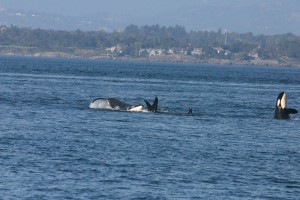
Wednesday was definitely one of the best days we have had with the whales so far. We followed 30 or 40 whales, which is almost half of the entire southern resident population, while they were resting, and when they woke up it was amazing. We witnessed close to 30 breaches, countless tail slaps, and the whales continued to “play†for over an hour. I will remember this day forever and we have some great pictures to help share the experience.
Read More
September 12th & 13th, 2010
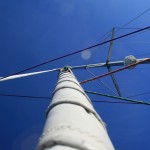
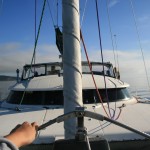
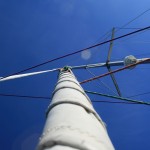
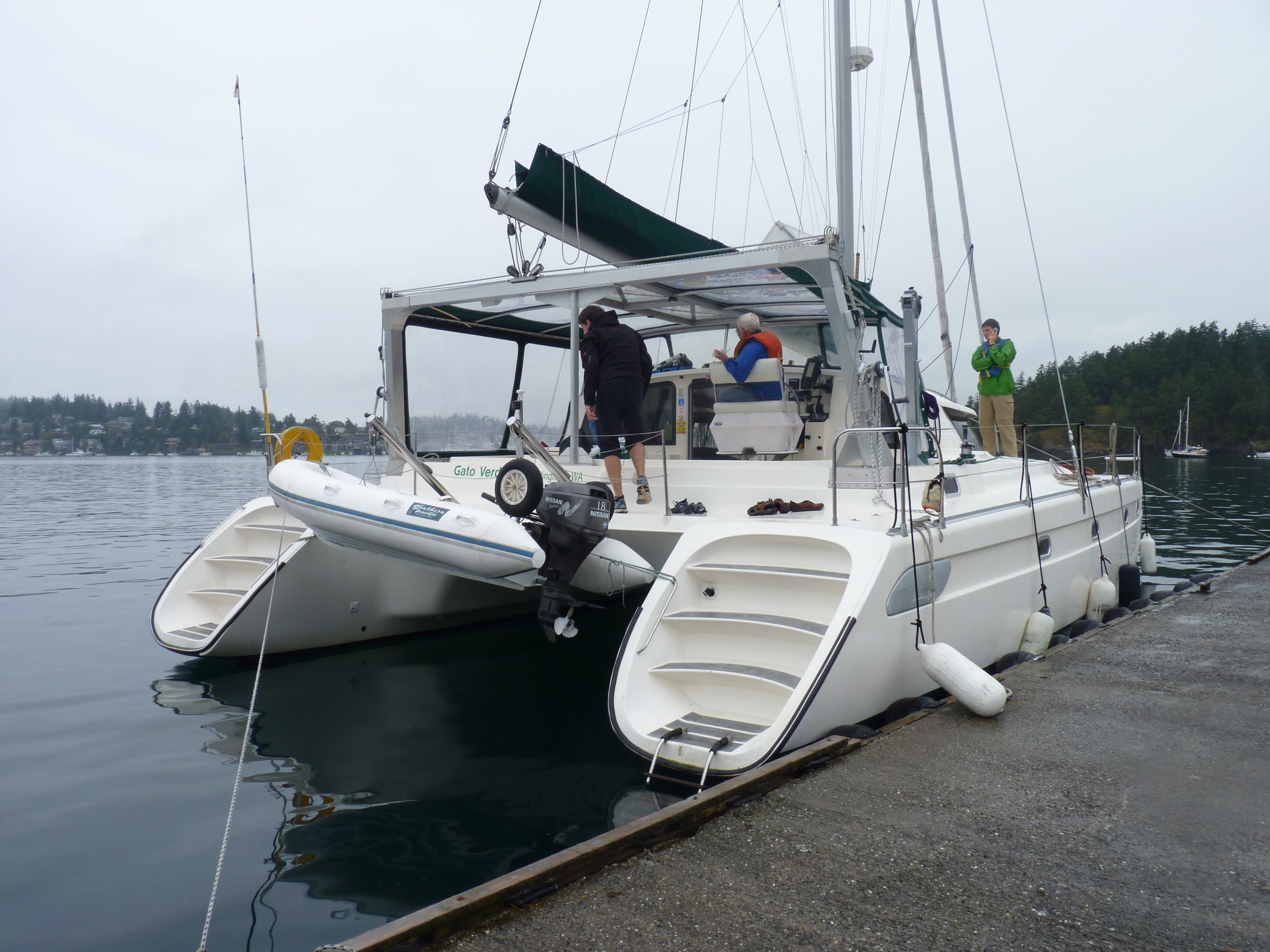
After 3 weeks of intense studies on bioacoustics, the ecology and conservation of the southern resident killer whales of the Salish Sea and their prey of choice, Chinook salmon, among many other fascinating aspects of the San Juan ecosystem, the Beam Reach crew for this fall: Dr. Scott Veirs, Dr. Jason Wood, Dr. Val Veirs, Hana, Cat, Garrett, Dave, Meagan and myself, were ready to meet Captain Todd and his great Cat (short for catamaran) the “Gato Verde.”  The ship which will sail us through this great “blue orca domain†is really magnificent and upgraded as an eco-boat with a “silent†biodiesel engine and propellers that harvest energy as they spin. El “ Gato Verde”, a 42′ state of the art catamaran, was named by Captain Todd Shuster as a Spanish equivalent of “green cat”, green (verde) as the boat is run as an eco-ship and seeks sustainability in all aspects, and cat (gato) after the common abbreviation used for catamarans. And so, with a 23′ beam (boat width), a mast 63’ tall (off the water), a large fully-battened mainsail, a jib and a screecher (foremost sail), this great cat can top to speeds of 12 knots under sail (at 50% of wind speed) under ideal wind conditions, reaches 7.2 knots top speed under biodiesel-power and averages a cruising speed of 6.5 knots.
Our main work/research area will be the cockpit where all of our acoustic REC-equipment will be placed during the recordings. During this season will be using a total of 6 hydrophones: 4 on a linear array that trolls behind us attached to the cleat under the stern pulpit on the port side (aft-left), a High Frequency Hyd., also known as the CRT, trolling behind from the starboard pulpit. This arrangement will allow us to record the large range of the orca vocalizations, and, with detailed observations and meticulous data taking, will also let us localize the individual/s emitting the sounds.
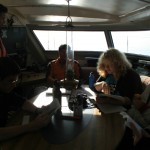
The cabin or galley holds our kitchenette, dining and navigation tables (the latter known as the “nav tableâ€), this is indeed the most crowded area of the boat by far, as all of our meals and most of our meetings and clasess, as well as after-hours studying and data-entering takes place here. Our ‘dance’ as a group will be tested by our use of this space out of all other areas.
El gato has 4 cabins accessible from the cabin, 2 inside the starboard pontoon and two in the portside one. Each holds 2 people comfortably. Additionally, there  are two  single/occupancy cabins in triangular shape at the bow end of each pontoon, this are accessible through a hatches on the deck.
As sustainability is a very important component of our course, detailed energy and water consumption as well as “black water†production will be  monitored and recorded each morning. This allows the group and each student to be aware of their impact and ‘carbon footprint’ in a daily basis.
As far as active research on this first day, we learned the general protocol to deploy our hydrophone array and our CRT (high freq. hyd) to test and learn the basics. We also distributed the general daily duties among the crew for the first week.
After this brief description of what our “floating living quarters†for the next 5 weeks will be like, I shall move onto more picturesque accounts of our adventures and research in the Salish Sea.
Thanks for reading.
Fair winds to all.
V V
Read More
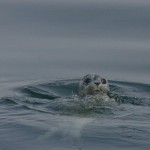
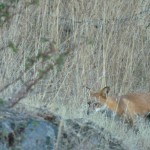
This is my first blog entry so I am going to give an overview of my experiences and feelings for the first part of the fall beam reach program. I have had limited internet access while on the boat for the last week so this is my first chance to update everyone. I started the first week by getting to know the other students in the program, as well as getting use to our living situation while we are on land at the Friday Harbor Laboratories. One of the most interesting aspects from the beginning was discovering where each person is from and hearing stories about their previous experiences. Cat is the only student from the UK and a different country, and that has led to many funny conversations and explanations about differences in our cultures and words. We started to become a proper group by taking a series of walks along the trail system near the labs which lead to the shoreline of San Juan Island. While we were out there three of the girls in our group had their first experiences with marine wildlife in Northwest Washington, and this resulted in hundreds of pictures; mostly of tiny seal heads just above the water. The wildlife in the area is not limited to the marine environment, and we see deer and hawks on a daily basis; we were even lucky enough to see a fox (see picture). All these animals are associated with a 200 acre biological reserve that is adjacent to the labs, and that has given me a great place to go for a runs and walks.
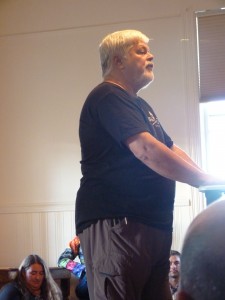
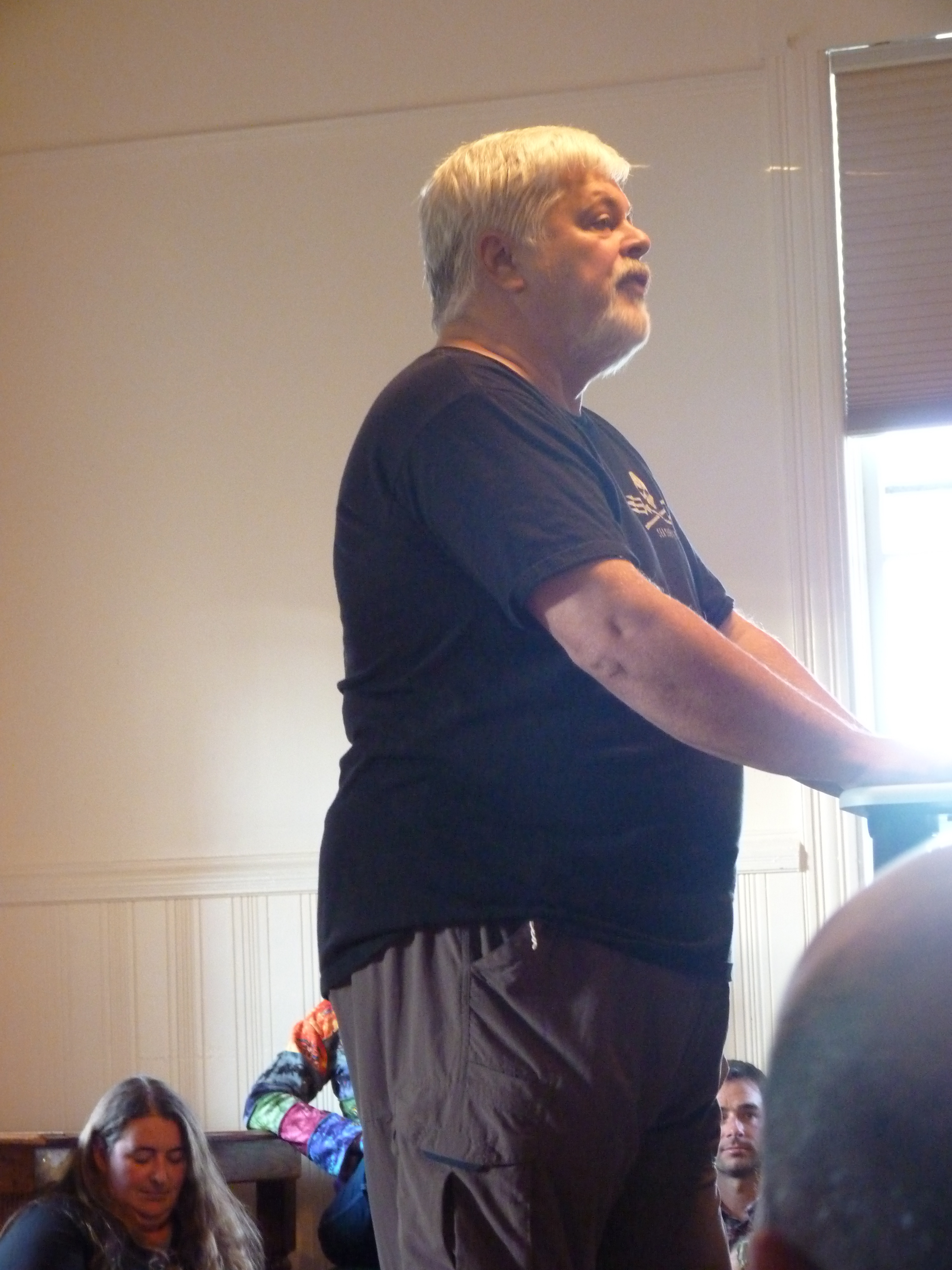
The academic side of the program has been equally stimulating, and our professors have provided us with a crash course in acoustics, which includes how to use a series of hydrophones to record sounds made by killer whales for our research. In addition to our daily classes we were lucky enough to have outside guests come give lectures to our class about their personal research and experiences. On a couple of the nights we rowed into the town of Friday Harbor and enjoyed lectures from an octopus expert from the Seattle Aquarium, and Captain Paul Watson from the Sea Shepards at the local whale museum. Overall, the first three weeks on land were a great start for getting oriented to this type of program and living arrangement. However, now that we are on the boat everything has shifted again.
Each day on the boat has a rotation for various jobs which include cleaning up, and preparing breakfast, lunch, and dinner. I think the quality of the meals has surprised everyone, and each night has had a different delicious meal. We are lucky enough to have access to the 42 foot Gato Verde with Captain Todd Shuster. The Gato Verde is a 42 foot catamaran sail boat that is powered by a biodiesel generator, and an electric motor.  The electric motor produces extremely low levels of sound which allows us to take very accurate measurements of the whales while we are actively following them. Captain Todd has also been very helpful and effective at teaching everyone some essential knots, and techniques used for sailing, navigation, and operating the boat in a safely. As part of the course on sustainability we track our usage of electricity and water daily, and this has helped everyone realize how much each person uses in terms of resources on a daily basis. This is important information because the boat is a closed system with finite amounts of fresh water, food, fuel, and space for various forms of waste. Also we try to consume foods on lower trophic levels by staying with a vegetarian diet in order to further reduce our impact on the environment.
On a more exciting note we have encountered numerous marine species in our first week including Minke Whales, Harbor Seals, Stellar Sealions, River Otters, Tufted Puffins, Porpoises, and last but not least killer whales. We saw our first killer whales early in the week which resulted in a scramble to get some initial recordings which turned out to be amazing. It was a little difficult to follow them for as long as we would have liked due to heavy fog, however, we have had some very nice sunsets during dinner time for many of the days this week. On Wednesday we learned a valuable lesson when some of our batteries ran out and we lost some recordings for one of our hydrophones. Everyone on the boat has become more comfortable with equipment as the week progressed, and tonight is our first night on land in about a week. Everyone is busy taking showers and using the internet before we leave again tomorrow for another week of studying the whales. I am sure I will have many new and exciting stories by the end of next week to blog about, and I will post them as soon as I have a chance thanks for reading.
Read More
We finally get to get our feet wet (not literally we hope!). On Sunday we packed up S-1 and headed down the dock to the Gato Verde, our home for the next two weeks. Gato Verde means green cat, and the boat really optimises that name, it is a catamaran (hence the cat) and we operate on a combination of biodiesel and sail power (hence the green).
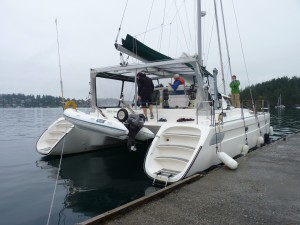
Our first steps on the boat held all the excitement you feel when you first go holiday and see your hotel for the first time – this is far cooler than a hotel though! There are 3 bed rooms in each of the two hulls. The galley has and amazing round sofa in it and an Aladdin lamp (yes we are all immediately thinking Disney!). Captain Todd is really nice and we have already learnt so much from him in just a couple of days. He also must be very trusting as he quickly let us all have a turn at the helm and decide our anchorage.
We spent the first night in Griffin bay, where we learnt how to drop the anchor. On our first full day the whales were shy so we did some hydrophone tests for ambient (background) noise and headed for Snug harbor, which was our second anchorage. On day two our luck changed and as soon as we set sail (well motor because of the lack of wind) we found the whales! It was so amazing!!!! It was really foggy in the morning so we couldn’t always see the whales but we could hear them through the hydrophone and their blows when they surface, then they would emerge from the fog. We headed back to snug harbor in the evening, and the weather was dramatically different with bright sunshine and few clouds – this called for a few hours ofreading and playing on the trampoline and soaking up the weather!
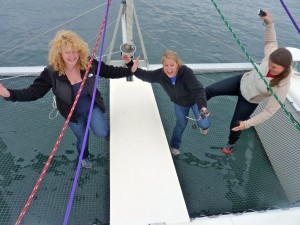
Day four at sea was the coolest day ever! We set off as normal but soon slowed down when we saw a bait ball and birds feeding on it. We were going to try and catch some fish for Russell Barsh back at the labs when a Minke whale surfaced right in the
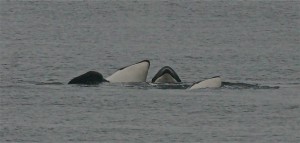
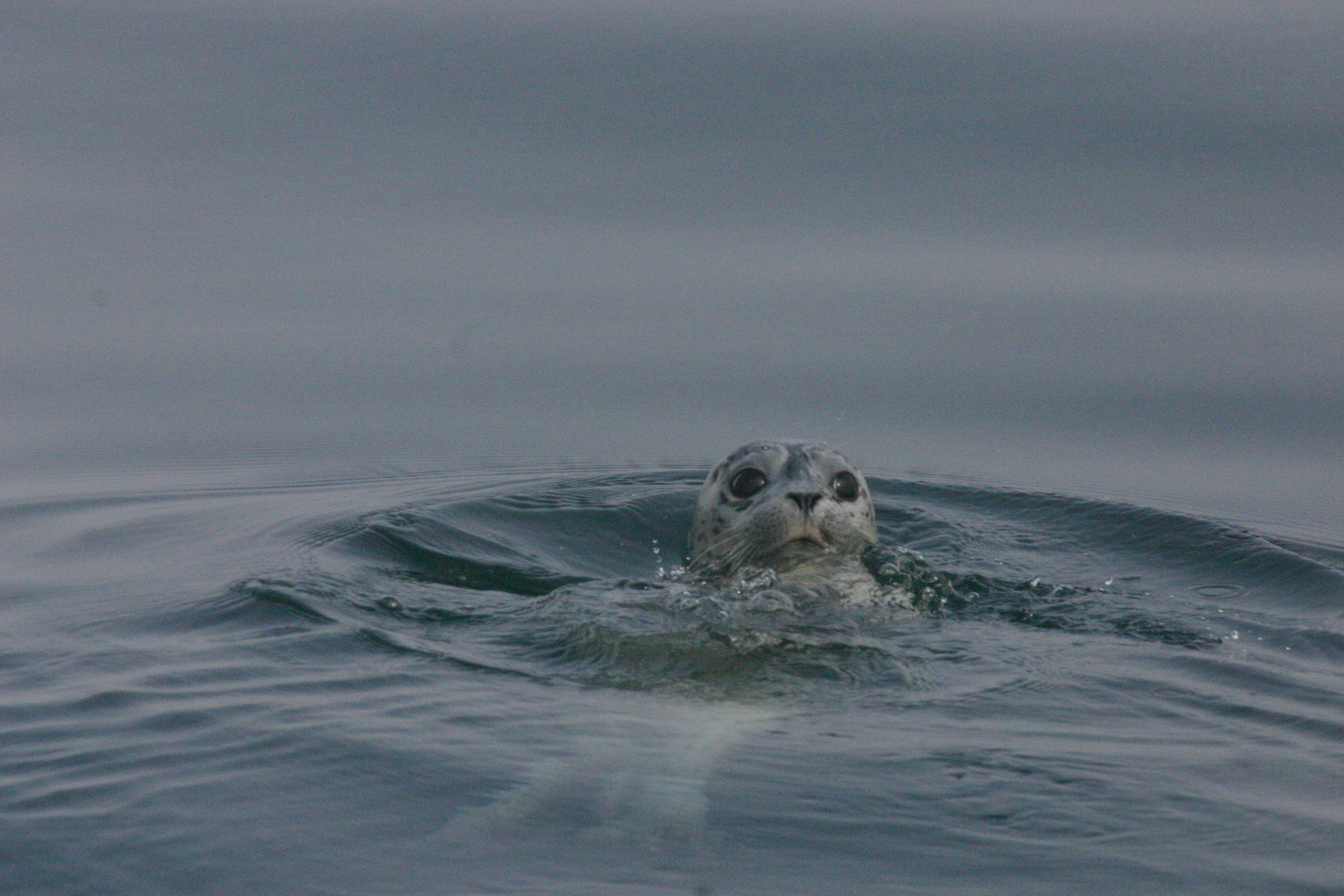
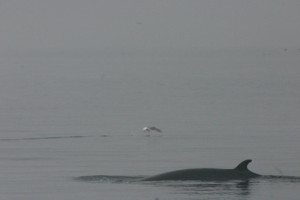 middle of the birds we were looking at! Then we saw another – it was sooooooooo cool, i even got some blow recordings. After a while the whales became less frequent and we were just chilling at the back of theboat when a seal pup came up right next to the boat (i could even see his flippers moving as he swam), i thought he would swim off but instead he swam right up to our back steps and a tried to climb on the boat!!! When that failed he swam through the middle of the hulls and under the trampoline!!!! It was very cool. We had to get moving after that and we all thought that would be the thing to write home about but it got even better! We headed out to false bay to catch up with the Orcas, and put our hydrophones in to get some recordings and i got my first successful in air recordings of the Orcas. I was merely recording after lunch when a group of females with their calves started performing some really cool behaviours. My recording was so funny it started out very sciency with me saying things like “female, j-pod, traveling, 150m” and as they got closer it changed to “oh my gosh i can’t believe what im seeing” as they started a greeting display with tail slaps, breeches, pectoral slaps, rolls and above surface calls (and i recorded it!). We were just processing what we had seen when out of the corner ouf our eyes we saw a sealion come up and joined the killer whales! Very weird – were they sharing food!!? On the way home we came across Dalls and Harbor porpoises bow riding with another boat! So our pinnipeds got larger and the day went on but our cetaceans got smaller!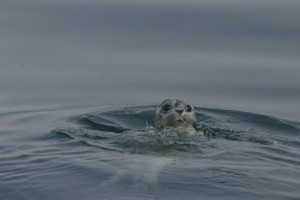
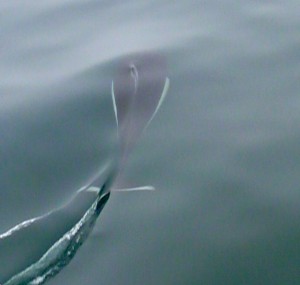 After a couple of quiet days, we got the chance to see bow riding up close. We were heading back to Friday Harbor labs for an overnight stop off when 5 porpoises (4 Dalls and 1 hybrid) stared bow riding the catamaran! They were so close we could feel the splash as they surfaced.
We are now back on land,ready for showers and excited to start our second week at sea tomorrow 🙂 x x
Read More
Right now we’re currently anchored in Snug Harbor where we can borrow internet from the mainland and I couldn’t resist signing on and forwarding some pictures. I’ll have more details to come since internet access is limited and I have tons of work to do, but I had to share the potentially best day I’ve EVER had. Let me name the reasons: an incredibly gorgeous sunset last night segued into a peaceful, foggy morning today. We started our day seeing minke whales and an adorable baby harbor seal swimming around the boat, and trying to climb up our back stairs. We moved on to see orcas, lots and lots of orcas!
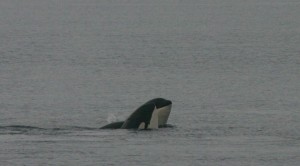
My favorite part was seeing a mom and calf interact and play around–it was amazing to see how curious and playful the calf was! Plus we heard orcas vocalizing in AND out of the water and saw so many(/much) peck flaps, tail slaps, spy hopping, breaches, playing around, nuzzling, familial bonding…The Southern residents were definitely out and about!
Our day ended with a stellar sea lion and both Harbor and Dahl’s porpoises, who were bow riding on another boat, on our way back. To top it all off? Mac and cheese and chocolate chips this evening! Seriously. You cannot top the day we had with the marine wildlife, especially the orcas. They are clearly such intelligent and playful animals, I’m continually amazed and awed and inspired by these beautiful creatures. I cannot believe this is my life right now.
Sorry I just word vomited out this amazing day. Everyone has been getting some great data for their projects, and I just couldn’t keep this day to myself!
Cheers,
Hana
Hey everyone,
My name is Cat and I am from the UK. I have definitely travelled the furthest and with the most complications (good old visa’s and customs!) but it is more that worth it now im here on San Juan Island. It is so beautiful I never want to leave! I am a Zoology graduate from the University of Manchester, and have joined this program to gain research experience, meet new people, travel and of course help save the beautiful Orcas that frequent these water.
This first blog will detail highlights from the first few weeks on land and hopefully the blogs will be more frequent once we are out at sea with the whales we are studying.
The exploring phase
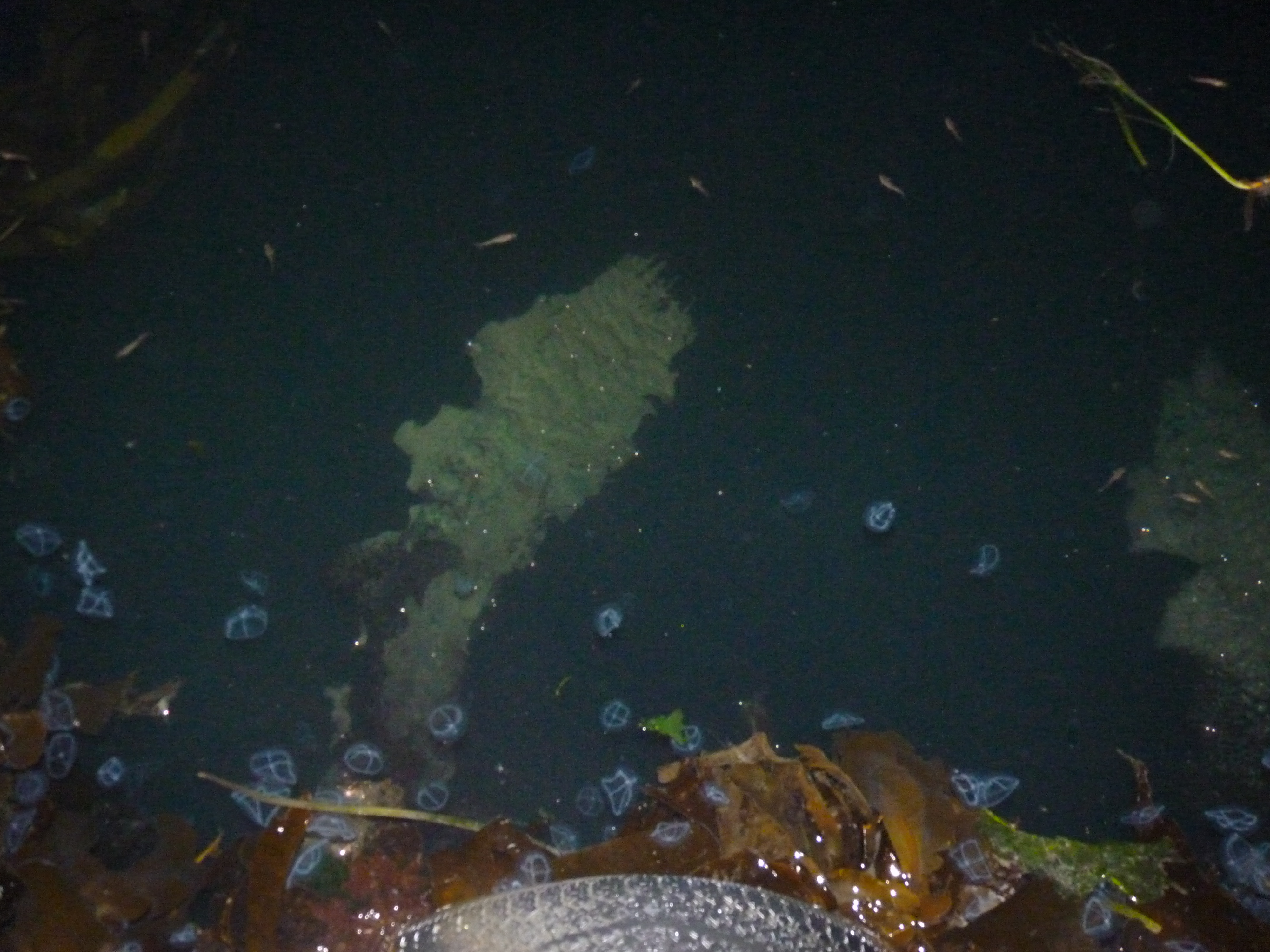
The best things about living at the labs are the hiking trails. Me, Megan, Hana and Garrett have been having a good explore around the area and Garrett even mapped all the runs. We have explored a couple of times and definitely always come back exhausted but happy. They also tend to always go straight for the candy. We have also been testing our rowing skills – which is something i definitely do not excel at! The situation is made even more embarrassing due to the fact that everyone keeps pointing out that the british one should know how to row. Im learning though! The water is amazing at night though, we all love the bioluminescence and jelly fish (as you can see in the picture).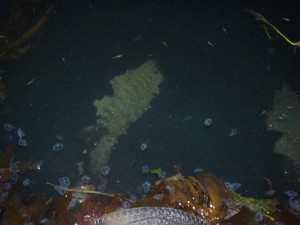
The planning phase
We have all had to think about our individual questions the first week. We went up to lime kiln, to look out over the water and think about our twenty topics of interest. 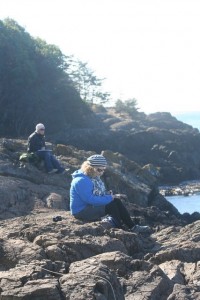 The setting was beautiful and very inspiring. We
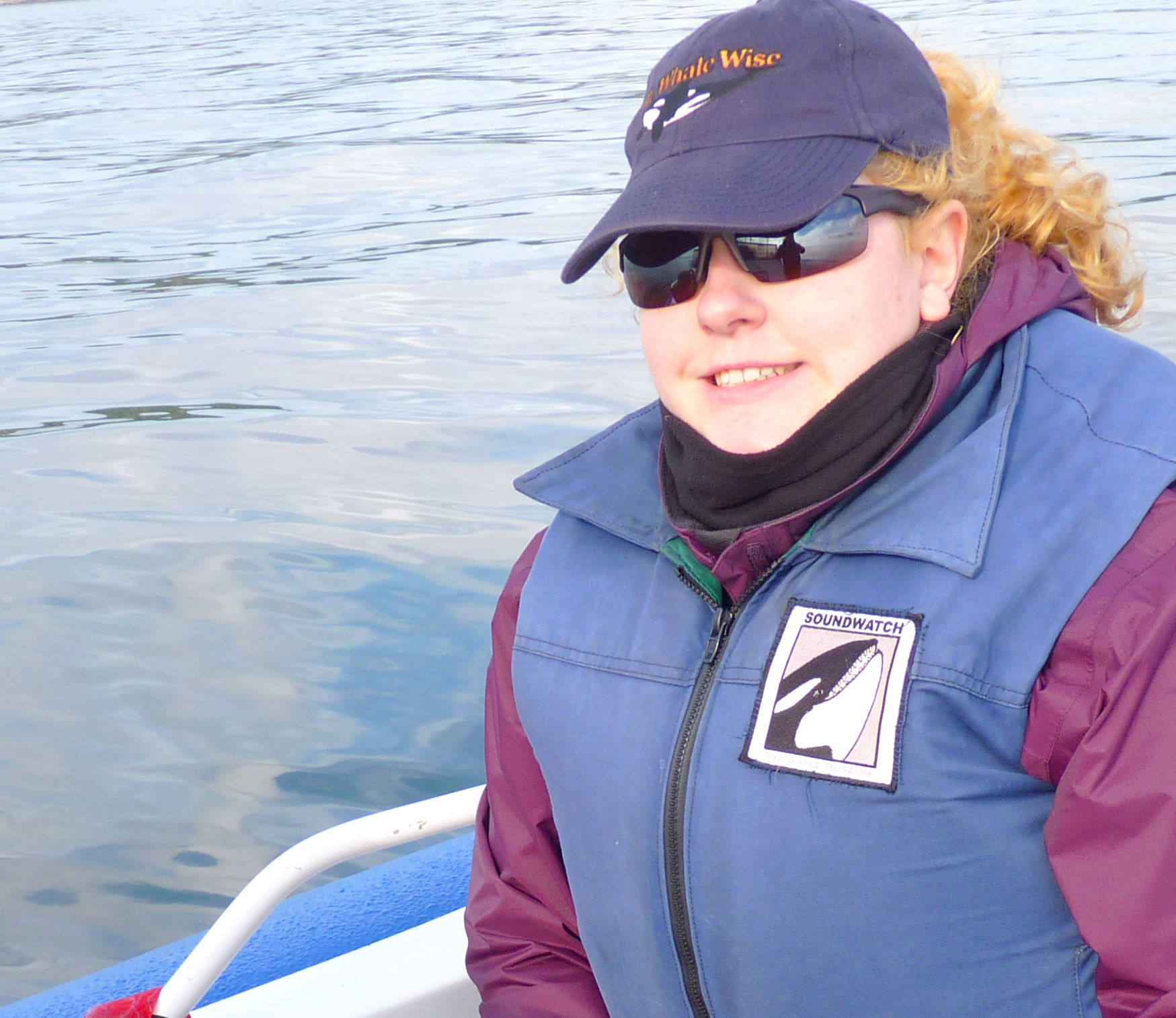
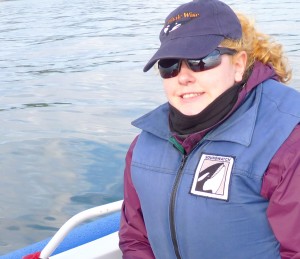 have also been having lots of mentor meetings and been working on our first proposal drafts. We also have lots of lectures to prepare us for field research and the topics we need to be familiar with on the boat. There has been a few guest lecturers here to, and its so interesting learning about all their research topics and how they got into the field. We all also have to do a service project, which is one day of volunteering. Me and Hana volunteered for Sound watch, which is an amazing non-profit working to help keep people more than 100m from the whales (http://www.whale-museum.org/programs/soundwatch/soundwatch.html). The coolest thing is the long pole they use to pass the leaflets to other boats. It was reall cool to get out on the boat and see the whales!
The having fun phase
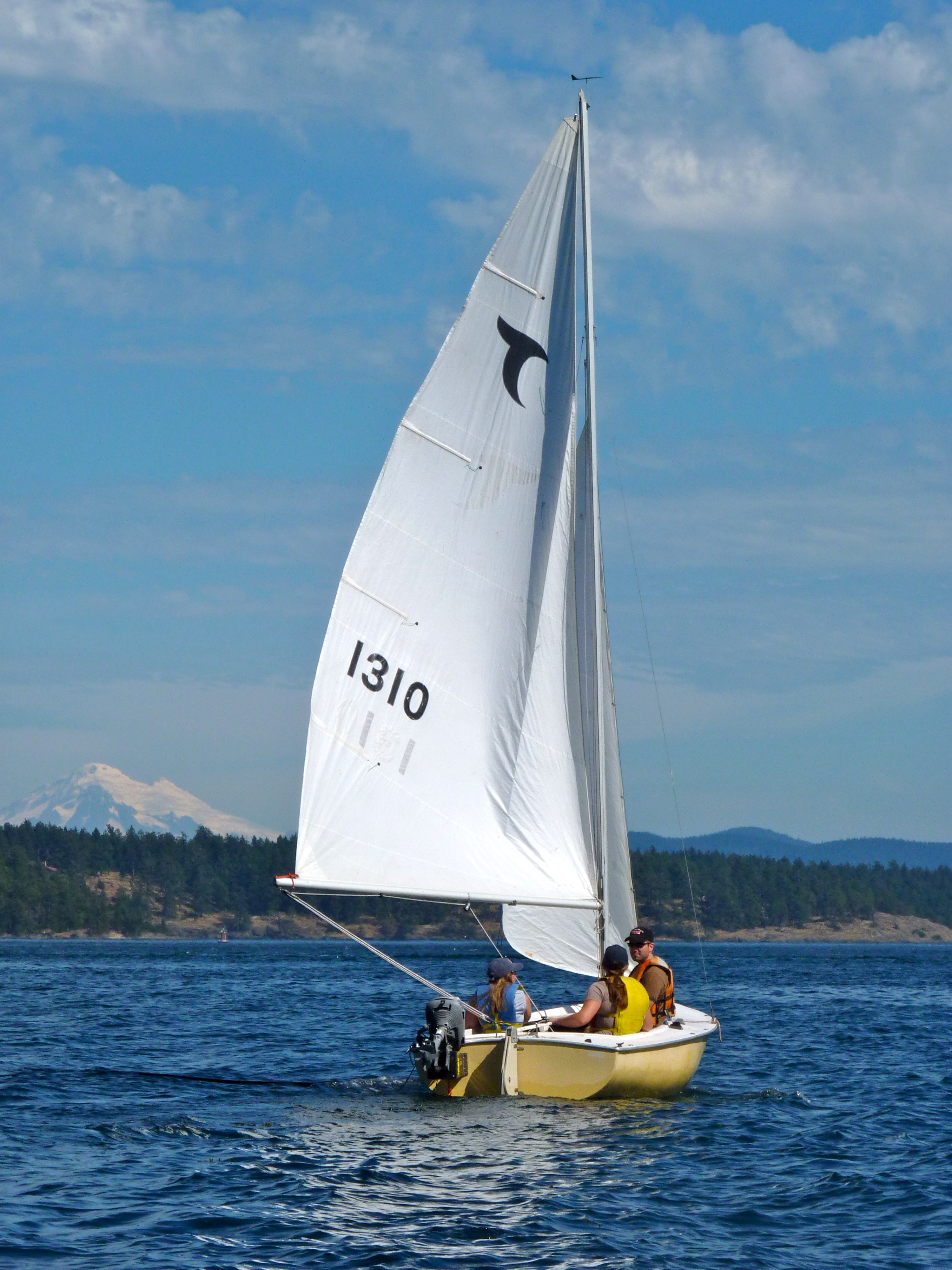
We have also been doing lots more fun things. The most memorable being our first experience of sailing. It was so good to get in the boat and learn how to tack! I really enjoyed it. We also had a had a lecture from Captain Paul Watson, which was organised through the whale museum. He is a very inspirational speaker, and had some great stories. The last fun thing i am going to tell you about was the plunge dive (i think you can call it fun!) We had to jump off the docks and swim to the other side to climb out! It was seriously cold, to the point you can’t even speak! Believe me i tried. But if the aim was to teach us not to fall of the boat or tip it, it cartainly worked! It was fun though – in a wierd way.
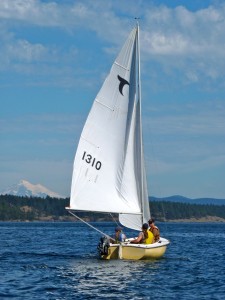
All in all a great first few weeks, with far too many stories to write in one post! We are now off to sea for two weeks, and im sure this course will continue to be great fun and very inspiring. x x
Read More


Today was our first full day on the Gato Verde. Despite being bookended by fog (pea-soup in the morning and thin, wispy, romantic fog out of a painting in the evening) , we did find a little bit of sunshine in the middle of the day. The big benefit of fog is that it is often complemented with still water. In fact, we have yet to test the sea-worthiness of our stomachs as we had an entire day of completely smooth water (really like glass). Who knew the ocean could be like that? The disadvantage of fog is, of course, that it makes it hard to look for whales. Harbor seals, Stellar sea lions and porpoises all made appearances close to our vessel, but all reports indicated that our neighborhood orcas were off in international waters. Luckily, being bioacousticians, we were able to listen for whales as well using our hydrophone array and our fancy new high-frequency hydrophone. Alas, there was nothing but engine noise to be heard.* However, now that our equipment has been properly tested and proved itself to be up to the challenge of dealing with the rigors of the sea, we will be ready for the appearance of our lovely black and white friends on the morrow.
Of equal importance to the knowledge we gained about our hydrophones was the knowledge we gained about seamanship today. Not only did we learn about luffs and leeches (parts of a sail) but practiced our bowlines and half-hitches and sheet bends as well. We are in good spirits, well fed and learning a lot about each other, about whales, about research methods and about sailing. And, as we head to bed tonight, we are treated not only to cold, clear skies and a million lights above us, but also to cold, clear waters and a million lights (via bioluminescence) below.
Be there wind or be there whales tomorrow, we’ll be ready!
*Not our engines, however. We found out today why Captain Todd named our boat the Green Cat. It turns out that running on a combination of wind power, nearly silent electric motors and a bio-diesel generator that is not attached to the hull is not only good for avoiding disturbing the wildlife with noise, it’s also good for the environment by reducing emissions and using zero petroleum products for locomotion or cabin electricity.
Read More
Friday Harbor Labs to Griffin Bay
Although the rain made the logistics of loading the boat more difficult and Todd faced 25 knot wind as he departed Bellingham, the Gato Verde made it to the FHL dock just afternoon and we departed just a few hours later. Everyone got a chance to steer as we worked our way south into Griffin Bay where we anchored for the night and enjoyed some award-winning chili and corn — no wait — oatmeal bread for dinner.


A highlight for me was watching the skipper of a 20′ scow row his boat past us using a yuloh — a stern oar that is swept side to side like a fish tail. Made of Douglas fir and almost as long as the boat, the oar was mounted in a horse-shoe shaped oar lock on the transom and the end of the loom was held down by a lanyard. Without working hard (not even holding the end of the oar) they made 1-2 knots past us and then set an anchor and boom tent.
The yuloh is another nice way to move oneself sustainably across the planet, one that is simpler than our biodiesel-electric propulsion system, but certainly less powerful and able to make a schedule. Of course, it might be hard to keep up with the southern resident killer whales using yuloh power… and our 12 kg electric motors and 14 kW biodiesel genset are a grand improvement over the dual 27 horsepower inboard diesels that we started with in 2005!
Read More
Hello! I’m Megan, from Colorado, but I attend college at the University of Hawaii at Hilo.
The fall 2010 program is running full force! We are now 3 weeks into the program and setting out for our first sail today! So far this is one of the best experiences of my life. Since I have failed at keeping a daily journal I will just give you all some quick highlights.
This was my first trip to Washington State, and was blown away by the beauty of the San Juan Islands, I was even amused by the ferry ride over to Friday Harbor. One of the best feelings is living next to the ocean and having hiking trails in your back yard, which I have found at the Friday Harbor Labs. Hana Cat and I took walks in the first weeks here (while it was warm) to explore these trails, and every time I was so impressed by the view of the shore trails. One of the best parts of living at the labs is the fact that we have the option to row into town. I’ll admit I’m not the best, but not the worst, at rowing. It’s so peaceful and a totally different view of the island. Typically we run across a few harbor seals on our way to town.
During our time on land we were lucky enough to be here while The Whale Museum was still doing their summer science lectures so we got to listen to talks by Roland Anderson-the octopus guru, Captain Paul Watson, and our one and only Dr. Jason Wood. We’ve also had various people come into our own classroom (which just so happens to be our living room) to tell us about their research and what they are interested in.
The best highlight from these weeks on land is of course…. WHALES! My first sighting of the whales was on the ferry back from Seattle the first weekend here. We caught a brief glimpse at them as we were coming into Friday Harbor, which is very rare. Later that week the whale phone (we get updates via text of where they are during the day) was going off all day and they were hanging out on the west side of the island, so Hana Cat and I jumped into Dave’s car to “chased” them up the coast to meet up with them at the county park. It was the first time I was able to document the whales, most exciting day of the program so far!
Of course it’s not all play, we have been doing a lot of work too! We’ve been preparing our proposals, and trying to figure out our methods before we set sail. It all feels a little rushed but we have to get it done while the whales are still here. Lots of research and reading going on.
Talk to you all when we get back on land!
Aloha!
Megan
Read More


 You truly get an idea of their speed and power when they’re in travel mode! We even got to observe foraging behavior, as many of the whales stuck around to feed, making quick lunges, deeper dives, and moving in random, sporadic movements! All the behavior changes were great for me, since part of my research question will be comparing echolocation click rates and behavior states; I got a lot of excellent data to analyze!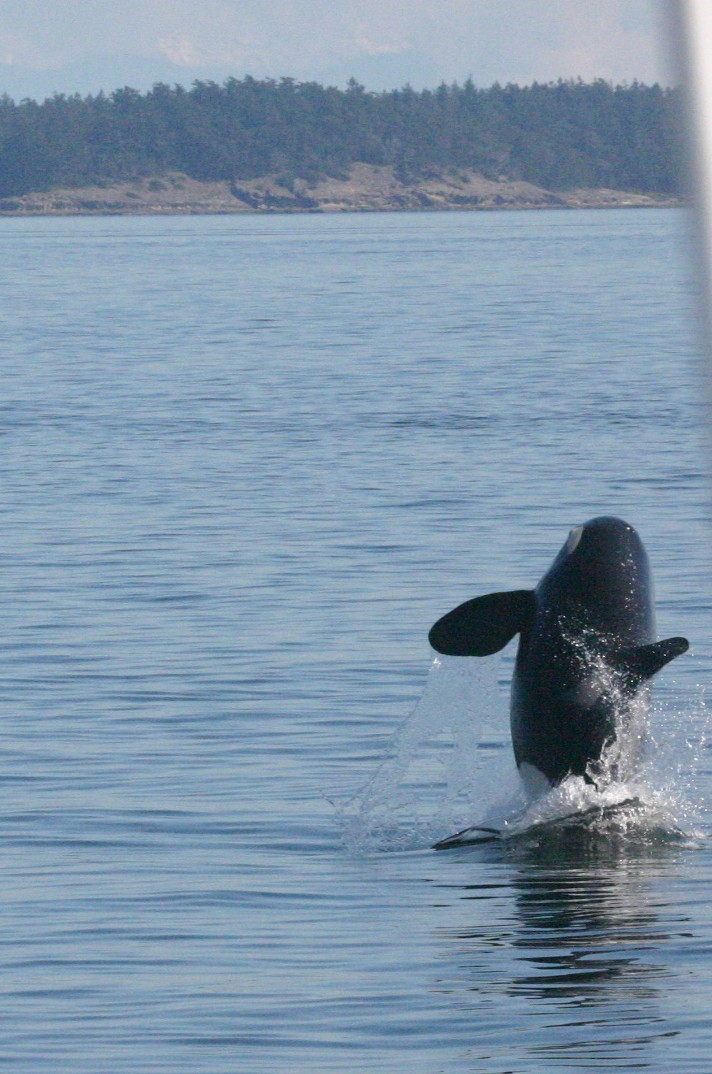








 Twitter
 LinkedIn
 Facebook
