With transient killer whales sighted in the vicinity yesterday and the whereabouts of the endangered southern residents unknown, we were surprised and concerned to hear active mid-frequency sonar and distorted underwater voices this evening in Haro Strait. Thankfully, the broken hydrophone at Lime Kiln State Park had been repaired just hours earlier by Beam Reach students and staff conducting a service project at The Whale Museum‘s acoustic laboratory that is housed within the light house. Eventually, Jeanne Hyde heard from the Coast Guard that we were likely listening to a U.S. Navy submarine. (4/9 update from Christopher Dunagan: the Navy confirms it was the USS San Francisco, a LA-class fast attack submarine which ran into a seamount near Guam in 2006. Since there was clearly damage to the sonar dome and it was replaced with the nose of decommissioned sub, I speculate that it was a higher priority of the Navy to test the sonar while still close to the ship yard than it was to go beyond the call of Naval duty to protect marine mammals.)
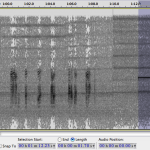
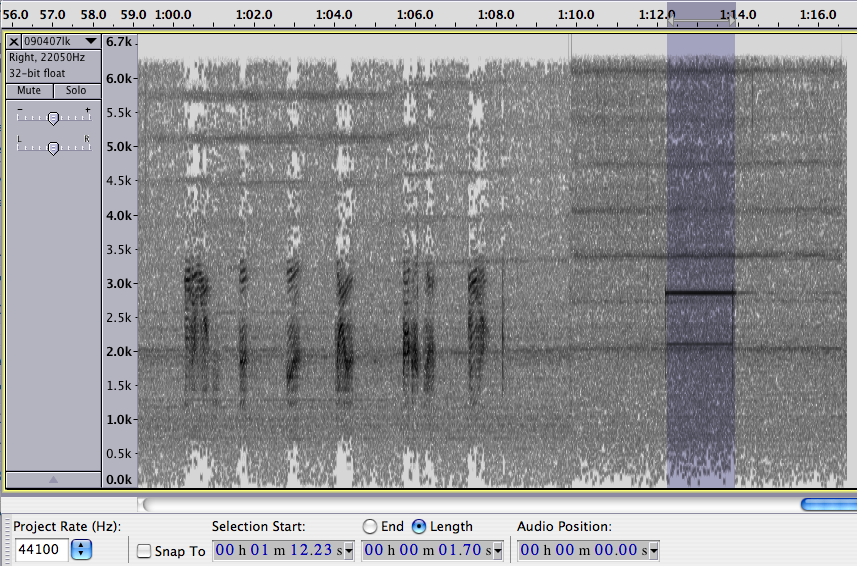
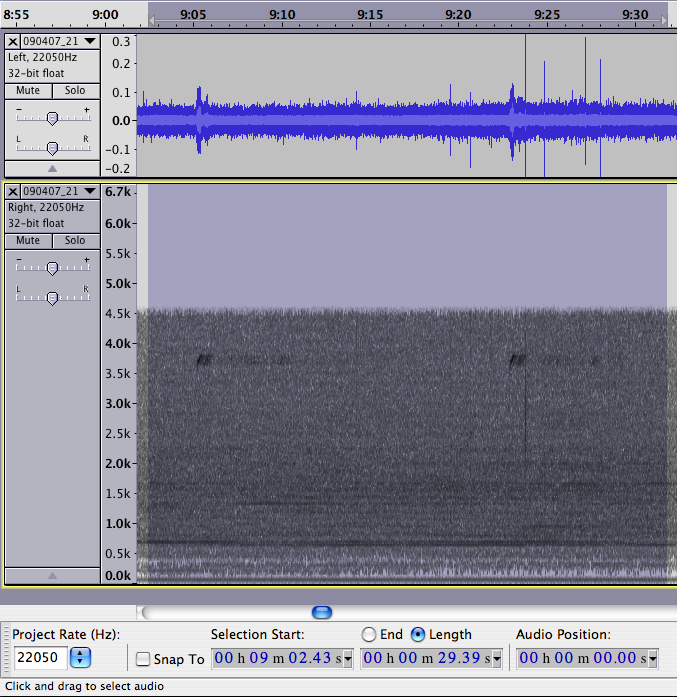
An example spectrogram of the voice and a sonar ping
At 18:55 PST, Jeanne first reported someone “talking” into the Lime Kiln hydrophone of the Salish Sea Hydrophone Network. At 19:10, I started recording the Lime Kiln stream, capturing about 6 sequences of 5-10 distorted human words over about 11 minutes. The sequences seem to come every 1-3 minutes and begin with the same first few words and then vary in content and length. Most words had most of their power at 1.5-3.5kHz. About a minute and 15 seconds after the preceding word sequence, there was a 1.7-second tonal sonar ping at 2.9 kHz. At right is a screen grab from Audacity that shows the ping and the preceding word sequence. Here is a concatenation of the sequences and the ping: 090407_1910clips-lk_voice-sonar
Listening to both west side streams at around 19:15 it seemed that the voice and pings were louder at Lime Kiln, though they could be heard after a few second delay at the Orcasound hydrophone. By 21:00 it seemed the signals were louder at Orcasound than at Lime Kiln. This suggests that the Navy submarine was moving northward up Haro Strait. Since we have only a single hydrophone at each node and node-to-node timing isn’t synchronized in the streams, it’s not possible to verify the direction of travel using arrival time differences.
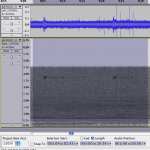
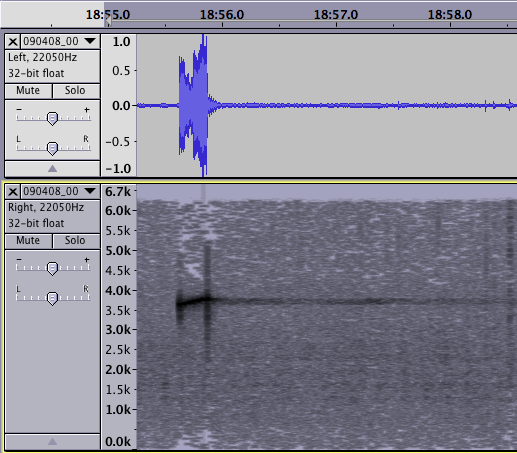
2 pings of a 3.75 kHz sonar
At 21:02 I made another recording from the Lime Kiln stream that contains two of the word sequences.  Then I switched to recording the Orcasound stream. The voice was clearly audible for the next half hour and there were a few sonar pings interspersed. By 21:34 the voice was pretty faint and the last time it’s dectable in the sonogram (and by ear, very faintly) is around 10:05. However, at about 21:59 the final recording caught a couple of unique pings (3.7-3.8kHz, 0.8 second) and their echoes ( 090407_2150_os_375khz-sonar ). The two pings were spaced 16 seconds apart and had a noticable echo at 3.67 seconds, equivalent to about 5.5 km. Assuming the echo was off the eastern wall of Haro Strait bathymetry (about 6km from Orcasound), the two-way travel time suggests the submarine was probably pretty close to the San Juan Island side of Haro Strait.
Longer, unedited recordings are available at http://orcasound.net — including:
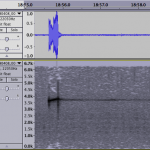
A single 3.75 kHz ping
The acoustic experience continued on past midnight. At 00:24:30 on 4/8/09 I heard a series of beeps (back at ~2.9 kHz) and then their echoes at Orcasound. At 00:30-00:32 I again recorded the voice along with tones and their echoes on the Lime Kiln stream. Around 00:40-00:45 I heard and recorded what sounded like a conversation, rather than the separated single words of the previous sequences. At 00:48:30 there was a very loud ping (close to Lime Kiln?) and either an echo or a ping from a separate, more distance location. This was followed by many repeated word sequences.   At 01:00 things got quiet, but then at 01:11:00 there was suddently another impressive single ping (sound clip: 090408_0038_lk_single-375khz-ping ). At 01:13, the slow voice started repeating sequences again. Another single ping came at ~01:22 as two cargo ships came abeam of Lime Kiln and increased the ambient noise levels. Another at 1:31:00 with a nice echo was followed by more conversing at 01:36. Then there was an extended sequence of sonar tones and verbal interjections that grew progressively fainter and then stopped ~01:45.  Around 01:50 things picked up again with more conversation and then — most interestingly — what sounded like an exchange of longer tones, possibly between two sources, one near Lime Kiln and one substantially further away. After about 5 minutes of silence, there were two more loud pings with echoes at 02:00:45.
Recordings made for much of the following hour, but I think I missed two loud pings at ~02:53:00. More pings heard at: 03:11…
Read More
After several years of “regrouping” (a.k.a. child-rearing) I will finally take the next step toward my academic goal this coming fall. I’m entering the Master’s program in Wildlife and Fisheries Science at Penn State. Thanks to ongoing encouragement from Jason, Scott, Val, and Celia (of course!), and a lucky posting on MARMAM last spring, I found my advisor, Dr. Jennifer Miksis-Olds, who works jointly with the Graduate Program in Acoustics and the Wildlife and Fisheries department at Penn State. I will be supported through the Applied Research Laboratory at Penn State and am excited to be the first master’s student in Wildlife and Fisheries to receive ARL support (thanks to my acoustics background via BR). I hope to set a good example for that partnership, and also to raise interest in Beam Reach at Penn State.
My research project will use acoustics to study sport fish populations in local Pennsylvania lakes following habitat restoration. Current study practices utilize “electro-fishing” techniques and will provide a comparison. Acoustics should allow a less intrusive and more sustainable approach to fisheries management. How does that relate to Southern Residents? I plan use the acoustic and fisheries experience I gain from this project to investigate salmon populations in the Salish Sea. Examining the salmon populations was actually one of my 20 questions on day one in ’05… imagine that! 🙂
Best wishes to the new Beam Reach spring class of 2009!Â
(Hang on to those questions)
Read More
After a fantastic overview of recent research and very current concerns expressed by the commercial whale-watcher industry, Scott and I parted company with the brand new Beam Reach students and their lead instructor, Jason. They took a very rocky ferry ride from Port Townsend across to Whidbey Island. We watched the little white ferry bobbing in the midst of a sea of angry whitecaps and waves.
A few hours later, Scott and I started north on Cat’s Cradle, our 32′ catamaran. With sails reefed and motor running fast and smooth we fought away from Port Townsend with 30 kt winds, 3-6′ waves and an adverse tide. The boat did well and we braved white knuckles and arrived 16 miles north on Lopez Island about an hour after dark. The last miles were done carefully with radar and GPS.
Beam Reach 2009 – Spring Program – BEGINS!


Read More

Standing room only
On Monday and Tuesday this week we attended the Transboundary Naturalists workshop. While we made our way from Seattle’s Aquarium out to Port Townsend in some very densely packed vehicles, Val and Jason sailed down on Val’s boat from the San Juan Islands. Captain Todd drove down to Bellingham and we all got to listen to the latest findings in killer whales science, as well as updates on new regulations and enforcement.

The pace of lectures and networking opportunities was intense and the
final agenda (PDF) read like a who’s-who of southern resident killer whale experts. We were able to meet and ask questions of some of the old guard, like Ken Balcomb and John Ford, as well as a bunch of talented youg researchers. At meals and a Monday night reception, we met many of the naturalists who work aboard whale watch vessels, as well as the vessels’ drivers and owners. With luck, all these contacts will prove useful — either during proposal development in the next few weeks on land, or at sea when we will need help locating the whales and cooperation while studying them.
We are off to a great start of classes for the quarter after a harowing ferry crossing to the islands. This morning we even had snow! We can’t wait for the cold plunge in 3 weeks when we get to feel how cold things can be here.
Read More

Walking to the Port Townsend beach to ask 21 questions. (From the left: Matthew, Erica, Peter, Hilary, and Hannah)
We’ve made it safely from a fun initial meeting at the Seattle Aquarium to Val’s boat at the Port Townsend Marine Science Center dock. Thanks to Leslie and Val for a delicious sesame noodle dinner, supplemented with fresh-baked rolls from Jason, we were re-fueled and ready for a first class exercise.
We walked to the local lighthouse at Point Wilson and sat on the beach for a half hour to think up 21 questions we have about killer whales and their environment. These questions, or other ones inspired by the workshop talks we’ll attend the next two days, may form the basis for student proposals that will develop in the first three weeks of the program.
Despite some big ship wakes, we all got a good night’s sleep. Now we’re off to the Transboundary Naturalists Workshop to hear from local experts about the status of the southern residents and our efforts to recover the population. Here are some more photographs from our first day.
Read More
With about 6 weeks before the spring program begins we have created a home page for the spring 2009 class (091) that includes links to their photo gallery and blog entries. Keep an eye on it to learn more about the incoming students and track their progress.
A most exciting and unique aspect of the spring program is that we have all been invited to participate in the Southern Resident Killer Whale Transboundary Naturalist Workshop (March 30-31 in Port Townsend, WA). It’s looking like quite the tour of the current state of SRKW policy and science, with about 25 20-minute talks from many of the most active managers, enforcement agents, and researchers! See tentative speakers/topics list (PDF) and latest draft agenda below:
Suggested Schedules for SRKW Transboundary Naturalist Workshop
Draft 2/10/09
Monday March 30, 2009
Start    End   Task   Time
9:00   10:00   Coffee/ Pastries   1 hour
10:00   10:15   Welcome Remarks   15 min
Management/Enforcement/Human Dimensions Panel
Management
1Â Â Â Â Â Â 10:15Â Â Â 10:30Â Â Â Lynne Barre – NMFS/NWRÂ Â Â 15 min
2Â Â Â Â Â Â 10:30Â Â Â 10:45Â Â Â Paul Cottrell – DFOÂ Â Â 15 min
Human Dimensions
3Â Â Â Â Â Â 10:45Â Â Â 11:05Â Â Â Suzanne Russell – NMFSÂ Â Â 20 min
11:05   11:15   Questions for above   10 min
Enforcement Panel
4Â Â Â Â Â Â 11:15Â Â Â 12:00Â Â Â Alan Wolf – NOAA LEÂ Â Â 45 min
5Â Â Â Â Â Â Â Â Â Â Â Â Larry Paike – DFO
6Â Â Â Â Â Â Â Â Â Â Â Â Russ Mullins – WDFW
12:00Â Â Â 1:00Â Â Â LUNCHÂ Â Â 1 Hour
Outreach/Population
7/8      1:15   1:55   Kari Koski-Soundwatch & Nic-Straitwatch   40 min
9      1:55   2:25   Ken Balcomb   30 min
2:25   2:40   Questions   15 min
2:40Â Â Â 3:00Â Â Â AFTERNOON BREAKÂ Â Â 20 min
Vessel Interactions/Sound
10      3:00   3:20   Marla Holt   20 min
11      3:20   3:40   Deborah Giles   20 min
12      3:40   4:00   Dawn Noren   20 min
13      4:00   4:20   Rob Williams   20 min
4:20   4:30   Questions   10 min
4:30   5:00   Keys/Room Check-In   30 min
5:00   6:30   COCKTAIL at Port Townsend Marine Science Center   1 hour 30 min
6:30   8:00   Dinner   1 hour 30 min
8:00   10:00   Salish Sea Member Meeting   2 hour
Tuesday March 31, 2009
Start    End   Task   Time
7:00Â Â Â 8:20Â Â Â BREAKFASTÂ Â Â 1 hour 20 min
8:20   8:30   Gather/Organize   10 min
Prey Relationships
14      8:30   8:50   John Ford   20 min
15      8:50   9:10   Brad Hanson   20 min
16      9:10   9:30   Eric Ward   20 min
9:30   9:50   Questions   20 min
9:50Â Â Â 10:10Â Â Â MORNING BREAKÂ Â Â 20 min
Contaminants
17      10:10   10:30   Sandie O’Neill   20 min
18      10:30   10:50   Peggy Krahn   20 min
19      10:50   11:10   Teresa Mongillo   20 min
16      11:10   11:30   Questions   20 min
Health
20      11:30   11:50   Steve Raverty   20 min
21      11:50   12:10   Pete Schroeder   20 min
12:10   12:20   Questions   10 min
12:20Â Â Â 1:20Â Â Â LUNCHÂ Â Â 1 hour
Health Continued
22      1:20   1:40   Katherine Ayers   20 min
23      1:40   2:00   John Durban   20 min
2:00   2:10   Questions   10 min
Habitat Use
24      2:10   2:30   Brad Hanson/Robin Baird   20 min
2:30Â Â Â 2:50Â Â Â AFTERNOON BREAKÂ Â Â 20 min
25      2:50   3:10   Candice Emmons   20 min
26      3:10   3:30   Val or Scott Veirs, Jason Wood   20 min
3:30   3:50   Questions   20 min
3:50Â Â Â 4:00Â Â Â CONCLUDING REMARKSÂ Â Â 10 min
Read More
52653
Yesterday Marla Holt and I teamed up to measure the source levels (broadband and spectrum) of a new device called the Thrustor. Essentially a cowling that houses the propeller, the Thrustor is known to increase the efficiency and “bollard-pull” power of an outboard or stern-drive engine propulsion system. The Thrustor was co-patented by Terry Smith in 2005 and is manufactured by Marine Propulsion Technologies.
52734
Terry drove his test boat up from California, his brother Chris flew out from Colorado to lend a hand, and Leif Bentzen provided and captained a boat from which to deploy the hydrophones. Marla and the Northwest Fisheries Science Center donated her expertise, her calibrated Resond hydrophone system, laser range finder, and hand-held GPS. I brought along the Beam Reach calibrated Inter-Oceans system and some buoys to mark the 100m and 400m ranges from the hydrophones. And thankfully, the weather really cooperated — while we expected drizzle and wind, we got clear skies and placid waters.
Despite substantial background noise from the Edmonds-Kingston ferry and passing freight trains, we gathered a bunch of data using dual-hydrophones that have a flat frequency response from 1-40kHz and are capable of recording up to frequencies up to 96kHz. First we tested Terry’s boat (powered by a Honda 80hp outboard) without the Thrustor, then with it. We made passes at 7-30 knots at ranges of 400, 100, and ~50m. We also measured the noise generated when accelerating from an idle to cruising speed.
Stay tuned for some preliminary acoustic results… For now, here are some photos from the day.
Read More
 Lead Instructor Jason Wood (also Research Curator at The Whale Museum) is a guest speaker at the Port Townsend Marine Science Center this month (Sat 2/21/09, 4pm, Fort Worden Building 204, $5 non-members).  This should be a great talk that combines Jason’s 15+ years of experience in Africa with his more recent immersion in killer whale acoustics with Beam Reach and The Whale Museum.
Read More
Thanks to Fred Felleman for the appended articles: new B.C. ferries are drawing complaints about being too noisy in air. One has to wonder whether the Coastal Celebration and its two sister ships, the Coastal Inspiration and the Coastal Renaissance, are also noisier underwater than their predecessors. The Celebration
BC’s Noisy New German Ferries
BC’s German Ferries May Be Lemons
BC Ferries Battles Fuel Costs
As killer whale scientists and conservationists we need to be more watchful of the ferry replacement process, particularly the standards for underwater broadband source levels and spectrum levels. We should all consider influencing the ferry selection/design process — on both sides of the border. For future replacements, let’s ensure that reliable estimates of noise impacts are available for existing designs and that strong underwater noise standards are required for new designs.
While the team who has selected designs for the new Washington ferries is confident that the new 144-car ferry will be more quiet than the fleet average, their modeling effort suggests there may be no improvement. The smaller ferry design is in operation on the east coast, but its underwater signature remains unmeasured.
More specifics at the Beam Reach wiki on ship quieting technologies
Read More




 Twitter
 LinkedIn
 Facebook