 Well, what can I say besides we are still alive. The great October sunshine has officially disappeared and the rain has come. Thankfully I like the rain in moderations. This week was harder than most because we had a relief captain and the boat broke AGAIN! We have been using the dinghy as the only source of powering the boat and get really wierd looks from people when entering a marina. Ya, I would probably stare too if I wasn’t on the boat. We had no power when docking at the labs today and the boat almost got away by doing a 360 in the docking area. Luckily it took six people to pull the boat into the dock while the wind was trying it’s hardest to push it away. We once again walked the boat into the dock at the labs. At least I got data this week and am excited to have it finished and analyzed quick. I am losing some data points because of some electric noise screwing up the recordings. I realize that’s just how science works. I am counting the days to be able to see my family when they come up. I hope to get more opportunities to acquire more data for my project in this next week. I do hope to have my project complete soon. Did I mention we also had some great porpoise bow riders last week, it was a highlight of mine!
—–
Read More
We humans are fundamentally challenged to grasp the nature of the seas. Sound is the key to perception underwater, yet our ears are rudimentary tools compared to our eyes. Despite all our communicative abilities and sensory technologies, we really struggle to understand what is going on in our local marine ecosystems, and it’s taken us a long time to determine that a global oceanic collapse is afoot.
After spending a week with the Beam Reach students, I returned to land with a broad suite of observations. Since then, my brain has been struggling to synthesize them.
Given how difficult it is for us to predict and detect the movements of our top marine predator (the killer whale), it’s fascinating to consider how we have come to sense that a global oceanic collapse is afoot. Why is it so hard for me (an oceanographer) to witness first-hand, or at least be whole-heartedly convinced that the seas are truly troubled?
It is also tantalizing to ponder how effectively a long-lived matriarch and her pod may be able to intercept food in the Salish Sea — particularly salmon with their own complex life history, migratory mechanisms, and distributions.
“Everything’s late this year.” says Kari Koski.
Someone notes that this year El Nino conditions are developing in the tropical Pacific.
An 80=year fishing Derby in Admiralty Inlet experiences a unprecented event: only one fish is caught!
Steve Mihaly relays catch data that indicate 90+ percent of the Fraser River fall run of Sockeye are returning to the north of Vancouver Island. In “normal” years, I guess more come around the south end and are accessible to southern residents
A clerk in Kings Market says her long-time fisherman customer became sick of catching nothing locally and fished all the way out the Strait of Juan de Fuca, and finally found salmon (chum, Chinook, and sockeye) 10 km offshore.
The Seattle Times publishes a series on the decline of our local oceans
Andy Foote says the herring aren’t returning to the Norwegian fiords.
Thus, I conclude that a great asset of human society is our ability to communicate, or “network.” Our environmental salvation may hinge on our innate drive to share information and our increasingly effective ways of doing so. To this end, I drafted a list of cell phone numbers for key marine observers around the Salish Sea, and I encouraged our students and staff to reach out to them. I left feeling like we should be hailing every visible boat on the VHF, especially fishermen and whale watch operators, to glean their marine insights and to share our own (primarily acoustic) ones.
I sense a similar interconnectedness of humans is critical in maintaining an accurate sense of how our local marine ecosystem is faring. The Orcasphere is a step in the right direction, but we need much more (if we continue to impact the oceans as we currently do). Georeferenced multi-species monitoring could help. The expanding network of hydrophones and underwater sensors (from Race Rocks to Athena and Neptune) hold promise for keeping us conscious of the state of the seas.
—–
Read More
As of today we have now completed our third week of the sea component. We set out with new methods and ideas for projects ready to test them in practice. Also, Scott joined us for the week to get a sense of what we’d accomplish and to work out difficulties we’d been encountering. I’d have to say our duties this past week could be summarized effectivly in one word…â€SCIENCE†Each day we talk about goals for the day, task to accomplish and projects to work on, but it typically comes down to doing just plain old “SCIENCEâ€. Some days this entails our killer whale research projects, while other days we record water quality data from various locations in the San Juan Island to monitor specifications of the water that might affects eel grass growth. Sometimes we’re fiddling with equipment, trying to reduce water flow noise past the hydrophone or troubleshooting a number of computer programs designed to analyze acoustic data. But some of the best SCIENCE abord the Gato Verde comes spontaneously through frequent observations. One day we sailed in front of the Lime Kiln Lighthouse, sprawled across the trampoline on the bow marveling at the Dall’s porpoises surfing the wake off our bow. On another occasion we spotted sea lions rummaging through a mixing area picking out prey and occasionally keeping an eny on our boat as we drifted past. And finally some days, there is not much to observe minus “birds, boats, and lots and lots of water!†best communicated in a thick British accent.
That said, all of us Beam Reachers are having a fantastic time abord the Gato Verde, floating up and down the Westside, talking with experts and enthusiats in the field of killer whale research, doing our own “SCIENCE†and keeping ourselves sane with jokes, games, silly accents, great food and nightly entertainment…
um…who loves October!!
Stay tuned for updates from week seven of the Beam Reach Adventure…
—–
Read More
It has been far too long since I’ve “blogged†and much has happened. First and foremost, I’ve seen breaching Orcas and bow riding Dall’s Porpoise and its been great. There are only 3 weeks left of the course, unbelievably. In the 7 weeks we’ve been here we’ve been to Lime Kiln State Park, a short kayaking trip, a short sail on a Cal 20 with the Commodore of the local yacht club, developed research proposals including methodology, meet many interesting people including some well known killer whale researchers, and we’ve spent 3 weeks on a catamaran around the San Juan Islands. Our first two weeks were an adventure. The first week we mostly spent getting used the boat and learning about sailing as the whales weren’t around. The second week we had two encounters with the whales and perhaps as interestingly the propulsion system on the boat stopped working. Our relief captain stepped up to the challenge and although we had no propulsion and little wind we managed to spend another couple of days on the water until safely returning to the Friday Harbor Labs. To return to the labs we rigged the dinghy up at the stern between the two hulls and ran that 18hp engine which was able to push us back to the labs and allowed for decent steering ability using the catamaran’s rudder. Somehow that week every time we were docking with little/no engine capabilities and only light winds I always ended up at the helm. I don’t mean to brag but I did pretty damn well and am proud of myself, plus I really learned a lot over that interesting week. Our third week out on the boat, the propulsion was mostly fixed and we were back with the owner/captain. We had one great day with the whales and collected quite a bit of good data but then the disappeared for the rest of the week. We kept ourselves busy with data analyzing and reading while we drifted around in Haro Strait hoping to intercept the whales as the returned. Despite having no Orcas we had a couple of wonderful encounters with some Dall’s Porpoise. There was one day we were sailing at 5kts or so and a group of 6-10 came up and bow rode for at least 20 min. I was sitting up on the starboard bow seat and when the came up to breathe they were 3 feet away and it felt like I could reach out and touch them. With their distinct black and white shading we could see them as they swam around underwater near the surface. A couple of days later we were just drifting with the current in Haro and a group of Dall’s came up and played around the boat for maybe 30 min. It was great!
—–
Read More
Where does one begin? My days are starting to blend together, so I will just share some of my favorite moments from these past few weeks. Well, we safely returned to Friday Harbor yesterday to provision the boat, shower, and get ready to go out to sea again for two weeks. Being on land, freshly showered, in dry clean clothes may sound quite ordinary, but yesterday I was enjoying all those things and more. The Gato Verde has been our home for about three weeks, taking us to places around the San Juans in search for whales. The weather has been heavenly and for the last nine days Colleen and I have been commenting on the fact that “October is the BEST month of the year!” Our birthdays are only two days apart so it has been fun enjoying every sunset, gawking at the Harvest moon, and noticing all the colors of fall. We are planning a Bowling Night to celebrate our birthdays and I can’t wait to show off my moves. Ha Ha! I do have to admit that I’ve thoroughly enjoyed getting to know all of the students, instructors, and captains over this whole experience. We belly laugh at least a hundred times a day and for some reason I get the giggles sometime between 1 and 2 DAILY. It’s often a restless, stir crazy kind of madness that often catches me by surprise. Smile! We have all enjoyed mooring in different locations around the San Juans, but Stuart has to be one of my favorites so far. Colleen, Erin and I explored and got some major energy out there. We ran some stairs, scrambled up a steep hill, and like clockwork we had lotttts and lottttts of laughs. We have only had one whale encounter this week and it was with J’s and part of L’s off the west side of San Juan Island. We collected lotttts and lotttts of data which I still need to spend more time analyzing in the upcoming week. I was able to use my PDA to collect data, which felt great being my first time entering the data right into the palm pilot. I felt like it was a more accurate representation of where the whales were and kept a time stamp for every entry which was a little piece of heaven. When I was using my data sheets in the first two weeks, I felt very distracted and honestly not the most efficient. Using the PDA allowed me to stay focused by prompting me of what to collect. I’m excited to use it again this week; Dr. James Ha from the University of Washington wrote the software for the palm and was out again with us on Friday. Well, I realize that I haven’t shared my Dall’s porpoise bow riding stories, yogas every morning on the bow, or about being mugged by porpoise when we were just floating. But I can’t wait to tell you in person…hopefully soon. I need to do a few more things and then we are off again.
—–
Read More
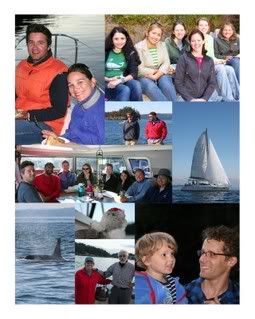
Well it’s now getting into the 7th week and it has been a roller coaster ride. See Colleen’s blog for the adventures of the Gato Verde. I am getting homesick but the beautiful weather is making it worthwhile to be away. I know the whales are in the area and hopefully they are ready to be studied when we get out to the water. We move back on the boat tommorrow and hopefully have a smooth sail off.
—–
Read More
So, it’s September 30th and much has evolved in the past few weeks…Our first week on the Gato Verde was a great mix of beautiful weather, new and unfamiliar anchorages to most of us, days on the water practicing and testing our methods and procedures, and enjoying the adventure of living on a boat. The Gato Verde is definitely more spacious and more ‘posh’ than I had imagined. We sleep in shared bunks with even a small closet, doormat and a wee bench…it’s no comparison to the salon couch where I slept on the last sailboat I was on! We cook our own food which is typically quite scrumptious, and sail daily thorough the San Juan Islands…rough life, eh? Our first week culminated with lunch on Shaw Island for the annual Friends of the San Juans meeting and a talk by Peter Ross on chemical contaminants in Puget Sound and its inhabitants. Shaw was lovely and we were accompanied by Leslie and Val back to Friday Harbor for a veggie burger dinner and a quick 24hr turn around to re-provision and start the second week with our relief captain, Mike.
During week two, Mike certainly got a bit more than he bargained for! Highlights include spotting Minke whales, two days worth of superpods, and a crippled boat…yes, that’s correct, the Gato Verde was unfortunately a bit ‘under the weather’ for a few days and more than once we found ourselves in the middle of Haro Strait without propulsion…thank goodness we were sailing! With a stroke of luck, though, one day we found ourselves trying to maneuver the boat without propulsion, not really moving anywhere, stuck within the fickle currents and winds of the Strait. “Lucky?†you might ask, but yes, because after spinning in circles for hours, L Pod decided to make its way up the west side of San Juan and passed within a few meters of our boat on their way north. Typically we might have been cited for “parking in the path†of the whales, but we’d been there for hours! Comical, but it unfortunately meant that we’d have to return to Roche Harbor for repairs and eventually we were forced to use the dingy as propulsion back to Friday Harbor where the Gato Verde still rests in need of a few tweaks here and there to restore propulsion, battery power and a sufficient generator.
While the Gato Verde rested, the six of us have been working quite hard this past week analyzing our data and assessing our methods from the preliminary two weeks at sea. On Wednesday we each presented a “Progress Report†of our work to our instructors, Scott, Val, and three researchers who were visiting. From their feedback and our own understanding of the strengths and weaknesses of our projects, we completed the final draft of our proposals yesterday! Today, we have the spectacular fall day in the San Juans off to regroup for our final three weeks at sea starting tomorrow!
While this seems like a fair assessment of the past three weeks, much is lacking…in particular all the FUN FUN FUN we’ve been having on the boat, laughing, joking, playing and wholeheartedly enjoying the experience. In particular, we have adopted a team mascot, a ridiculously looking stuffed cat Emily’s mom sent…â€Kitty†has appeared in numerous occasions to add a little comic relief and has been documented photographically mimicking the ‘goings-on’ of the Gato Verde…Jason has wowed us all with is culinary prowess-his sourdough ‘pet’ is loved by all, especially in the form of pancakes and fresh bread…Erin is the newly appointed ‘relief captain’ for her amazing work docking us under sail power…Emily is now known for her Ishmael obsession and stinky feet…we always know Peggy is around when a fantastic interpretation of the marine radio is broadcasted…Securite!Securite!…or “Git in my belll-ae!†Probably not as funny written as said, so ask her sometime…Rena is the new Connie Chung or Barbara Walters or Katie Couric, interviewing everyone for their play-by-play of the latest boat trial…Donna, well, Donna doesn’t really ‘do’ mornings without coffee but she makes a mean homemade pesto and is ALWAYS up for a laugh…yo yo yo…Juliette is best known for her mad sushi-making capabilities and the unfortunate fate of her camera, but she’s newly outfitted with a brand new one and ready to tackle the next three weeks with a vengeance…and nearly every morning I have to share my ridiculously crazy dreams, I relish fighting elbows with Peggy at the dinner table and sometimes people laugh at me for reasons unknown…I should look into that…
So, as we embark on a new sea session I’m getting ready for more whales, fewer technical difficulties, more laughs, more fantastic sounds from beneath the surface, and most importantly, more fun!
—–
Read More
Back on land! We got back two days early due to the propulsion system on the boat. The Generator, and electric engine weren’t working, so we hooked up the dinghy to the back and used the little outboard on that along with some help from the Buzzard to get back to the labs. Not the ideal way to travel, but it worked. One good thing about having to come back early is that I finally got to see the movie “Little Miss Sunshine” as it finally made it to the theatre on island! I highly recommend it to everyone, its hysterical!
So now, the Gato Verde is safely at the dock, we are back in the cabins, sleeping in our own beds, showered and wearing clean clothes. We have switched from living on the boat to living on land. This week had been dedicated to improving our projects, giving progress presentations and finalizing our proposals. As usual we had a numerous guest lecturers come which is always great. This time four of them along with the four instructors sat on the panel as we all gave our presentations. I think mine went well and so did everyone else’s. The rest of the week we worked on proposals and I along with others tried to figure out Ishmael. We have been calling and emailing the author and others who know the program really well asking for help and explaining our situation. They are all super busy but have been very nice and given us some of their time and helped us out! I am confident, while it doesn’t work perfectly, we will be able to make some progress. Any progress is a step in the right direction. While it is really frustrating now, someone has to do it. Once it gets figured out, not only will it be really important in analyzing acoustics, it will be really cool to know that I helped, even just a little.
To get away from science, we again watched Greys Anatomy as I now have season 2 on DVD and its free to watch the new episodes on the internet AND as a little (and very much appreciated) end of the week present Scott brought “Life Aquatic” up with him, which we are well overdue to watch!
—–
Read More
I didn’t shake during my presentation today! or speak at riddiculously high speeds! Or stumble over every other word! And!… I LOOKED at the Audience!!
Whoa.
teehee.
Read More
The Gato Verde arrived under the helm of Captain Todd Schuster at 13:00 at the University of Washington ’s Friday Harbor Labs. Waiting on the dock, with all the food, science equipment and personal gear were the crew of 8. Shortly after arrival the Quarter Master Colleen Barry had the crew stowing the gear in record time for a departure from the dock at 17:00 hours. We were prepared for a short crossing to Parks Bay on Shaw, but found the anchorage full and so headed farther North to Jones Island for the evening. The weather was sunny and calm for our maiden voyage, and so we were not able to set sail, but rather relied on our electric motors and bio-diesel generators. Along the way we spotted several harbor seals, a number of large burgundy colored lion’s mane jellies and one of our crew (Juliette) managed to be the first to loose their camera overboard. All in all a pleasant hour and one half of passage time.
Sea date 9-12-06 (day 2)
After reveille and breakfast at 8:00 the crew turned out for cleaning of the Gato Verde followed by an introduction to the vessel and sailing. Winds were non-existent until around 11:00 when we set sail through Speiden Channel where we caught good sightings of the introduced Fallow and Sika deer, but did not see any of the Mouflon sheep. We did however get a close sighting of 2 harbor porpoises feeding behind the boat. From there we headed out to Haro Strait to take advantage of the light wind to practice our tacking techniques (see the zig zags on our route for the day). By late afternoon we steered a more direct course for Reid Harbor on Stuart Island and a calm and secure anchorage.
Sea date 9-13-06 (day 3)
Morning started with a hearty breakfast of sourdough pancakes prepared by yours truly and crew member Peggy Foreman, after which we got to experience our first pump out of waste material. Although not a very pleasant task, it is an essential part of our existence on the Gato Verde and a good way to force us to consider some of the impacts we have, at least in regards to direct waste products generated by our active physiologies. After leaving Reid Harbor we set forth into Haro Strait in the search of whales and wind. We were successful in finding patchy winds and made some good progress towards the south end of Haro Strait in an attempt to find some transient killer whales that had been reported off of Victoria , British Columbia , but did not sight any whales. We did however see some Dall’s porpoises in the Straits. We also made our first attempts at deploying our science gear. As it so happened we attempted to deploy our hydrophone when the wind was steady and we were sailing at a steady seven knots. At that speed our hydrophone refused to sink and so we had to fasten downriggers to force it down, which was successful, but we still had significant noise from the water flowing past the hydrophone as it undulated underwater. After consulting with our Beam Reach acoustics specialist, Val Veirs, we decided that for the next deployment of that hydrophone we would fasten a long cord to the trailing edge of the hydrophone to stop it from undulating, much as one fastens a tail on a kite to steady it in heavy wind. We ended the day in Mitchell Bay across from Snug Harbor . After a sumptuous meal prepared by Erin Soucy and Colleen Barry (following a recipe called “Rice with chick-peas, herbs, and sun-dried tomatoesâ€) we held our weekly journal club meeting. This endeavor helps us to sharpen our scientific acumen by reading and discussing research articles that spark our interest. Each week one of the students picks an article that is dear to their interests; we all read the article, and then have a discussion on the merits and weaknesses of the article, led by the student who picked the article. The article picked this week by Peggy Foreman was: Baird, R.W., Hanson, M.B. & Dill, L.M. 2005 Factors influencing the diving behaviour of fish-eating killer whales: sex differences and diel and interannual variation in diving rates. Canadian Journal of Zoology 83:257-267. As it turns out, it was a particularly apropos time to discuss this article as Robin Baird and Brad Hanson, two of the authors, are in the San Juans at the moment continuing their studies on the diving behavior of killer whales. In fact they gave talks to our class before we left port, and we bumped into them in Haro Strait this very day as they were out searching for more whales to fasten their suction cupped time depth recorders to. A couple of days ago they were successful in attaching their device to a transient (i.e. marine mammal eating) killer whale in Admiralty Inlet , and in retrieving it after it fell off. They are in the area for the next week and we hope we will hear further news of their success in studying these marine mammals.
Sea Date 9-14-06 (day 4)
This morning Captain Todd picked up Val from the dock in Mitchell Bay along with the hydrophone array Val has built for this class. We spent the morning listening to instruction of sailing and meteorology, followed by our first deployment of the hydrophone array. One of the hydrophones was not working that well, but was working nonetheless. We then made our way out into Haro Strait to field test our equipment further. Unfortunately the problematic hydrophone stopped working and another stopped working as well, leaving us with only two hydrophones working in the array. We nevertheless deployed the dingy with Val, Erin, and Rena so that they could bang on a steel pipe at a distance from the Gato Verde to see if we could record the sound and determine the direction from which the sound was coming using a software program called Ishmael. Even with two hydrophones we seem to be getting good measures of the direction the sound is coming from, something that is important to Emily and Colleen’s research projects. After we finished testing our equipment we were treated by a group of five transient killer whales that were swimming north through Haro Strait . Our first whales for the course! Oddly we also saw a number of porpoises and an elephant seal in the vicinity of the whales. Our day ended with a fabulous pasta repast prepared by Donna and Emily while at anchor once again in Mitchell Bay .
Sea Date 9-15-06 (day 5)
We had wonderful rain last night and awoke to the sun shining through the mist in Mitchell Bay , truly magical. We did our morning chores and then picked up Val from the Snug Harbor dock. He had spent yesterday evening fixing our hydrophone array in his garage. After running a few experiments, such as measuring the salinity and temperature of the water in Mitchell Bay to get a direct measure of the speed of sound in that water, we headed out to the deeper waters of Haro Strait to continue debugging our equipment. We think we have finally found a good way to deploy our single hydrophone and minimize any exterior sounds such as water turbulence and boat noise. So that Val could continue work on the array we dropped him at Roche Harbor , pumped out our holding tanks and took on more fresh water. Oh, we also took advantage of the store at Roche Harbor for a few sundries to please the palates. Upon leaving Roche Peggy and I started on dinner: fresh baked sourdough bread and Moroccan tagine over couscous, with cilantro, jalapeno, and lime salsa. We ate underway and lowered our anchor in Deer Harbor just as we finished our evening meal. Tomorrow morning we pick up our relief captain in Deer Harbor .
Sea Date 9-16-06 (day 6)
We awoke to a glorious Fall morning in Deer Harbor and sent Peggy and Rena ashore to conduct part of their service project which involves marking creosote logs on public beaches. Todd also picked up our relief captain Mike Dawson at the dock in Deer Harbor . We then set sail into and down San Juan Channel towards Parks Bay on Shaw Island where we attended the annual meeting of the Friends of the San Juans. This allowed us to go ashore and explore the Ellis Biological Preserve and the grounds of the Ellis homestead including their memorial bells. To top off the lovely lunch we heard a talk given by Peter Ross on “Toxics in the Mammals of the Salish Sea : Orcas, Seals, and Humansâ€, altogether a wonderful way to spend a lovely afternoon. We then set sail across San Juan Channel to dock at the Friday Harbor Labs.
Sea Date 9-17-06 (day 7)
We started today with a later start since it was our ‘shore’ day where we clean the boat thoroughly, re-provision, fill up the water tanks, refuel, and pump out the holding tanks. After cleaning the boat we headed to town for all our errands and then had a little time off this afternoon for showers, laundry and calls/emails to home before once again setting sail for Parks Bay . Winds were very light for the crossing, but under the guidance of Captain Mike we managed to make it across with a few tacks here and there (see track on map for today for the wonderful zigzag patterns that Rena made while at the helm).
Sea Date 9-18-06 (day 8)
Today we navigated south through San Juan Channel and Cattle Pass into the south end of Haro Strait where we ran a series of experiments with our single hydrophone and hydrophone array to make sure that all systems were functioning correctly. As a bonus, after we had brought our equipment back in we spotted two minke whales in the area of Salmon Bank. We spent a good hour with them as they fed before heading back to Griffin Bay . While traveling back through Cattle Pass we spotted three California sea lions, one of which swam towards the boat and made aggressive displays. Once in Griffin Bay we picked up Val on the shore in the dingy so that he could join us for a couple of days aboard the Gato Verde.
Sea Date 9-19-06 (day 9)
We decided to head back out into Haro Strait and towards the Straits of Juan de Fuca, with the thought that if the resident killer whales were going to return to these waters, they would probably come back in through the Straits between Vancouver Island and the Olympic Peninsula. Our instincts were correct as all three resident pods heading back into the inland waters. We had some difficulty with our electric motors along the way, but thanks to skillful sailing by Erin (as the Captain was fixing things), we managed to intercept with some of the whales and follow them to the north as we gathered our first set of data. All were very excited as whale calls were heard through our recording equipment. Our final encounter with the whales was off the west side of Henry Island , so we decided to head for Stuart Island to overnight.
Sea Date 9-20-06 (day 10)
We awoke to rain, forecasts of heavy winds and an electrical system that was not working completely well, so we decided to head across Speiden Channel and into Roche Harbor where we tied up to the docks to recharge our batteries and continue repairs on the electrical system. I forgot to turn the GPS unit on for today, so we don’t have our track on the map. We seem to have made headway on fixing things on the boat, and people seem to appreciate coming in to the dock to catch up on phone calls to family and friends.
Sea Date 9-21-06 (day 11)
Today we headed back out into Haro Strait to test our equipment some more and managed to have a good recording session with the whales. Unfortunately our propulsion system had completely failed us by that time and so we could not maneuver out of the way as the whales swam past. This did allow us to capture some good quality data as we tried to sail out of the way with only a light breeze. After the whales passed Mike rigged up the dingy behind the boat, which we then used as our motor to get back in to the dock at Roche Harbor . An ingenious way to rig up an alternative propulsion system. Bravo Mike. We were joined in the evening by James Ha, a professor from the University of Washington who gave us a stimulating talk on animal behavior.
Sea Date 9-22-06 (day 12)
We were unable to repair the electric propulsion system, so we decided to limp back to the UW Friday Harbor Lab docks where Todd could eventually fix the system. We were escorted back to the Labs by the M/V Buzzard (the Whale Museum ’s marine mammal stranding response boat) as a safety precaution. It was a pleasant journey that took a bit over two hours, but we were glad to make it back to our ‘home’ dock and a week back on terra firma.
Read More



 Twitter
 LinkedIn
 Facebook