This looks like a generous fellowship if you’d like to study marine ecosystem sustainability in Alaska for a few years. They are offering $30k+tuition/year for graduates students attending the University of Alaska, Fairbanks, for cohorts starting in 2009 through 2012. They even include health insurance and research funding.
To me, the MESAS program (Marine Ecosystem Sustainability in the Arctic and Subarctic) seems philosophically aligned with Beam Reach. They emphasize interdisciplinary research, a focus on sustainable solutions, and even provide service opportunities within local communities.
At Beam Reach, we discuss recycling and strive to live more sustainably, both on land and at sea. But this visionary fellow is setting a new pace down in Mexico, living, growing locally, and maybe setting out to sea on an island he built out of plastic bottles.
For a long while I’ve been trying to locate a guy who is trying to use traditional Northwest canoes as a vehicle for watching grey whales as they migrate along the outer coast of Washington. Tonight I finally found news of Fred Woodruff after reading about him years ago in Brenda Peterson’s Sightings.
Brenda was intrigued with the counterpoint of the Makah’s decision to hunt grey whales and the Quileute’s decision to watch whales (despite their Treaty right to hunt). While I am awed by the Makah’s sea-going prowess, their hunting culture and artifacts, on my visits to maintain the hydrophone in Neah Bay it’s clear that further boosting tourism in Neah Bay would be welcome. I know I’d pay good money to help paddle a canoe out into the Pacific, and I’d pay even more if there was a chance I’d see (or hear) some whales, too. Here’s hoping Fred or similar innovators can give me such opportunities.
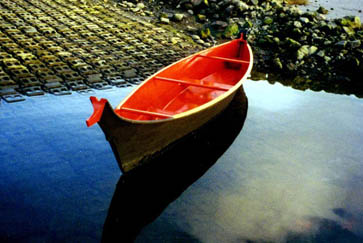
The Quileute Tribe is a small, federally recognized nation of 800 enrolled members, whose 900 square miles of ancestral lands include the Pacific Slopes of the Olympic Peninsula and the watersheds of the Sol Doc, Bogachiel, Calawah and Dickey rivers. With the loss of the great natural abundance that once sustained the Quileute, seasonal tourism has come to constitute a significant portion of the tribe’s economy. Unlike the nearby Makah, who are profiting from whale hunting, the Quileute are proponents of whale watching. In the past 13 years, members of the Quileute’s tribally owned Northwest Native Adventures have paddled more than 4,000 miles by ocean-going cedar canoe. Canoe leader Fred Woodruff’s stories and songs have entranced hundreds of visitors who have ventured into the Pacific to watch the migration of Pacific gray whales. Fred’s tours have hosted youth, the elderly, and on one occasion, a boatload of Tibetan monks. But the tribe needed a larger canoe capable of carrying 12 to 15 passengers. The Quileute now have their new canoe – Kwa-dee Tabil (“Little Boat”) – a perfect replica of the traditional Quileute cedar dugout. Construction of Kwa-dee Tabil (beautifully handcrafted out of plywood by John McCallum of Applegate Boatworks) was made possible with a $3,800 grant from the International Marine Mammal Project. The grant was given in support of the Quileute’s devotion to whales and Woodruff’s dream of “putting back in place” a little of what humans have taken from the bounty of the Pacific Northwest. For information on arranging a sea-going canoe excursion, contact the Quileute Tribal Council [PO Box 279, La Push, Washington 98350-0279, (360) 374-6163].
This is the first replica canoe that I made for an Indian tribe. Fred Woodruff and the Quileute Tribal School at La Push Washington asked me to build this canoe in 2000. Tabil is the Quileute word for canoe. ( Pronounced “ta BALE” ) Fred is in command of the big 33 ft. Quileute cedar dugout “Os·Chuck·a·Bic” ( Pronounced “os CHA bic”). This design is a direct adaptation of a 25 ft Quileute canoe carved in 1928 by Conrad Williams at La Push. The lines were taken by Bill Durham in 1965 and printed in Leslie Lincoln’s book Coast Salish Canoes. The canoe was built with the taped-seam plywood method. This is the first time I used an extra thick bottom plank to duplicate the weight distribution of a real cedar dugout. The results are very satisfying. Tabil’s performance is similar to the traditional dugout’s. The resistance to rolling is rather small in the first 5 or 10 degrees and then rises rapidly at larger angles. Paradoxicly this low initial stability is a good thing. A raft has high initial stability but it jerks back and forth with each little wave. A traditional West Coast canoe does not tire out the crew by this kind of snappy response to small waves. The low center of gravity and the wide flaring sides ensure plenty of stability when the canoe rolls way over. They call this “the catch”. Fred told me that this canoe dances on the waves. This canoe is now at the Quileute reservation at La Push.
A couple weeks ago, Michelle Ma published a few 1-to-3-minute videos from around Puget Sound that capture voices of folks from Western Washington who are working to restore the ecosystem. The final video featuring Scott Veirs and Dave Dix introduces the possibility that underwater noise pollution may be an important factor for southern resident killer whales. The footage was collected as we took a little whale watching tour with San Juan Outfitters. Ken Balcomb and Will Stelle were the other guests.
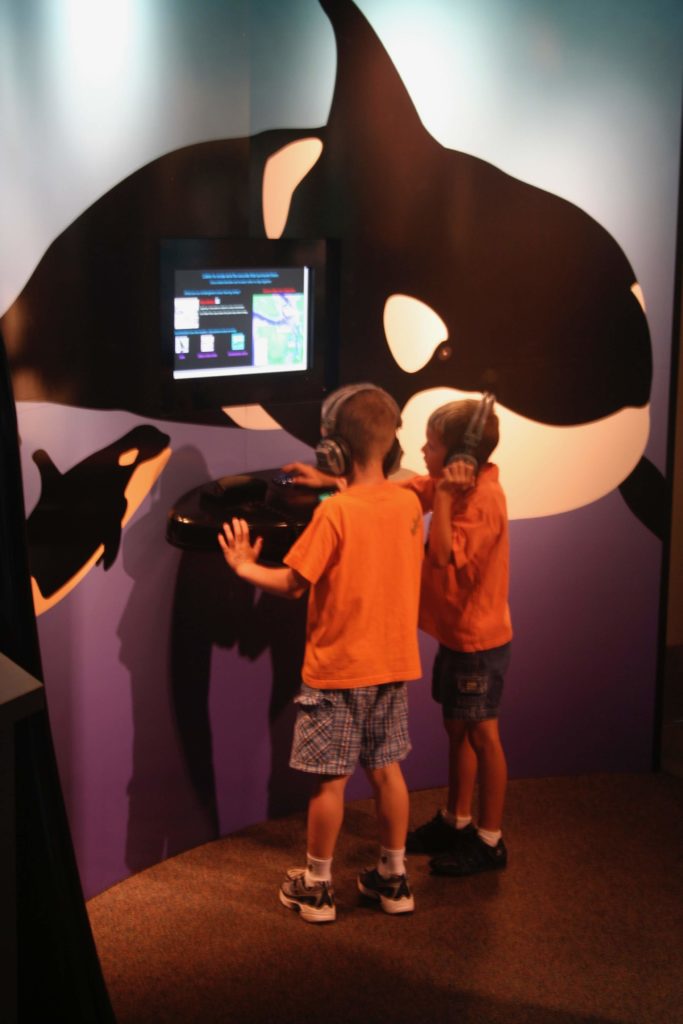
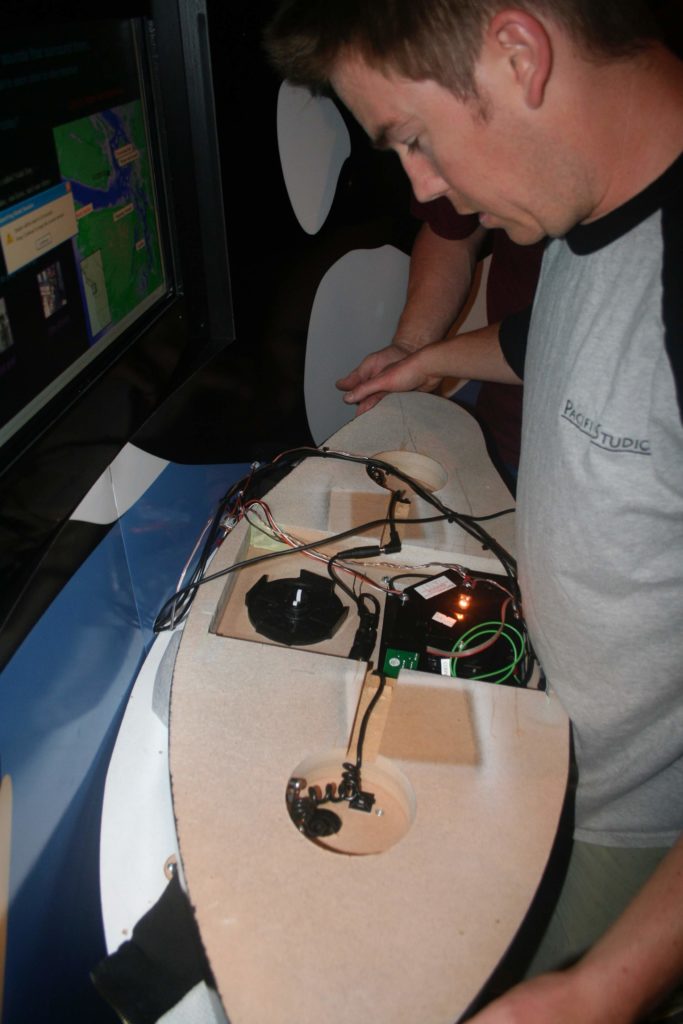
The listening station at the Seattle Aquarium lets visitors interact with orca sounds via web-based content (live and recorded audio), a monitor, and a trackball and headphones offered at kid-level on a matriarch’s fin.
At the bottom of the concrete helix at the Seattle Aquarium is the Family Activity Center (FAC)– a marine mammal hub adjacent to the big underwater dome. While fur seals and sea otters dive past visitors one side of the room, the majority of the space is dedicated to presenting the parallels between our human families and those of our regional icon, the killer whale, or orca.
Just a week ago the FAC received an acoustic enrichment. A listening station that enables visitors to listen live to the ocean or hear recordings from underwater has replaced the writing station and a panel describing orca prey (Chinook salmon). The listening station project was proposed by Brooke Nelson and me, managed by Michael Darling, and implemented by me (web design/html/php); Val Veirs (Java coding); Grant Glover, Jesse, Zach, Gary, and team at Pacific Studio (art and kiosk fabrication); Steve Harvey and Richard Ramsby (demolition, Internet, and installation).
Since the station needed Internet access for the live streams, we decided to host content on-line, primarily for ease of maintenance, trouble-shooting, and future enhancement. If you don’t have a chance to visit the Aquarium and test it out in person, you can view the pages here: http://orcasound.net/sakiosk/
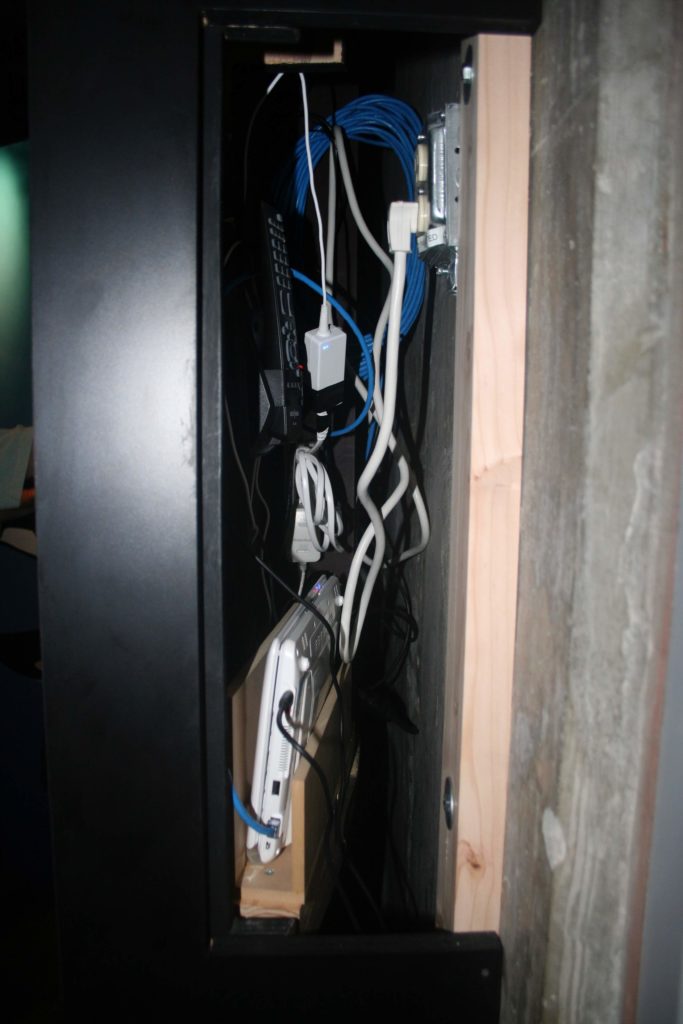
The site delivers sound through a Java-based audio player called jlGui that can handle both recorded mp3 files and Shoutcast streams while embedded and hidden within a browser window. There are also some nice photos and words to go along with the sounds. In the Aquarium, the content is presented on a 22″ monitor (using 1280×768 resolution) by an Eee PC running Firefox with the Open Kiosk plugin over Windows XP Home. A cool thing about this Eee PC is you can set it to keep running when the case is closed; that enabled us to fit it easily in the constrained space behind the mural.
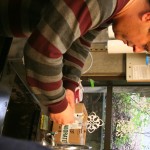
A view behind the scenes…
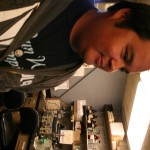
…and under the fin!
The highlights of watching folks try it out on the first day were hearing a 9 year-old boy walk away saying “That was really cool,” and a mother telling her child as they departed, “How would you feel if you had to listen to that all day?” Google Analytics suggests that thus far, about 20 unique visitors per day are listening to the underwater sounds for an average of about 2 minutes.
Below are links to photos of the installation, as well as notes regarding the hard-/software we considered and used in implementing the project.
Install Firefox 3.0.14 (3.5 didn’t work with Open Kiosk — though I didn’t try all version permutations)
Add the Open Kiosk add-on, version = “Firefox 3 Install Here” [July 16, 2009] (follow instructions at https://www.mozdevgroup.com/clients/bm/ — don’t download from the (outdated?) FF add-on site!)
Get updates to Java (upon autoprompt) (installed JRE and registered it…)
Disabled login screen; made user1 autologin (no password prompt)
Scheduled FF to run at system re/boot for user1
Used Kiosk admin UI to set FF-Kiosk-fullscreen to be default browser (firefox.exe -kiosk admin)
Had to restart Firefox a few times in safe-mode w/various defaults re-set… (via firefox.exe -safe-mode)
Enable jsLib 0.1.359 and BMA Kiosk 1.65
Change default start page
Under Filters tab click “Enable JavaScript on all pages” (so streams can be played through browser)
Under Sessions tab: set Kiosk to reset session after 5 minutes (max time anyone likely to listen?)
Under Customize tab: Disable tabbed browsing and Hide All UI Widgets
Click OK
Test it out (Launch under Kiosk submenu); first time I clicked on link to page that calls jlgui player, I got auto update of JRE6, then Security query re JavaZoom Team digital signature not being verifiable — clicked Always trust and Run; stream started after about 10s load/lag-time…
Had to de-select location under the View menu in FF to get location bar at bottom of window to be hidden in Kiosk mode
Back in admin, make FF-kiosk the default browser and select full-screen mode
Reboot computer and see if FF-kiosk comes up automatically with start screen
Reboot performance: blue screen at 30s, desktop at 40s; start screen in FF-kiosk mode in 65s, but XP Taskbar locked and visible at bottom of screen (though non-reactive to clicks); select auto-hide in Taskbar properties; reboot…
Reboot performance: blue screen at 30s, chime at 37, desktop at 50, start screen in FF-kiosk mode in 70s
Now has gap at bottom where taskbar is hiding, and location bar is back… (solved by resetting defaults via -safe-mode)
XP takes about 45 seconds to boot up to desktop
Eee PC Xandros 4Gb notes: — Took WAY too long to get a real desktop environment ++ Wireless connected automagically — Open Kiosk didn’t seem to want to run on the version of Firefox I initially downloaded (but I didn’t keep good notes on which permutations I tried…)
I enjoyed this ~20minute documentary by CBC science reporter Monica Kid on noise pollution in the ocean. It provides a synthesis and synopsis of many of the inter-linked issues — from Navy LFA sonar and seismic air guns to boats and ships — with interviews with Arthur Popper, Alexandra Morton, Ken Balcomb, Michael Jasny, and Douglas Wartzoff.
I was particularly interested to hear about some of the potential impacts of noise on fish. It was also interesting to hear from Alexandra about the avoidance of seal harassment devices by resident killer whales in the Broughton Archipelago (2/3 drop in sighting rate) and from Ken about the Bahama strandings.
Thanks to Michael Darling of the Seattle Aquarium for letting me know about this nice piece (high-lighted on “and-the-winner-is” show).
       Surfactants are used in our everyday life, whether we are washing our hands to our hair, cleaning dishes, or cleaning clothes. Surfactants play an important role in our everyday life as humans. Surfactants work by having a hydrophilic head, which loves water and a hydrophobic tail, which hates water. What makes it so useful is the fact that the hydrophobic tail will leech onto all the oil and grease we on household items and on ourselves. Then when each of the tails form a core that encloses an oil droplet, this is called a micelle. This makes both of each end of a surfactant happy. What is useful to humans is causing harm to fish and other inner tidal organism.
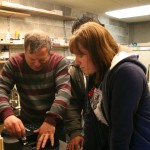
           Erica and I, as Beam Reach students in the spring 2009 term, have decided to measure the surfactants that the program releases into the ocean, while on the Gato Verde. With the help of Dr. Russel Barsh we have created a process of measuring each of the samples we have collected on the Gato Verde.
           This is our process for collecting each sample:
1.    Must be 48 hours before we run the test, if it sits to long the sample turns bad.
2.    Rinse syringe three times in sample test water
3.    Attach the filter to the syringe
4.    Filter out the sample and place into a clean container
5.    Place in the refrigerator to keep cool
Once we get back to the Friday Harbor Labs and meet Russel, here is the sample
testing process:
1.    Dilute the sample: 1mL of sample to 99mL of nano pure water.
2.    Scan the blank sample
3.    Add bicarbonate of soda to bring the pH up (used as a buffer)
4.    Add sodium chloride (salt) to bring up the density of the water.
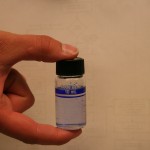
5.    Add 2mL of methylene blue and toluene mix
6.    Mix for 1 minute to allow the formation of micelles
7.    Let it sit for 5 minutes
8.    Shoot the sample
9.    Read the Results
Our results with the four samples we have taken are:
1.    1st grey water sample: 1.7 ppm (2 gallons of water with 2 squirts of joy soap)
2.    2nd grey water sample: 5.5 ppm (4.5 gallons of water with 2.5 squirts joy soap)
3.    Roche Harbor: 0.3 ppm
4.    Mitchell Bay: 1.5 ppm
Most of these numbers are terrible, because 0.5 ppm is lethal to fish and inner
tidal organisms. Some of the effects are disrupting gas exchange across the gill, which clogs up oxygen exchange, and it suffocates the fish. It can also clog pours and disrupt membranes in crustacean causing the membrane to burst. If surfactants are doing damage to fish, how can that affect the SRKW? Our best option right now is to use less, but still find a efficient way to be clean! Remember the saying less is more.
Â
Best Wishes,
PeterÂ
Â
PS: Thank You Dr. Russel Barsh for helping us in the lab and informing us about surfactants and its effects!  Â
Yesterday Marla Holt and I teamed up to measure the source levels (broadband and spectrum) of a new device called the Thrustor. Essentially a cowling that houses the propeller, the Thrustor is known to increase the efficiency and “bollard-pull” power of an outboard or stern-drive engine propulsion system. The Thrustor was co-patented by Terry Smith in 2005 and is manufactured by Marine Propulsion Technologies.
52734
Terry drove his test boat up from California, his brother Chris flew out from Colorado to lend a hand, and Leif Bentzen provided and captained a boat from which to deploy the hydrophones. Marla and the Northwest Fisheries Science Center donated her expertise, her calibrated Resond hydrophone system, laser range finder, and hand-held GPS. I brought along the Beam Reach calibrated Inter-Oceans system and some buoys to mark the 100m and 400m ranges from the hydrophones. And thankfully, the weather really cooperated — while we expected drizzle and wind, we got clear skies and placid waters.
Despite substantial background noise from the Edmonds-Kingston ferry and passing freight trains, we gathered a bunch of data using dual-hydrophones that have a flat frequency response from 1-40kHz and are capable of recording up to frequencies up to 96kHz. First we tested Terry’s boat (powered by a Honda 80hp outboard) without the Thrustor, then with it. We made passes at 7-30 knots at ranges of 400, 100, and ~50m. We also measured the noise generated when accelerating from an idle to cruising speed.
Stay tuned for some preliminary acoustic results… For now, here are some photos from the day.
Thanks to Fred Felleman for the appended articles: new B.C. ferries are drawing complaints about being too noisy in air. One has to wonder whether the Coastal Celebration and its two sister ships, the Coastal Inspiration and the Coastal Renaissance, are also noisier underwater than their predecessors. The Celebration
As killer whale scientists and conservationists we need to be more watchful of the ferry replacement process, particularly the standards for underwater broadband source levels and spectrum levels. We should all consider influencing the ferry selection/design process — on both sides of the border. For future replacements, let’s ensure that reliable estimates of noise impacts are available for existing designs and that strong underwater noise standards are required for new designs.
While the team who has selected designs for the new Washington ferries is confident that the new 144-car ferry will be more quiet than the fleet average, their modeling effort suggests there may be no improvement. The smaller ferry design is in operation on the east coast, but its underwater signature remains unmeasured.
Lead Beam Reach instructor Jason Wood makes a cameo appearance in this nice video put out a week ago by the Puget Sound Partnership.  Here he is wearing his Research Curator hat for The Whale Museum and pointing out the aesthetic value of the Salish Sea along with Kari Koski, Jenny Atkinson, and other local marine conservationists.





 Twitter
 LinkedIn
 Facebook