Port Townsend to Port Townsend
(Boat Haven to Marine Science Center)
We raised anchor early today and were out of Boat Haven by 0715. Capt. Todd had anticipated strong winds, but when we got out in open water, we realized the 35 knot gusts weren’t worth the risk. We turned back toward Port Townsend around 0800 and tied up at the dock by the Port Townsend Marine Science Center.
At 1400 we went to the science center to test the Flip videocamera in its underwater housing. We took footage of a juvenile octopus as we knocked on the glass, trying to get an idea of how sound from the outside affects the octopus’s acoustic environment.
We also used a hydrophone to listen to sounds inside several of the center’s tanks to see whether or not the organisms were making any sounds. We deployed the same hydrophone into the ocean but realized we couldn’t hear anything when we used the Marantz (which,we later realized, was due to a faulty XLR to quarter inch cable).
Port Townsend to Port Townsend
(Marine Science Center to Boat Haven)
Departed Port Townsend after breakfast at about 8:00. Arriving out at Admiralty Inlet, both Jason and Scott performed their SnowPud experiment with lightbulbs and a hydrophone array. Scott, along with Nora and Libby, set out on the small dinghy, the Gatito. Taping lightbulbs at 10 meters apart from each other on a marked rope, it was lowered into to the water with the help of a weight. A hydrophone array was lowered on the starboard side of the Gato Verde, where Jason was stationed to prepare to record. A shackle with a weight would be sent down the lightbulbed rope, hoping to break all the lightbulbs. The sounds would be recorded by the hydrophone array at 100m, 200m, and 400m distance. Being in Admiralty Inlet made it difficult to perform exact distances, plus some lightbulbs did not break. Recordings were still taken. Docking at Boat Haven, Port Townsend Marina, we pumped out and charged the boat.
Griffin Bay to Port Townsend:
We departed San Juan Island with the intention of sailing all the way to Neah Bay, but shortly after finishing our chores, Kathryn said the word everyone was hoping to hear “whale off Starboard!”
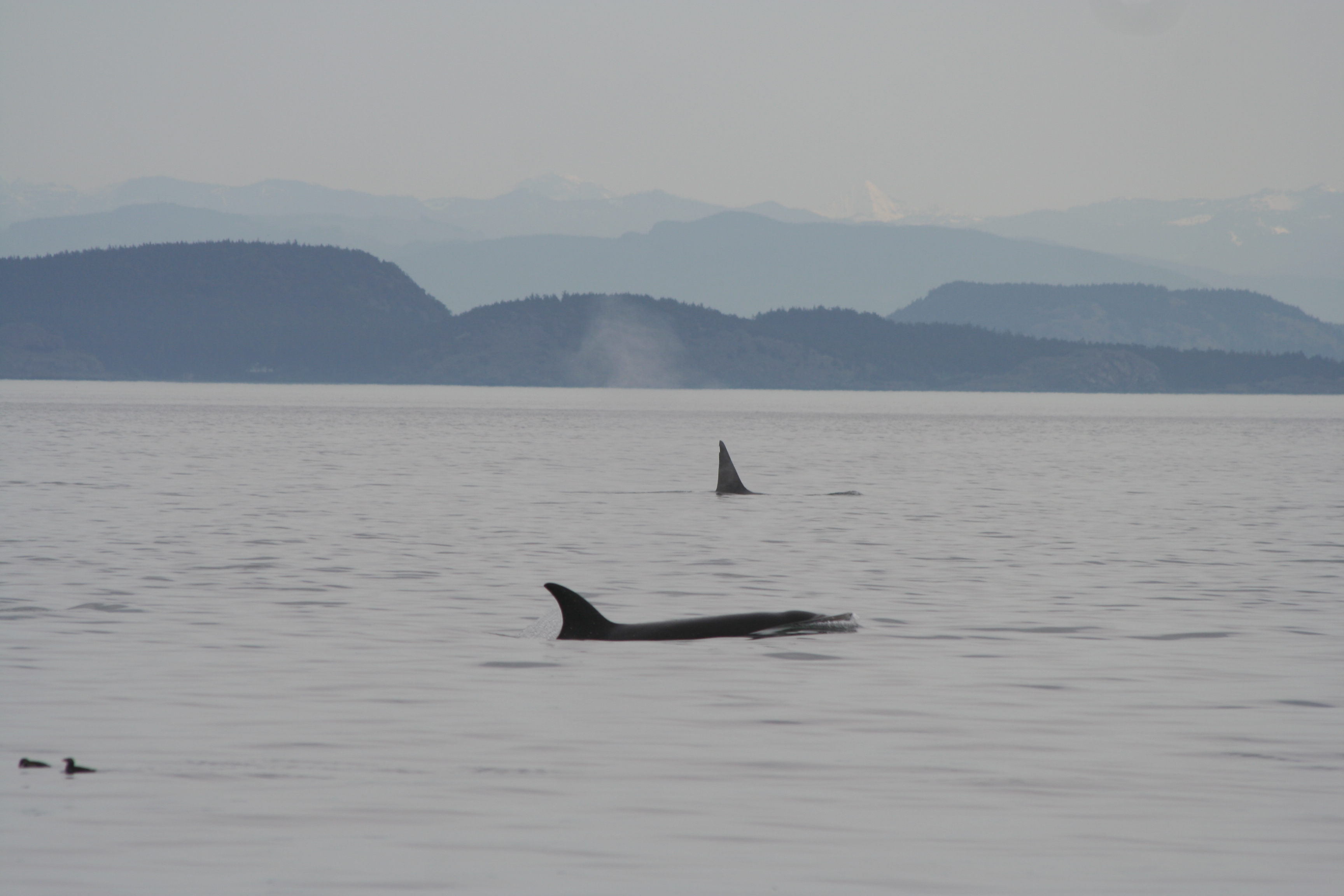
We were able to identify Transient male #87, and think we know some of the females as well. First the male was swimming with four others, then two groups converged for a bit of exciting times, and departed once again. Overall, the transient group seemed bound to the east/southeast. They led us past Smith Island and all the way into Admiralty Inlet.
Once we were joined by two whale-watching boats the whales seemed to lighten up and give us a show. We saw plenty of tail slaps and harmonious movements, and even a spy hop and peck slap were seen. Great first day of being on the boat! The sun was out for most of the day, and the wind was gentle so we did not put up the sails.
We set up and tested the new hydrophone array. All 4 elements work and we were able to hear nearby boats, but the transients made no audible sounds during the hour or so that the array was in the water.
We left the Labs at about 3:45 pm and used the screecher sail and motor, each taking a turn at the helm. We arrived and got an introduction to anchoring around 5:00. Because it was our first day we didn’t do any science but Jason saw a seal. We had great weather.
It was a great pleasure to meet the four incoming students for the spring 2010 program last Sunday (3/29). Libby, Kathryn, Horace, and Nora all arrived safely in Seattle in time for a 10:30 tour of the Seattle Aquarium. We saw Pacific salmon and rock fish in the new big outer coast tank, noticed a drift wood log snagged on the cable when viewing the hydrophone station behind the scenes, and listened to underwater sounds and John Ford videos down in the orca exhibit.
After a quick lunch of crumpets and salmon jerky and a brisk walk through Pike Place Market, we drove northward in a caravan just after 13:00. We dodged Seattle traffic detours and light rain to make the 14:45 ferry with just 5 minutes to spare. Amazed that both of our cars got the final two center lane (first off) spots on the ferry, I declared it an auspicious entry into the Archipelago!
Here is a link to the spring 2101 class home page. There you will find more information about the new students, their instructors, and the adventures upon which they are embarking.
Thanks to a calm weather window and the on-going support of collaborators at the University of Washington and NOAA/NWFSC, we were able to re-deploy two fish tag detectors along the west side of San Juan Island in the first days of 2010. We plan to re-deploy a third in the first quarter of 2010. Stay tuned for a separate post summarizing what fish were detected in the last year or so. In the interim, here are some notes and photos from the field work.
Saturday 1/2/10:
During a hydrophone maintenance dive, Jason Wood and I deployed a new Vemco fish tag receiver (VR2W SN#100905) at Lime Kiln lighthouse. We supported the receiver on doubled crab pot line with a salvaged WDFW float (#3398) and anchored it with about 10 liters of concrete in a paint bucket with rebar/PVC legs. A length of chain embedded in the concrete served as an attachment point for both the receiver mooring (clipped on with a taped SS carabiner) and a tether which was tied to the first hydrophone stand.
The Lime Kiln mooring location is about 30m west of the iron bar near the high tide mark adjacent to the SW corner of the lighthouse. The mooring anchor depth is about 10m.
The highlight of the dive was Jason finding the old VR2W (SN#100914). After we had been led astray by an old yellow line, I was pretty sure we were in the wrong spot and wouldn’t have enough air to search for the old mooring. Yet we had to be close because we had encountered one of the old hydrophone stands whose pair should have been within about 10m. I was thinking about whether the old hydrophone stand might have been moved by the pesky Lime Kiln currents when Jason waved in front of my face. I looked up to see him smiling around his mouthpiece, the algae-encrusted old mooring in his grasp. It was a cinch to raise it with the lift bag and the exfoliated kelp hardly slowed our return to shore.
The VR2W looked great and the red light was confirmed still flashing once uncovered at the lighthouse picnic tables. The float was pretty overgrown with algae and the indelible ink was no longer legible.
Orcasound mooring ready to deploy
Sunday 1/3/10:
While the leaded line tethering the Orcasound VR2W to shore was intact as recently as NN months ago, when we looked for it late last night we found only a short section still attached to the intertidal eyebolt. Luckily the other end was found only a few meters away, pinned under a boulder by 10 cm of gravel. The remainder was entangled in nearshore subtidal rocks, but I managed to tease it out by wading around. I was able to wade to where it was attached to a braided nylon line. There I attached a crab pot float and then re-secured the leaded line to shore.
This morning, Liam helped Val and I pick up the float and back away from shore while taking up the nylon line. The mooring came up fine (though a thicker line for that concrete weight would be easier on the hands) and the red light on the VR2W (SN#100913) was still flashing!
After laying out the new hydrophones (to ensure we didn’t overlay the new Vemco tether), Jason paid out some extra slack in the leaded line. I reattached the nylon line to the leaded line and we drew this longer line tight above the water and maneuvered Cat’s Cradle until we had a clear path straight offshore through the kelp. I attached the new VR2W (Serial Number 100912 moored on the line/float from Lime Kiln recovered yesterday) to the SS hoop in the concrete mooring weight, lowered away, and Liam helped me slip the line. It was pretty slick and fast. It should be interesting to see how the leaded line fares this next round.
The Orcasound mooring location is about 30m offshore of the lowest eyebolt (latitude = 48.55823212, longitude = -123.1737158; UTM y = 5378363, UTM x = 487182). The mooring anchor depth is about 7.7 meters below mean zero tide level.
Here is a spreadsheet that lists all Beam Reach deployments of Vemco receivers:
This looks like a generous fellowship if you’d like to study marine ecosystem sustainability in Alaska for a few years. They are offering $30k+tuition/year for graduates students attending the University of Alaska, Fairbanks, for cohorts starting in 2009 through 2012. They even include health insurance and research funding.
To me, the MESAS program (Marine Ecosystem Sustainability in the Arctic and Subarctic) seems philosophically aligned with Beam Reach. They emphasize interdisciplinary research, a focus on sustainable solutions, and even provide service opportunities within local communities.
At Beam Reach, we discuss recycling and strive to live more sustainably, both on land and at sea. But this visionary fellow is setting a new pace down in Mexico, living, growing locally, and maybe setting out to sea on an island he built out of plastic bottles.
For a long while I’ve been trying to locate a guy who is trying to use traditional Northwest canoes as a vehicle for watching grey whales as they migrate along the outer coast of Washington. Tonight I finally found news of Fred Woodruff after reading about him years ago in Brenda Peterson’s Sightings.
Brenda was intrigued with the counterpoint of the Makah’s decision to hunt grey whales and the Quileute’s decision to watch whales (despite their Treaty right to hunt). While I am awed by the Makah’s sea-going prowess, their hunting culture and artifacts, on my visits to maintain the hydrophone in Neah Bay it’s clear that further boosting tourism in Neah Bay would be welcome. I know I’d pay good money to help paddle a canoe out into the Pacific, and I’d pay even more if there was a chance I’d see (or hear) some whales, too. Here’s hoping Fred or similar innovators can give me such opportunities.
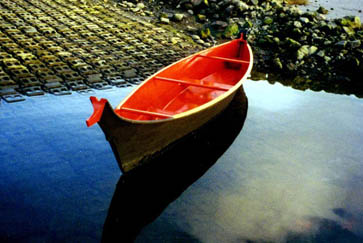
The Quileute Tribe is a small, federally recognized nation of 800 enrolled members, whose 900 square miles of ancestral lands include the Pacific Slopes of the Olympic Peninsula and the watersheds of the Sol Doc, Bogachiel, Calawah and Dickey rivers. With the loss of the great natural abundance that once sustained the Quileute, seasonal tourism has come to constitute a significant portion of the tribe’s economy. Unlike the nearby Makah, who are profiting from whale hunting, the Quileute are proponents of whale watching. In the past 13 years, members of the Quileute’s tribally owned Northwest Native Adventures have paddled more than 4,000 miles by ocean-going cedar canoe. Canoe leader Fred Woodruff’s stories and songs have entranced hundreds of visitors who have ventured into the Pacific to watch the migration of Pacific gray whales. Fred’s tours have hosted youth, the elderly, and on one occasion, a boatload of Tibetan monks. But the tribe needed a larger canoe capable of carrying 12 to 15 passengers. The Quileute now have their new canoe – Kwa-dee Tabil (“Little Boat”) – a perfect replica of the traditional Quileute cedar dugout. Construction of Kwa-dee Tabil (beautifully handcrafted out of plywood by John McCallum of Applegate Boatworks) was made possible with a $3,800 grant from the International Marine Mammal Project. The grant was given in support of the Quileute’s devotion to whales and Woodruff’s dream of “putting back in place” a little of what humans have taken from the bounty of the Pacific Northwest. For information on arranging a sea-going canoe excursion, contact the Quileute Tribal Council [PO Box 279, La Push, Washington 98350-0279, (360) 374-6163].
This is the first replica canoe that I made for an Indian tribe. Fred Woodruff and the Quileute Tribal School at La Push Washington asked me to build this canoe in 2000. Tabil is the Quileute word for canoe. ( Pronounced “ta BALE” ) Fred is in command of the big 33 ft. Quileute cedar dugout “Os·Chuck·a·Bic” ( Pronounced “os CHA bic”). This design is a direct adaptation of a 25 ft Quileute canoe carved in 1928 by Conrad Williams at La Push. The lines were taken by Bill Durham in 1965 and printed in Leslie Lincoln’s book Coast Salish Canoes. The canoe was built with the taped-seam plywood method. This is the first time I used an extra thick bottom plank to duplicate the weight distribution of a real cedar dugout. The results are very satisfying. Tabil’s performance is similar to the traditional dugout’s. The resistance to rolling is rather small in the first 5 or 10 degrees and then rises rapidly at larger angles. Paradoxicly this low initial stability is a good thing. A raft has high initial stability but it jerks back and forth with each little wave. A traditional West Coast canoe does not tire out the crew by this kind of snappy response to small waves. The low center of gravity and the wide flaring sides ensure plenty of stability when the canoe rolls way over. They call this “the catch”. Fred told me that this canoe dances on the waves. This canoe is now at the Quileute reservation at La Push.
A couple weeks ago, Michelle Ma published a few 1-to-3-minute videos from around Puget Sound that capture voices of folks from Western Washington who are working to restore the ecosystem. The final video featuring Scott Veirs and Dave Dix introduces the possibility that underwater noise pollution may be an important factor for southern resident killer whales. The footage was collected as we took a little whale watching tour with San Juan Outfitters. Ken Balcomb and Will Stelle were the other guests.







 Twitter
 LinkedIn
 Facebook