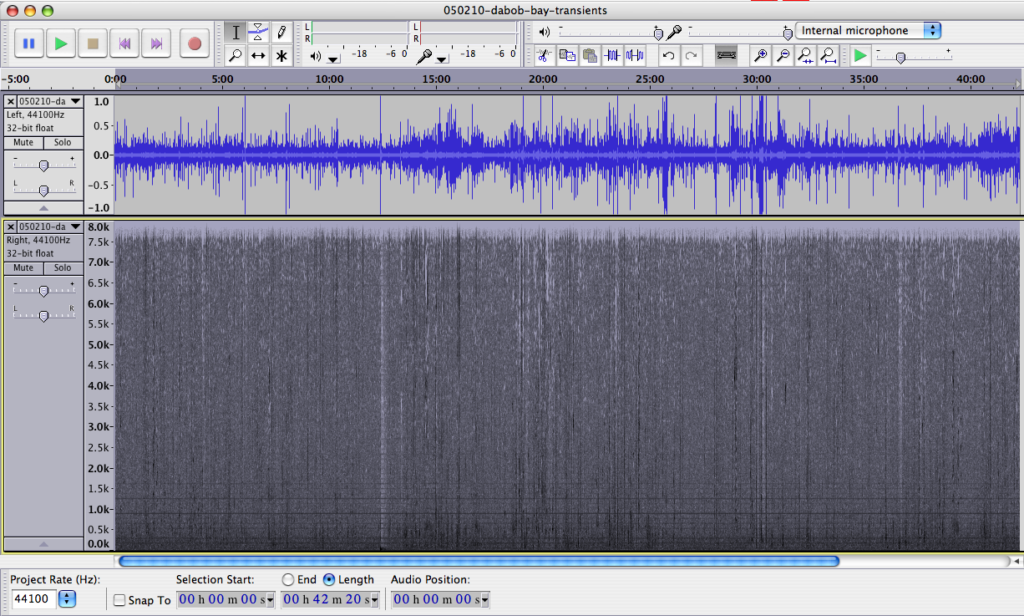
In a recent meeting led by Rear Admiral James Symonds (Commander, Navy Region Northwest), Shaari Unger of Naval Undersea Warfare Center (NUWC), Division Keyport, kindly handed out a CD with a great recording of transient orcas made in Dabob Bay (Hood Canal, WA) on February 10, 2005. She asked if any and all acoustic afficionados could listen to it and analyze it.
Here’s hoping our Northwest Navy neighbors are able to acquire and release additional recordings like this one that help us understand and enjoy the marine environment.
The CD jacket provides the following information:
The point of contact for the recording is NAVSEA, Keyport Public Affairs Officer, (360) 396-2699, kypt_pao@navy.mil
Start time: 10:45 (PST) 10 Feb 2005
End time: 11:27 (PST) 10 Feb 2005
Weather: Sunny and clear, unlimited visibility, light winds
Animals (data compiled by John Durban and Graeme Ellis): These are six killer whales, known to be part of the ‘west coast transient’ stock that ranges between the coastal waters of SE Alaska and California. These particular animals have been most frequently documented in SE AK and British Columbia. This group is comprised of two adult females [(T71 and T124A, both more than 20 years old), each with two offspring – one older offspring per femaile (T71A — 10 years, T124A1 — 9 years) and one younger offspring per female (T71B and T124A2, both around 5 years)]. These two ‘matrilines’ have not always been seen in association with each other.
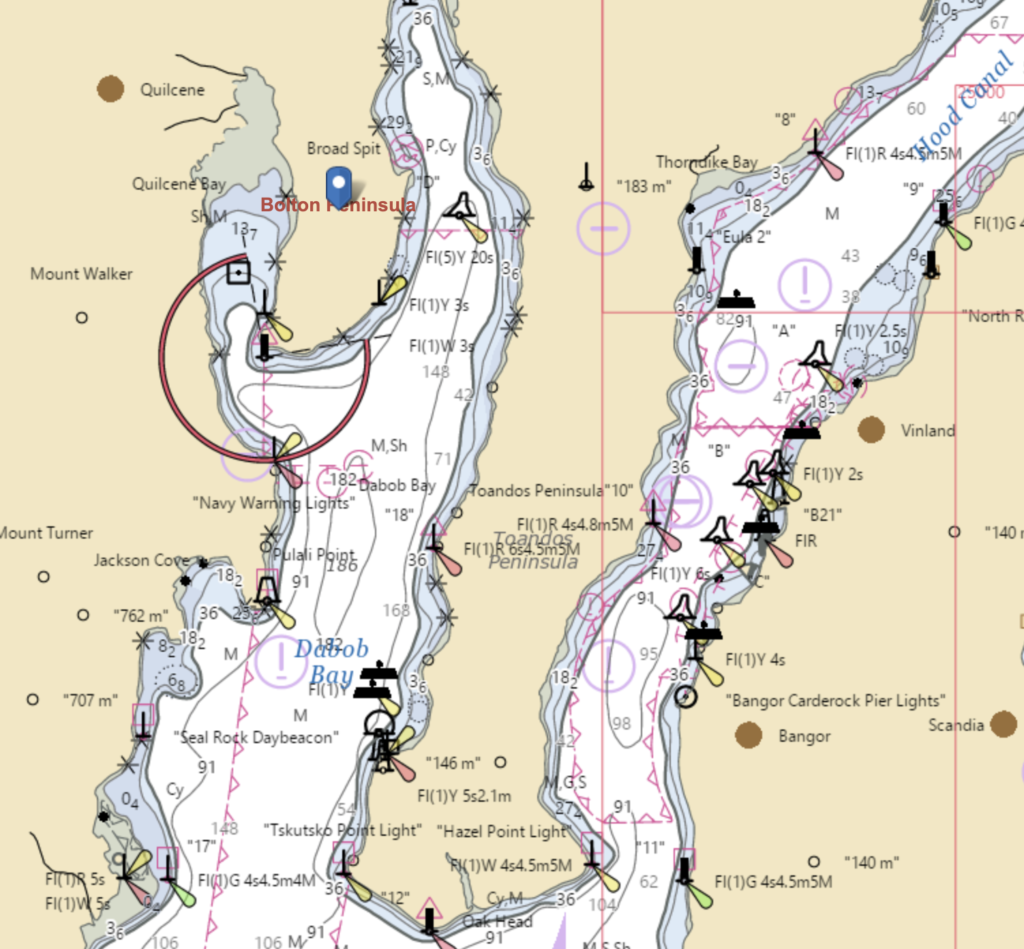
Visual observation during the recording: The animals were off Bolton Peninsula when first sighted. They were staying in one location moving back and forth over one area, which is considered feeding behavior. They then moved as a group from Whitney Point south, along the west side of Dabob Bay and continued south out of Dabob Bay.
As a standard operating procedure, the NAVSEA Keyport does not conduct active acoustic operations in the presence of whales at any NAVSEA Keyport test range. The Dabob Bay Range Site is staffed during normal working hours by NAVSEA Keyport. Our range operators are trained by NOAA to identify marine mammals.
NUWC maintains and operates the range on Dabob Bay where this recording was made. Their purpose is to test and evaluate undersea systems in support of research and development, and in support of maintenance and upgrade of existing systems. There were no operations scheduled the day this was recorded, and all scheduled testing activities were postponed for several days until the range was clear of the transient Orcas.
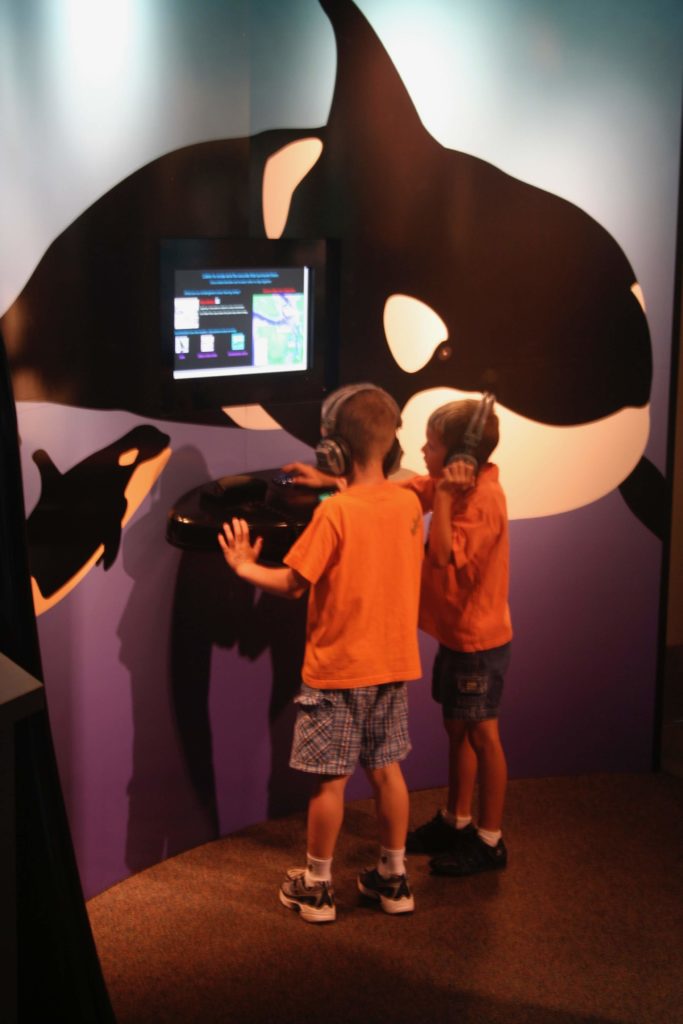
The listening station at the Seattle Aquarium lets visitors interact with orca sounds via web-based content (live and recorded audio), a monitor, and a trackball and headphones offered at kid-level on a matriarch’s fin.
At the bottom of the concrete helix at the Seattle Aquarium is the Family Activity Center (FAC)– a marine mammal hub adjacent to the big underwater dome. While fur seals and sea otters dive past visitors one side of the room, the majority of the space is dedicated to presenting the parallels between our human families and those of our regional icon, the killer whale, or orca.
Just a week ago the FAC received an acoustic enrichment. A listening station that enables visitors to listen live to the ocean or hear recordings from underwater has replaced the writing station and a panel describing orca prey (Chinook salmon). The listening station project was proposed by Brooke Nelson and me, managed by Michael Darling, and implemented by me (web design/html/php); Val Veirs (Java coding); Grant Glover, Jesse, Zach, Gary, and team at Pacific Studio (art and kiosk fabrication); Steve Harvey and Richard Ramsby (demolition, Internet, and installation).
Since the station needed Internet access for the live streams, we decided to host content on-line, primarily for ease of maintenance, trouble-shooting, and future enhancement. If you don’t have a chance to visit the Aquarium and test it out in person, you can view the pages here: http://orcasound.net/sakiosk/
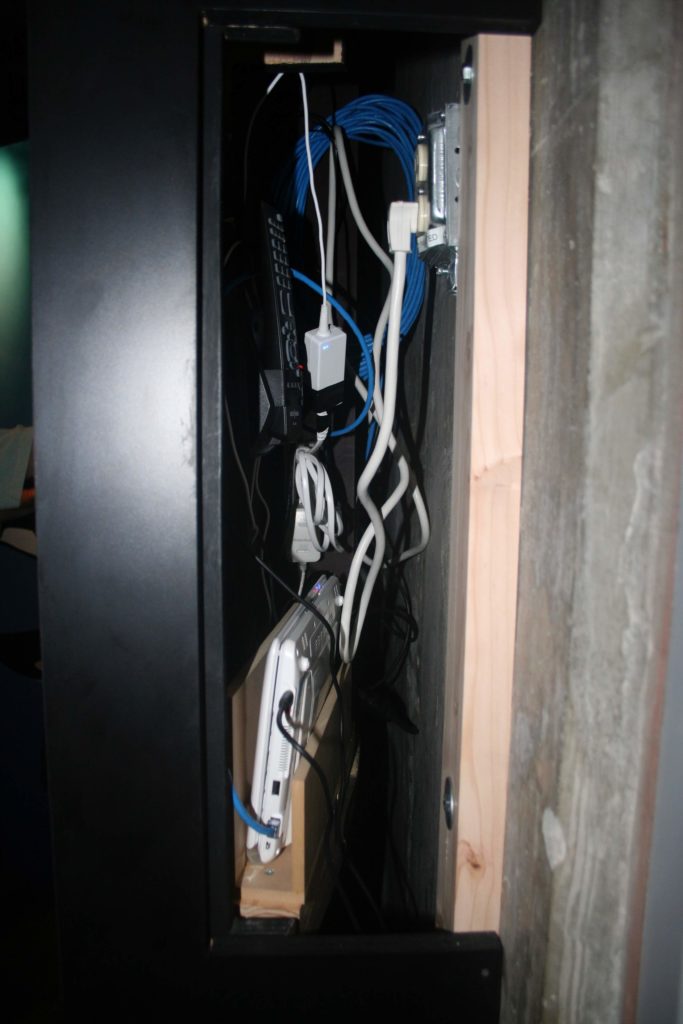
The site delivers sound through a Java-based audio player called jlGui that can handle both recorded mp3 files and Shoutcast streams while embedded and hidden within a browser window. There are also some nice photos and words to go along with the sounds. In the Aquarium, the content is presented on a 22″ monitor (using 1280×768 resolution) by an Eee PC running Firefox with the Open Kiosk plugin over Windows XP Home. A cool thing about this Eee PC is you can set it to keep running when the case is closed; that enabled us to fit it easily in the constrained space behind the mural.
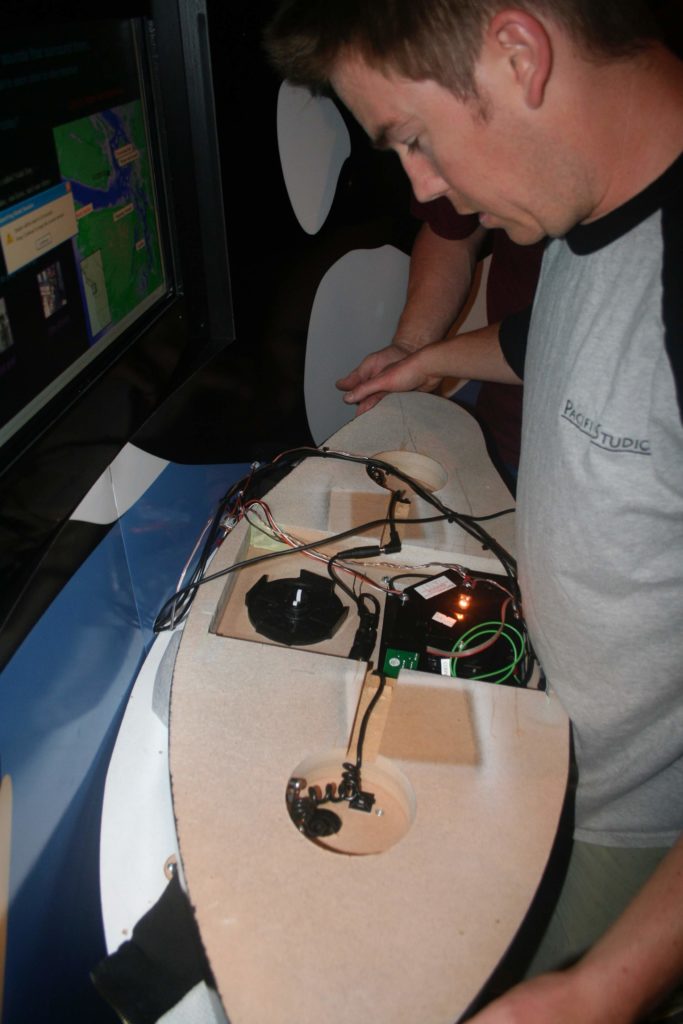
A view behind the scenes…
…and under the fin!
The highlights of watching folks try it out on the first day were hearing a 9 year-old boy walk away saying “That was really cool,” and a mother telling her child as they departed, “How would you feel if you had to listen to that all day?” Google Analytics suggests that thus far, about 20 unique visitors per day are listening to the underwater sounds for an average of about 2 minutes.
Below are links to photos of the installation, as well as notes regarding the hard-/software we considered and used in implementing the project.
Install Firefox 3.0.14 (3.5 didn’t work with Open Kiosk — though I didn’t try all version permutations)
Add the Open Kiosk add-on, version = “Firefox 3 Install Here” [July 16, 2009] (follow instructions at https://www.mozdevgroup.com/clients/bm/ — don’t download from the (outdated?) FF add-on site!)
Get updates to Java (upon autoprompt) (installed JRE and registered it…)
Disabled login screen; made user1 autologin (no password prompt)
Scheduled FF to run at system re/boot for user1
Used Kiosk admin UI to set FF-Kiosk-fullscreen to be default browser (firefox.exe -kiosk admin)
Had to restart Firefox a few times in safe-mode w/various defaults re-set… (via firefox.exe -safe-mode)
Enable jsLib 0.1.359 and BMA Kiosk 1.65
Change default start page
Under Filters tab click “Enable JavaScript on all pages” (so streams can be played through browser)
Under Sessions tab: set Kiosk to reset session after 5 minutes (max time anyone likely to listen?)
Under Customize tab: Disable tabbed browsing and Hide All UI Widgets
Click OK
Test it out (Launch under Kiosk submenu); first time I clicked on link to page that calls jlgui player, I got auto update of JRE6, then Security query re JavaZoom Team digital signature not being verifiable — clicked Always trust and Run; stream started after about 10s load/lag-time…
Had to de-select location under the View menu in FF to get location bar at bottom of window to be hidden in Kiosk mode
Back in admin, make FF-kiosk the default browser and select full-screen mode
Reboot computer and see if FF-kiosk comes up automatically with start screen
Reboot performance: blue screen at 30s, desktop at 40s; start screen in FF-kiosk mode in 65s, but XP Taskbar locked and visible at bottom of screen (though non-reactive to clicks); select auto-hide in Taskbar properties; reboot…
Reboot performance: blue screen at 30s, chime at 37, desktop at 50, start screen in FF-kiosk mode in 70s
Now has gap at bottom where taskbar is hiding, and location bar is back… (solved by resetting defaults via -safe-mode)
XP takes about 45 seconds to boot up to desktop
Eee PC Xandros 4Gb notes: — Took WAY too long to get a real desktop environment ++ Wireless connected automagically — Open Kiosk didn’t seem to want to run on the version of Firefox I initially downloaded (but I didn’t keep good notes on which permutations I tried…)
I enjoyed this ~20minute documentary by CBC science reporter Monica Kid on noise pollution in the ocean. It provides a synthesis and synopsis of many of the inter-linked issues — from Navy LFA sonar and seismic air guns to boats and ships — with interviews with Arthur Popper, Alexandra Morton, Ken Balcomb, Michael Jasny, and Douglas Wartzoff.
I was particularly interested to hear about some of the potential impacts of noise on fish. It was also interesting to hear from Alexandra about the avoidance of seal harassment devices by resident killer whales in the Broughton Archipelago (2/3 drop in sighting rate) and from Ken about the Bahama strandings.
Thanks to Michael Darling of the Seattle Aquarium for letting me know about this nice piece (high-lighted on “and-the-winner-is” show).
For the first time, the final talks of a Beam Reach program are available for viewing on-line as videos (hosted by Vimeo). Links to the videos, as well as the final PowerPoint presentations and papers can be accessed through the spring 2009 class page.
The footage taken by Brett Becker and Courtney Kneipp back in 2005 keeps adding value to the community of orca advocates and scientists. It was heartening to hear the fundraiser participants ooh and ah at the simultaneous “logging” behavior of J and L pod members, as well as the synchronous chorus of calls that occurs suddenly in the last 30 seconds of the video.
If you enjoy the video, don’t hesitate to make a donation to The Whale Museum this spring. They could use some help to keep Soundwatch on the water continuously this summer…
More than 150 avid supporters turned out at Mullis Community Senior Center Saturday night for The Whale Museum’s third annual Celebration of the Orca Greeting Ceremony. By the end of the evening, the museum had raised more than $16,000 to support its education and research projects.
The popular event, which features a gourmet dinner, raffle, and silent and live auctions, was inspired by an orca greeting ceremony documented in the waters off of Hannah Heights on Oct. 4, 2004, by Dr. Scott Veirs and a group of BeamReach students.
Auctioneer Eugene Cuomo cajoled and coaxed the enthusiastic crowd into raising their fluke-shaped bidding paddles for such treats as Leslie Veirs’ “Scrumptious Ice Cream Torte†($375)
Today Val and Scott re-deployed a Vemco VR2 fish tag receiver at Lime Kiln State Park. This receiver, provided for this pilot study to Beam Reach by Fred Goetz, will help marine scientists understand how juvenile and adult salmon use the San Juans, in addition to any other passing fish that have been “tagged” (surgically-implanted) with 69 kHz acoustic tags. We at Beam Reach are most interested in the behavior and distribution of adult Chinook salmon, and secondarily any other potential prey of the endangered southern resident killer whales.
58724
58727
The photos above show the mooring prior to being snorkeled down to the pier block that remained from the previous deployment (last November).
Two other VR2s have been provided by Kurt Fresh of NOAA. (Their serial numbers are: 100910; 100913.) One will be deployed on the west side of San Juan Island; the other will be placed near Cattle Pass.  We’ve mounted them on short (~2.25m) mooring lines (1.25cm diameter 3-strand poly), supported by single yellow shrimp pot floats (see below). The base of the receivers will be ~0.75-1m above the bottom. The floats will be ~1m above the top of the receivers. The mooring weights are either ~25kg concrete slabs (35cm x 35 cm x 15 cm; see below) or paint buckets filled with cement. Both types of weights have metal hoops or chain for attaching the mooring line and for lowering during deployments from a boat.
With transient killer whales sighted in the vicinity yesterday and the whereabouts of the endangered southern residents unknown, we were surprised and concerned to hear active mid-frequency sonar and distorted underwater voices this evening in Haro Strait. Thankfully, the broken hydrophone at Lime Kiln State Park had been repaired just hours earlier by Beam Reach students and staff conducting a service project at The Whale Museum‘s acoustic laboratory that is housed within the light house. Eventually, Jeanne Hyde heard from the Coast Guard that we were likely listening to a U.S. Navy submarine. (4/9 update from Christopher Dunagan: the Navy confirms it was the USS San Francisco, a LA-class fast attack submarine which ran into a seamount near Guam in 2006. Since there was clearly damage to the sonar dome and it was replaced with the nose of decommissioned sub, I speculate that it was a higher priority of the Navy to test the sonar while still close to the ship yard than it was to go beyond the call of Naval duty to protect marine mammals.)
An example spectrogram of the voice and a sonar ping
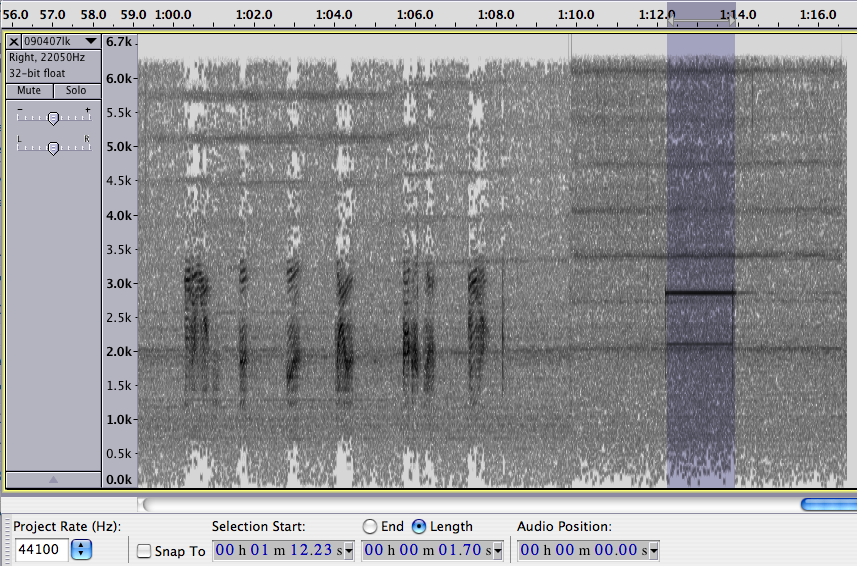
At 18:55 PST, Jeanne first reported someone “talking” into the Lime Kiln hydrophone of the Salish Sea Hydrophone Network. At 19:10, I started recording the Lime Kiln stream, capturing about 6 sequences of 5-10 distorted human words over about 11 minutes. The sequences seem to come every 1-3 minutes and begin with the same first few words and then vary in content and length. Most words had most of their power at 1.5-3.5kHz. About a minute and 15 seconds after the preceding word sequence, there was a 1.7-second tonal sonar ping at 2.9 kHz. At right is a screen grab from Audacity that shows the ping and the preceding word sequence. Here is a concatenation of the sequences and the ping: 090407_1910clips-lk_voice-sonar
Listening to both west side streams at around 19:15 it seemed that the voice and pings were louder at Lime Kiln, though they could be heard after a few second delay at the Orcasound hydrophone. By 21:00 it seemed the signals were louder at Orcasound than at Lime Kiln. This suggests that the Navy submarine was moving northward up Haro Strait. Since we have only a single hydrophone at each node and node-to-node timing isn’t synchronized in the streams, it’s not possible to verify the direction of travel using arrival time differences.
2 pings of a 3.75 kHz sonar
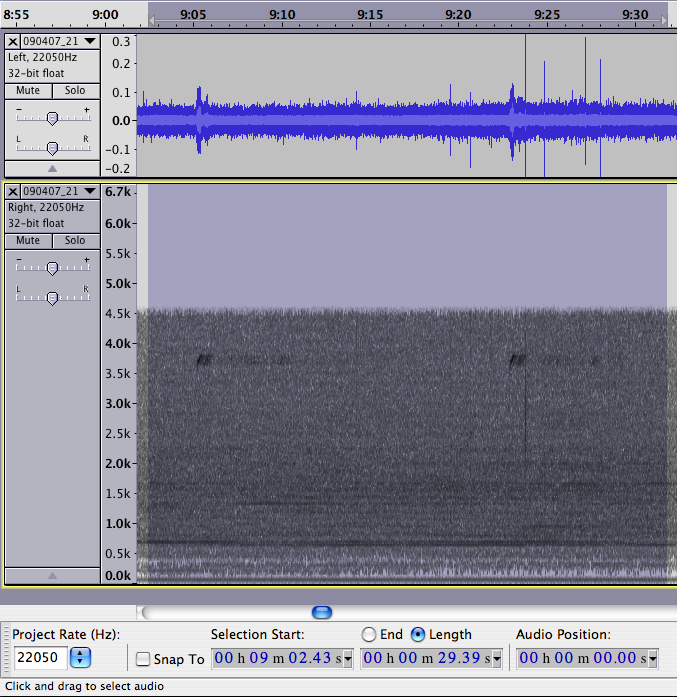
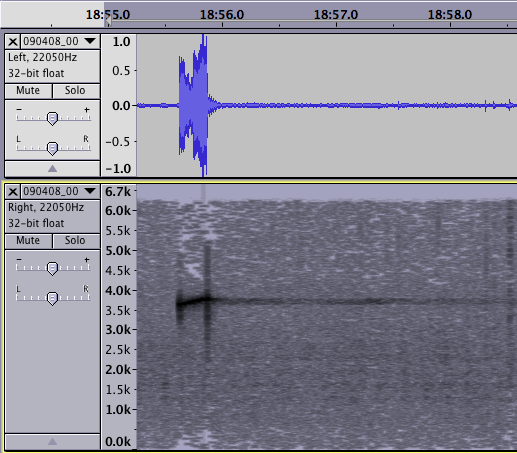
At 21:02 I made another recording from the Lime Kiln stream that contains two of the word sequences.  Then I switched to recording the Orcasound stream. The voice was clearly audible for the next half hour and there were a few sonar pings interspersed. By 21:34 the voice was pretty faint and the last time it’s dectable in the sonogram (and by ear, very faintly) is around 10:05. However, at about 21:59 the final recording caught a couple of unique pings (3.7-3.8kHz, 0.8 second) and their echoes ( 090407_2150_os_375khz-sonar ). The two pings were spaced 16 seconds apart and had a noticable echo at 3.67 seconds, equivalent to about 5.5 km. Assuming the echo was off the eastern wall of Haro Strait bathymetry (about 6km from Orcasound), the two-way travel time suggests the submarine was probably pretty close to the San Juan Island side of Haro Strait.
The acoustic experience continued on past midnight. At 00:24:30 on 4/8/09 I heard a series of beeps (back at ~2.9 kHz) and then their echoes at Orcasound. At 00:30-00:32 I again recorded the voice along with tones and their echoes on the Lime Kiln stream. Around 00:40-00:45 I heard and recorded what sounded like a conversation, rather than the separated single words of the previous sequences. At 00:48:30 there was a very loud ping (close to Lime Kiln?) and either an echo or a ping from a separate, more distance location. This was followed by many repeated word sequences.   At 01:00 things got quiet, but then at 01:11:00 there was suddently another impressive single ping (sound clip: 090408_0038_lk_single-375khz-ping ). At 01:13, the slow voice started repeating sequences again. Another single ping came at ~01:22 as two cargo ships came abeam of Lime Kiln and increased the ambient noise levels. Another at 1:31:00 with a nice echo was followed by more conversing at 01:36. Then there was an extended sequence of sonar tones and verbal interjections that grew progressively fainter and then stopped ~01:45.  Around 01:50 things picked up again with more conversation and then — most interestingly — what sounded like an exchange of longer tones, possibly between two sources, one near Lime Kiln and one substantially further away. After about 5 minutes of silence, there were two more loud pings with echoes at 02:00:45.
Recordings made for much of the following hour, but I think I missed two loud pings at ~02:53:00. More pings heard at: 03:11…
On Monday and Tuesday this week we attended the Transboundary Naturalists workshop. While we made our way from Seattle’s Aquarium out to Port Townsend in some very densely packed vehicles, Val and Jason sailed down on Val’s boat from the San Juan Islands. Captain Todd drove down to Bellingham and we all got to listen to the latest findings in killer whales science, as well as updates on new regulations and enforcement.
The pace of lectures and networking opportunities was intense and the final agenda (PDF) read like a who’s-who of southern resident killer whale experts. We were able to meet and ask questions of some of the old guard, like Ken Balcomb and John Ford, as well as a bunch of talented youg researchers. At meals and a Monday night reception, we met many of the naturalists who work aboard whale watch vessels, as well as the vessels’ drivers and owners. With luck, all these contacts will prove useful — either during proposal development in the next few weeks on land, or at sea when we will need help locating the whales and cooperation while studying them.
Walking to the Port Townsend beach to ask 21 questions. (From the left: Matthew, Erica, Peter, Hilary, and Hannah)
We’ve made it safely from a fun initial meeting at the Seattle Aquarium to Val’s boat at the Port Townsend Marine Science Center dock. Thanks to Leslie and Val for a delicious sesame noodle dinner, supplemented with fresh-baked rolls from Jason, we were re-fueled and ready for a first class exercise.
We walked to the local lighthouse at Point Wilson and sat on the beach for a half hour to think up 21 questions we have about killer whales and their environment. These questions, or other ones inspired by the workshop talks we’ll attend the next two days, may form the basis for student proposals that will develop in the first three weeks of the program.
Despite some big ship wakes, we all got a good night’s sleep. Now we’re off to the Transboundary Naturalists Workshop to hear from local experts about the status of the southern residents and our efforts to recover the population. Here are some more photographs from our first day.
With about 6 weeks before the spring program begins we have created a home page for the spring 2009 class (091) that includes links to their photo gallery and blog entries. Keep an eye on it to learn more about the incoming students and track their progress.
A most exciting and unique aspect of the spring program is that we have all been invited to participate in the Southern Resident Killer Whale Transboundary Naturalist Workshop (March 30-31 in Port Townsend, WA). It’s looking like quite the tour of the current state of SRKW policy and science, with about 25 20-minute talks from many of the most active managers, enforcement agents, and researchers! See tentative speakers/topics list (PDF) and latest draft agenda below:
Suggested Schedules for SRKW Transboundary Naturalist Workshop
Draft 2/10/09
Monday March 30, 2009
Start    End   Task   Time
9:00   10:00   Coffee/ Pastries   1 hour
10:00   10:15   Welcome Remarks   15 min
Management/Enforcement/Human Dimensions Panel
Management
1Â Â Â Â Â Â 10:15Â Â Â 10:30Â Â Â Lynne Barre – NMFS/NWRÂ Â Â 15 min
2Â Â Â Â Â Â 10:30Â Â Â 10:45Â Â Â Paul Cottrell – DFOÂ Â Â 15 min
Human Dimensions
3Â Â Â Â Â Â 10:45Â Â Â 11:05Â Â Â Suzanne Russell – NMFSÂ Â Â 20 min
11:05   11:15   Questions for above   10 min
Enforcement Panel
4Â Â Â Â Â Â 11:15Â Â Â 12:00Â Â Â Alan Wolf – NOAA LEÂ Â Â 45 min
5Â Â Â Â Â Â Â Â Â Â Â Â Larry Paike – DFO
6Â Â Â Â Â Â Â Â Â Â Â Â Russ Mullins – WDFW
12:00Â Â Â 1:00Â Â Â LUNCHÂ Â Â 1 Hour
Outreach/Population
7/8      1:15   1:55   Kari Koski-Soundwatch & Nic-Straitwatch   40 min
9      1:55   2:25   Ken Balcomb   30 min
2:25   2:40   Questions   15 min
2:40Â Â Â 3:00Â Â Â AFTERNOON BREAKÂ Â Â 20 min
Vessel Interactions/Sound
10      3:00   3:20   Marla Holt   20 min
11      3:20   3:40   Deborah Giles   20 min
12      3:40   4:00   Dawn Noren   20 min
13      4:00   4:20   Rob Williams   20 min
4:20   4:30   Questions   10 min
4:30   5:00   Keys/Room Check-In   30 min
5:00   6:30   COCKTAIL at Port Townsend Marine Science Center   1 hour 30 min
6:30   8:00   Dinner   1 hour 30 min
8:00   10:00   Salish Sea Member Meeting   2 hour
Tuesday March 31, 2009
Start    End   Task   Time
7:00Â Â Â 8:20Â Â Â BREAKFASTÂ Â Â 1 hour 20 min
8:20   8:30   Gather/Organize   10 min
Prey Relationships
14      8:30   8:50   John Ford   20 min
15      8:50   9:10   Brad Hanson   20 min
16      9:10   9:30   Eric Ward   20 min
9:30   9:50   Questions   20 min
9:50Â Â Â 10:10Â Â Â MORNING BREAKÂ Â Â 20 min
Contaminants
17      10:10   10:30   Sandie O’Neill   20 min
18      10:30   10:50   Peggy Krahn   20 min
19      10:50   11:10   Teresa Mongillo   20 min
16      11:10   11:30   Questions   20 min
Health
20      11:30   11:50   Steve Raverty   20 min
21      11:50   12:10   Pete Schroeder   20 min
12:10   12:20   Questions   10 min
12:20Â Â Â 1:20Â Â Â LUNCHÂ Â Â 1 hour
Health Continued
22      1:20   1:40   Katherine Ayers   20 min
23      1:40   2:00   John Durban   20 min
2:00   2:10   Questions   10 min
Habitat Use
24      2:10   2:30   Brad Hanson/Robin Baird   20 min
2:30Â Â Â 2:50Â Â Â AFTERNOON BREAKÂ Â Â 20 min
25      2:50   3:10   Candice Emmons   20 min
26      3:10   3:30   Val or Scott Veirs, Jason Wood   20 min
3:30   3:50   Questions   20 min
3:50Â Â Â 4:00Â Â Â CONCLUDING REMARKSÂ Â Â 10 min







 Twitter
 LinkedIn
 Facebook
